

(+)-Fenchone [4695-62-9]

Référence T7956-500mg
Conditionnement : 500mg
Marque : TargetMol
Contactez votre distributeur local :

Téléphone : +1 850 650 7790
(+)-Fenchone
Copy Product Info
(+)-Fenchone is a bicyclic monoterpene naturally occurring in fennel, thuja, and boldo essential oils. It demonstrates potent gastroprotective activity, with oral doses of 150 mg/kg significantly reducing ulcerative injury (p < 0.001) by restoring glutathione (GSH) and superoxide dismutase (SOD) levels while suppressing malondialdehyde (MDA), myeloperoxidase (MPO), and pro-inflammatory mediators TNF-α, IL-1β, and NF-κB. Research applications include investigating mucosal healing, intestinal barrier integrity via ZO-1 upregulation, and anti-inflammatory mechanisms in chemically induced colitis and ulcer models.
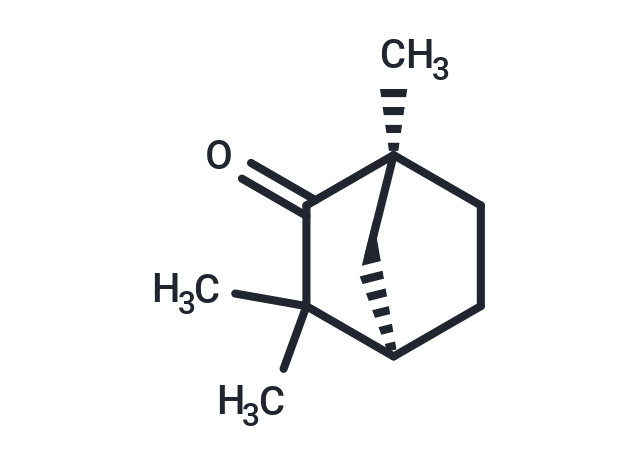
Cas No. 4695-62-9
For research use only—not for human use. No sales to individuals. Use as intended only.
Select Batch
Purity:99.35%
Appearance:Liquid
Color:Transparent
COA LCMS HNMR
Product Information
Bioactivity
Chemical Properties
Storage & Solubility Information
| Description | (+)-Fenchone is a bicyclic monoterpene naturally occurring in fennel, thuja, and boldo essential oils. It demonstrates potent gastroprotective activity, with oral doses of 150 mg/kg significantly reducing ulcerative injury (p < 0.001) by restoring glutathione (GSH) and superoxide dismutase (SOD) levels while suppressing malondialdehyde (MDA), myeloperoxidase (MPO), and pro-inflammatory mediators TNF-α, IL-1β, and NF-κB. Research applications include investigating mucosal healing, intestinal barrier integrity via ZO-1 upregulation, and anti-inflammatory mechanisms in chemically induced colitis and ulcer models. |
| In vivo | The anti-inflammatory and antimicrobial activities of fenchone and limonene oil increased collagen synthesis and decreased the number of inflammatory cells during wound healing and may be useful for treating skin wounds[1]. |
| Animal Research | An excision wound was made on the back of the rat and fenchone and limonene were applied topically to the wounds once daily, separately or together, for 10 days.?Tissue sections from the wounds were evaluated for histopathology.?The healing potential was assessed by comparison to an untreated control group and an olive oil treated sham group[1]. |
| Molecular Weight | 152.2334 |
| Formula | C10H16O |
| Cas No. | 4695-62-9 |
| Smiles | CC1(C)[C@@H]2CC[C@@](C)(C2)C1=O |
| Relative Density. | 0.948 g/cm3 at 25℃ (lit.) |
| Storage | Keep away from direct sunlight, Pure form: -20°C for 3 years | In solvent: -80°C for 1 year Shipping with blue ice/Shipping at ambient temperature. | ||||||||||||||||||||
| Solubility Information | DMSO: 1.53 mg/mL (10.05 mM), Sonication is recommended.  | ||||||||||||||||||||
| In Vivo Formulation | 10% DMSO+40% PEG300+5% Tween 80+45% Saline: 1.00 mg/mL (6.57 mM), Sonication is recommended. Please add the solvents sequentially, clarifying the solution as much as possible before adding the next one. Dissolve by heating and/or sonication if necessary. Working solution is recommended to be prepared and used immediately. The formulation provided above is for reference purposes only. In vivo formulations may vary and should be modified based on specific experimental conditions. | ||||||||||||||||||||
Solution Preparation Table | |||||||||||||||||||||
DMSO
Note : The dilution table applies only to solid products. For liquid products, please calculate the stock solution based on the stated concentration and/or density. | |||||||||||||||||||||