



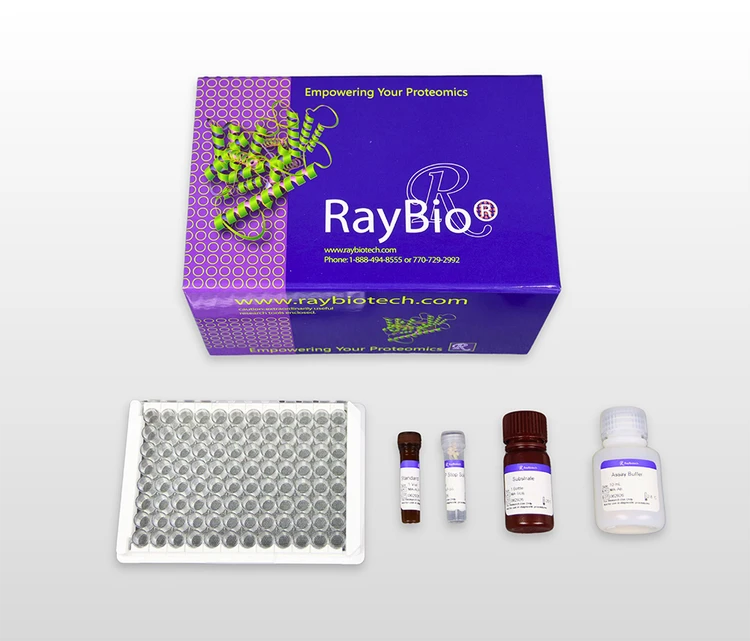
The RayBio® Alanine Transaminase Activity Assay Kit offers a user-friendly, reliable, and highly sensitive method for quantifying ALT activity in plasma, serum, cell lysates, and other biological fluid samples.
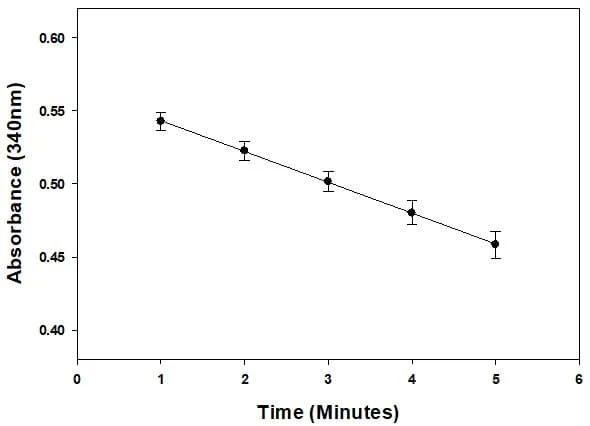
Example of OD value of Alanine Transaminase (ALT) Positive Control verse Time.
Alanine Transaminase (ALT) Activity Assay Kit (Colorimetric)
Contact Us for Bulk Request
Product Description
Specifications
| Size | 1 Plate Kit, 2 Plate Kit, 5 Plate Kit |
| Compatible Sample Types | Plasma, Serum, Tissue Lysates, Cell Lysates |
| Quantitative/Semi-Quantitative | Quantitative |
| Solid Support | 96-well Microplate |
| Method Of Detection | Colorimetric |
| Research Area | Diabetes, Energy Metabolism, Liver & Renal Function |
| Shipping Type | Blue ice |
| Storage | Room temperature |
Related Products
Aspartate Aminotransferase (AST) Activity Assay Kit (Colorimetric)
As low as $349.00
Branched Chain Amino Acid Assay Kit (Colorimetric)
As low as $349.00
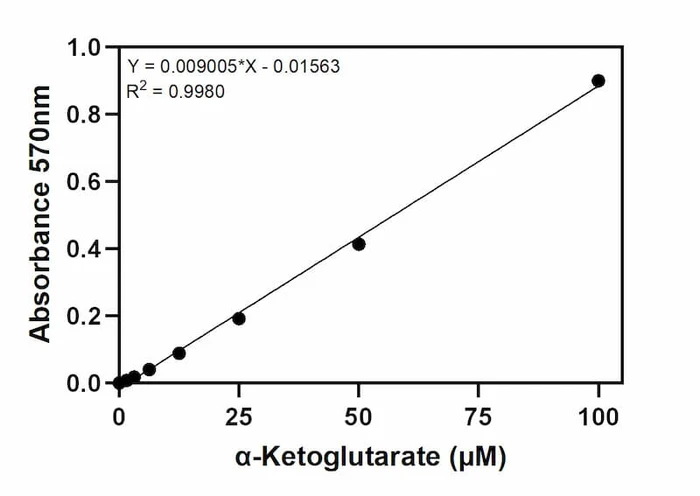
Alpha-Ketoglutarate Assay Kit (Colorimetric)
As low as $449.00
Introduction
Alanine transaminase (ALT), also known as alanine aminotransferase (ALAT) or serum glutamic pyruvic transaminase (sGPT), is a homodimeric enzyme dependent on cytoplasmic pyridoxal phosphate. It plays a vital role in cellular nitrogen metabolism, amino acid metabolism, and liver gluconeogenesis. ALT catalyzes the reversible transamination between alanine and α-ketoglutarate to form pyruvate and glutamate. ALT is found mainly in the liver, and, to a lesser extent, in kidney, heart, muscle, and pancreas tissues. Normal serum levels of ALT are low, and an elevation in serum ALT activity is a widely used marker for liver damage.
The RayBio® Alanine Transaminase Activity Assay Kit offers a user-friendly, reliable, and highly sensitive method for quantifying ALT activity in plasma, serum, cell lysates, and other biological fluid samples. In this assay, ALT catalyzes the transfer of the amino group from L-alanine to α-ketoglutarate resulting in the formation of pyruvate and L-glutamate. Simultaneously, lactate dehydrogenase catalyzes the reduction of pyruvate and the oxidation of NADH to NAD. The resultant rate of absorbance decrease is directly proportional to ALT activity.
Kit Components
| Component | Size / Description |
|---|---|
| Microplate | A 96-well (12 strips x 8 wells) plate |
| Sample Buffer | 10 ml |
| Assay Buffer | 10 ml |
| Enzyme Mix Solution | 2 ml |
| Alanine Transaminase (ALT) Positive Control | 1 Vial (10 µl) |
Additional Materials Required
- Microplate reader capable of measuring absorbance at 340 nm at 37°C
- Precision pipettes to deliver 2 µl to 1 ml volumes
- Multi-channel pipettes to deliver 20 μl to 200 μl volumes
- Tubes to prepare sample dilutions
- Incubator at 37°C
- 15 ml conical tubes
Assay Procedure Summary
Positive control, sample and Sample Buffer (used as a blank) should be assayed in duplicate or triplicate. A freshly prepared positive control should be used each time the assay is performed.
- Set up a microplate reader or a microplate incubator at 37°C.
- Prepare Working Solution (See Reagent Preparation, section A), and incubate it at 37°C for at least five minutes.
- Prepare Positive Control (See Reagent Preparation, section B).
- Pipette 10 µL of sample, Sample Buffer (as the blank) and Positive Control into each well of the 96-well plate.
- Transfer 100 µL of pre-warmed Working Solution into each well (it is recommended to use a multi-channel pipette), mix and incubate at 37°C for one minute.
- After one minute, read and record absorbance at 340nm (A1 Reading). Repeat readings every minute for the next four minutes at 37°C. (A2, A3, A4, A5 Reading).
citations
Development of recombinant anti-TLR2 antibodies and PLGA nanoparticle-based gene therapy for the treatment of neuropathic pain
- Year:
- 2026
- Journal Name:
- Molecular Therapy
- PubMed ID:
- 42528133
Targeting cellular senescence in dystrophin-/-/utrophin-/-double knockout mice improves musculoskeletal health and increases lifespan
- Species:
- Mouse
- Sample Type:
- Serum (mdx mice, ruxolitinib vs vehicle)
- Year:
- 2025
- Journal Name:
- Pharmacological Research
- PubMed ID:
- 41173171
Multi-target antidiabetic and organ-protective effects of a polyherbal ethanol extract in STZ-induced diabetic rats
- Species:
- Rat
- Year:
- 2026
- Journal Name:
- Frontiers in Pharmacology
- PubMed ID:
- 42453573
Oncolytic viruses expressing MATEs facilitate target-independent T-cell activation in tumors
- Year:
- 2025
- Journal Name:
- EMBO Molecular Medicine
- PubMed ID:
- 39789356
Delayed reinforcement of costimulation improves the efficacy of mRNA vaccines in mice
- Species:
- Mouse
- Sample Type:
- Serum (vaccinated mice, α4-1BB vs control)
- Year:
- 2024
- Journal Name:
- Journal of Clinical Investigation
- PubMed ID:
- 39432667
DOSE-RESPONSE DYNAMICS OF A MULTI-MICRONUTRIENT SUPPLEMENTATION ON REPRODUCTIVE HEALTH, REDOX STATUS, METABOLIC BIOMARKERS, AND FOLLICULOGENESIS IN HEALTHY FEMALE ALBINO WISTAR RATS
- Species:
- Rat
- Sample Type:
- Serum
- Year:
- 2026
- Journal Name:
- Genetics and Molecular Research
Influence of ApoE genotype on doxorubicin-induced cognitive impairment in juvenile rats
- Species:
- Rat
- Sample Type:
- Serum
- Year:
- 2025
- Journal Name:
- Scientific Reports
- PubMed ID:
- 41436539
The Therapeutic Effects of Moringa pterygosperma Extract on Type 2 Diabetes: Modulation of TNF-α, Oxidative Stress, and Liver Function Biomarkers
- Species:
- Rat
- Sample Type:
- Serum (alloxan-induced diabetes)
- Year:
- 2025
- Journal Name:
- Open Access Research Journal of Biology and Pharmacy
Comprehensive machine learning models for predicting therapeutic targets in type 2 diabetes utilizing molecular and biochemical features in rats
- Species:
- Rat
- Sample Type:
- Serum (type 2 diabetes model)
- Year:
- 2024
- Journal Name:
- Frontiers in Endocrinology
- PubMed ID:
- 38854687
Alabi, O.A., Afelumo, O.M., Oladipupo, F.O. et al. Safety assessment of three common food additives: the reproductive, oxidative and enzymatic perspective. Discov Toxicol 1, 8 (2024).
- Year:
- 2024
- Journal Name:
- Discover Toxicology