

Biovalley > Amyloid Oligomers (A11) Antibody
Amyloid Oligomers (A11) Antibody

Référence OASE00468-100UL-HRP
Conditionnement : 100ul
Contactez votre distributeur local :

Téléphone : +1 850 650 7790
Marque : Aviva Systems Biology
Contactez votre distributeur local :
Téléphone : +1 850 650 7790
Amyloid Oligomers (A11) Antibody (OASE00468)
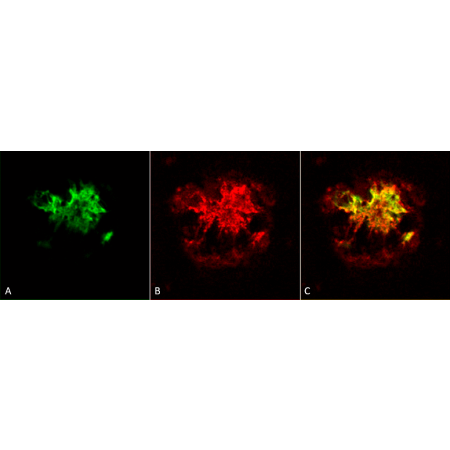
| Datasheets/Manuals | Printable datasheet for Amyloid Oligomers (A11) Antibody (OASE00468) |
|---|---|
| COA Datasheet | A 1:200 dilution of SPC-506 was sufficient for detection of amyloid oligomers in 10 µg of mouse brain lysates by colorimetric immunoblot analysis using Goat anti-rabbit IgG:HRP as the secondary antibody. |
| Predicted Species Reactivity | Eukaryote|Human|Mouse|Rat |
|---|---|
| Product Format | Liquid. PBS, 50% glycerol, 0.09% sodium azide |
| Clonality | Polyclonal |
| Host | Rabbit |
| Conjugation | Unconjugated |
| Application | DB,ELISA,ICC,IF,IHC,IP,WB |
| Additional Information | Cellular Localization: Membrane Certificate of Analysis: A 1:200 dilution of SPC-506 was sufficient for detection of amyloid oligomers in 10 ug of mouse brain lysates by colorimetric immunoblot analysis using Goat anti-rabbit IgG:HRP as the secondary antibody. |
| Reconstitution and Storage | -20°C |
| Immunogen | Synthetic molecular mimic of soluble human amyloid beta oligomers |
| Purification | Protein A Purified |
| Concentration | Varies by lot. See vial for concentration. |
| Specificity | Recognizes all types of amyloid oligomers. Appears to recog a peptide backbone epitope common to amyloid oligomers, but not found in native proteins, amyloidogenic monomer or mature amyloid fibrils. |
| Application Info | The suggested dilution for the current lot of OASE00468 in Western Blot and Dot Blot is 1:100; optimal dilutions for assays should be determined by the user. |
| Storage Buffer | PBS, 50% glycerol, 0.09% sodium azide |
| Gene Symbol | APP|EIF3G |
|---|---|
| Gene Full Name | amyloid beta precursor protein|eukaryotic translation initiation factor 3 subunit G |
| Alias Symbols | AAA, ABETA, ABPP, AD1, alpha-sAPP, alzheimer disease amyloid protein, amyloid beta (A4) precursor protein, amyloid beta A4 protein, amyloid precursor protein, amyloid-beta precursor protein, APPI, beta-amyloid peptide, beta-amyloid peptide(1-40), beta-amyloid peptide(1-42), beta-amyloid precursor protein, cerebral vascular amyloid peptide, CTFgamma, CVAP, eIF3-delta, EIF3-P42, eIF3-p44, EIF3S4, eukaryotic translation initiation factor 3 RNA-binding subunit, eukaryotic translation initiation factor 3 subunit G, eukaryotic translation initiation factor 3 subunit p42, eukaryotic translation initiation factor 3, subunit 4 delta, 44kDa, peptidase nexin-II, PN-II, PN2, preA4, protease nexin-II, testicular tissue protein Li 2. |
| NCBI Gene Id | 351|8666 |
| Protein Name | Amyloid-beta A4 protein|Homo sapiens amyloid beta precursor protein (APP), transcript variant 1, mRNA |
| Description of Target | Functions as a cell surface receptor and performs physiological functions on the surface of neurons relevant to neurite growth, neuronal adhesion and axonogenesis. Involved in cell mobility and transcription regulation through protein-protein interactions. Can promote transcription activation through binding to APBB1-KAT5 and inhibits Notch signaling through interaction with Numb. Couples to apoptosis-inducing pathways such as those mediated by G(O) and JIP. Inhibits G(o) alpha ATPase activity (By similarity). Acts as a kinesin I membrane receptor, mediating the axonal transport of beta-secretase and presenilin 1. Involved in copper homeostasis/oxidative stress through copper ion reduction. In vitro, copper-metallated APP induces neuronal death directly or is potentiated through Cu(2+)-mediated low-density lipoprotein oxidation. Can regulate neurite outgrowth through binding to components of the extracellular matrix such as heparin and collagen I and IV. The splice isoforms that contain the BPTI domain possess protease inhibitor activity. Induces a AGER-dependent pathway that involves activation of p38 MAPK, resulting in internalization of amyloid-beta peptide and leading to mitochondrial dysfunction in cultured cortical neurons. Provides Cu(2+) ions for GPC1 which are required for release of nitric oxide (NO) and subsequent degradation of the heparan sulfate chains on GPC1. |
| Uniprot ID | P05067 |
| Nucleotide Accession # | https://www.ncbi.nlm.nih.gov/nuccore/NM_000484.2 |
Protein interactions
| Name | # of Products |
|---|---|
| APBA | 4 |
| APBA2 | 26 |
| APBA3 | 11 |
| APBB1 | 142 |
| APBB2 | 4 |
| APBB3 | 10 |
| APPBP2 | 51 |
| BACE1 | 58 |
| BACE2 | 7 |
| CASP4 | 79 |
| COL25A1 | 9 |
| DAB1 | 93 |
| FLOT1 | 34 |
| Grb2 | 1020 |
| GSK3B | 566 |
| HSP90AA1 | 525 |
| HSPA4 | 423 |
| HSPD1 | 127 |
| HTRA2 | 38 |
| ITM2B | 14 |
| LDLRAP1 | 10 |
| LRP1B | 43 |
| MAPK8IP1 | 25 |
| MAPK8IP2 | 106 |
| NAE1 | 10 |
| NCSTN | 28 |
| NECAB3 | 4 |
| NUMB | 86 |
| NUMBL | 13 |
| PARK2 | 202 |
| PPID | 28 |
| PRSS3 | 20 |
| SET | 124 |
| Shc1 | 492 |
| SHC3 | 22 |
| SNCB | 16 |
| SPON1 | 4 |
| STUB1 | 399 |
| SYVN1 | 93 |
| TM2D1 | 4 |
| TP53BP2 | 75 |
| UBC | 7030 |
Biological pathways
| Name | # of Products |
|---|---|
| Activation of innate immune response | 61 |
| Adult locomotory behavior | 29 |
| Axon cargo transport | 9 |
| Axon midline choice point recognition | 17 |
| Cell adhesion | 1115 |
| Cellular copper ion homeostasis | 18 |
| Collateral sprouting in absence of injury | 5 |
| Dendrite development | 19 |
| Endocytosis | 153 |
| Extracellular matrix organization | 49 |
| G2 phase of mitotic cell cycle | 41 |
| Innate immune response | 905 |
| Ionotropic glutamate receptor signaling pathway | 22 |
| Mating behavior | 14 |
| MRNA polyadenylation | 25 |
| Neuron apoptosis | 73 |
| Neuron remodeling | 11 |
| Notch signaling pathway | 129 |
| Platelet activation | 875 |
| Platelet degranulation | 443 |
| Positive regulation of mitotic cell cycle | 80 |
| Protein phosphorylation | 100 |
| Regulation of epidermal growth factor-activated receptor activity | 11 |
| Regulation of multicellular organism growth | 58 |
| Regulation of synapse structure and activity | 6 |
| Regulation of translation | 122 |
| Visual learning | 26 |
Biological process
| Name | # of Products |
|---|---|
| Adult locomotory behavior | 39 |
| Axon cargo transport | 14 |
| Axon midline choice point recognition | 9 |
| Axonogenesis | 78 |
| Blood coagulation | 396 |
| Cell adhesion | 446 |
| Cell death | 133 |
| Cellular copper ion homeostasis | 12 |
| Collateral sprouting in absence of injury | 4 |
| Dendrite development | 26 |
| Endocytosis | 109 |
| Extracellular matrix organization | 77 |
| Forebrain development | 60 |
| G2 phase of mitotic cell cycle | 13 |
| Induction of apoptosis | 226 |
| Innate immune response | 300 |
| Ionotropic glutamate receptor signaling pathway | 26 |
| Locomotory behavior | 66 |
| Mating behavior | 13 |
| MRNA polyadenylation | 20 |
| Negative regulation of neuron differentiation | 65 |
| Neuromuscular process controlling balance | 31 |
| Neuron apoptosis | 25 |
| Neuron projection development | 72 |
| Neuron remodeling | 11 |
| Notch signaling pathway | 95 |
| Nucleotide-binding domain, leucine rich repeat containing receptor signaling pathway | 36 |
| Platelet activation | 202 |
| Platelet degranulation | 78 |
| Positive regulation of mitotic cell cycle | 32 |
| Positive regulation of transcription from RNA polymerase II promoter | 968 |
| Protein phosphorylation | 451 |
| Regulation of epidermal growth factor-activated receptor activity | 7 |
| Regulation of gene expression | 75 |
| Regulation of multicellular organism growth | 31 |
| Regulation of synapse structure and activity | 7 |
| Regulation of translation | 80 |
| Smooth endoplasmic reticulum calcium ion homeostasis | 5 |
| Suckling behavior | 13 |
| Synaptic growth at neuromuscular junction | 5 |
| Visual learning | 40 |
Cellular components
| Name | # of Products |
|---|---|
| Apical part of cell | 64 |
| Axon | 179 |
| Cell surface | 369 |
| Ciliary rootlet | 10 |
| Coated pit | 38 |
| Cytoplasm | 4549 |
| Cytoplasmic vesicle | 253 |
| Cytosol | 1868 |
| Dendritic shaft | 27 |
| Dendritic spine | 56 |
| Extracellular region | 1573 |
| Golgi apparatus | 794 |
| Integral to membrane | 2793 |
| Integral to plasma membrane | 817 |
| Intracel | 1 |
Protein function
| Name | # of Products |
|---|---|
| Acetylcholine receptor binding | 11 |
| DNA binding | 3958 |
| Heparin binding | 539 |
| Identical protein binding | 1130 |
| Peptidase activator activity | 27 |
| Peptidase inhibitor activity | 167 |
| Protein binding | 12191 |
| PTB domain binding | 27 |
| Receptor binding | 932 |
| Serine-type endopeptidase inhibitor activity | 229 |
| Transition metal ion binding | 21 |
Diseases
| Name | # of Products |
|---|---|
| Alzheimer disease | 138 |
| Amyloidosis | 223 |
| Disease mutation | 5332 |
| Neurodegeneration | 458 |
-
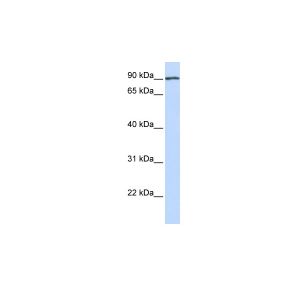 APP Antibody - middle region (ARP33075_P050)Catalog #: ARP33075_P050Species Tested: Human, MouseApplication: IHC, WBFormat: Liquid. Purified antibody supplied in 1x PBS buffer with 0.09% (w/v) sodium azide and 2% sucrose.
-
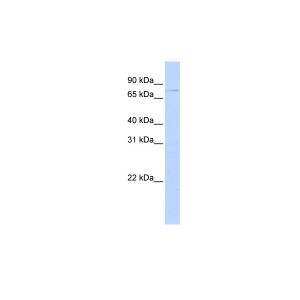 APP Antibody - middle region (ARP33074_P050)Catalog #: ARP33074_P050Species Tested: HumanApplication: WBFormat: Liquid. Purified antibody supplied in 1x PBS buffer with 0.09% (w/v) sodium azide and 2% sucrose.
-

-
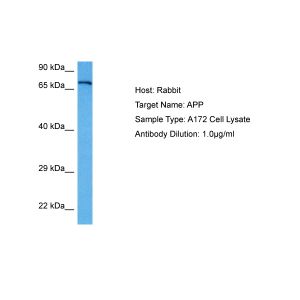 APP Antibody - middle region (ARP34012_P050)Catalog #: ARP34012_P050Species Tested: HumanApplication: WBFormat: Liquid. Purified antibody supplied in 1x PBS buffer with 0.09% (w/v) sodium azide and 2% sucrose.