



Mouse anti-Human/Sheep/Rabbit/Cow/Pig Cytokeratin 8 Antibody [Sodium Azide Free]
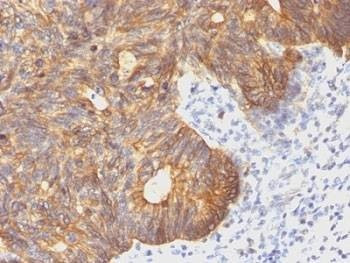
Anti-Cytokeratin 8 Antibody, Sodium Azide Free
Anti-Cytokeratin 8 Antibody, Sodium Azide Free
Contact Us for Bulk Request
Product Description
Specifications
| Size | 100 µg |
| Species | Human |
| Host Species | Mouse |
| Accession Number | P05787 |
| Gene Id | 3856 |
| Gene Symbols | KRT8, CYK8 |
| Protein Name / Synonyms | Keratin, type II cytoskeletal 8 (Cytokeratin-8) (CK-8) (Keratin-8) (K8) (Type-II keratin Kb8) |
| Immunogen | A cytoskeletal preparation from HeLa cells was used as the immunogen for the Cytokeratin 8 antibody. |
| Isotype | Kappa, IgG1 |
| Purity | Protein G affinity chromatography |
| Concentration (lot specific) | 1 mg/ml in 1X PBS, BSA free, sodium azide free |
| Recommended Applications | Flow Cytometry: 0.5-1ug/million cells in 0.1ml Immunofluorescence: 1-2ug/ml Immunohistochemistry (FFPE): 0.5-1ug/ml for 30 min at RT (1) Prediluted format: incubate for 30 min at RT (2) |
| Domain / Region / Terminus | Cytoplasmic |
| Research Area | Cancer |
| Shipping Type | Blue ice |
| Storage | ≤-20°C |
Description
Cytokeratin 8 (CK8) belongs to the type II (or B or basic) subfamily of high molecular weight cytokeratins and exists in combination with cytokeratin 18 (CK18). CK8 is primarily found in the non-squamous epithelia and is present in majority of adenocarcinomas and ductal carcinomas. It is absent in squamous cell carcinomas. Hepatocellular carcinomas are defined by the use of antibodies that recognize only cytokeratin 8 and 18. CK8 exists on several types of normal and neoplastic epithelia, including many ductal and glandular epithelia such as colon, stomach, small intestine, trachea, and esophagus as well as in transitional epithelium. Anti-CK8 does not react with skeletal muscle or nerve cells. Epithelioid sarcoma, chordoma, and adamantinoma show strong positivity corresponding to that of simple epithelia (with antibodies against CK8, CK18 and CK19). Reportedly, anti-CK8 is useful for the differentiation of lobular (ring-like, perinuclear) from ductal (peripheral-predominant) carcinoma of the breast.
Storage
Store the Cytokeratin 8 antibody at 2-8°C (with azide) or aliquot and store at -20°C or colder (without azide).
Expiration:
12 months from the date of shipment when stored properly.