Anti-HSP60 Antibody

Référence OAED00190
Conditionnement : 50ug
Marque : Aviva Systems Biology
Contactez votre distributeur local :

Téléphone : +1 850 650 7790
Anti-HSP60 Antibody (OAED00190)
| Datasheets/Manuals | Printable datasheet for Anti-HSP60 Antibody (OAED00190) |
|---|
| Predicted Species Reactivity | Beluga Whale|Bovine|Chicken|Dog|Drosophila|Fish|Guinea Pig|Hamster|Human|Monkey|Mouse|Mycobacterium bovis|Porcine|Rabbit|Rat|Sheep|Xenopus |
|---|---|
| Product Format | Liquid. PBS, pH 7.2, with 50% glycerol and 0.09% sodium azide. |
| Clonality | Polyclonal |
| Host | Goat |
| Application | Immunohistochemistry|Immunoprecipitation|Western blot |
| Reconstitution and Storage | Long Term Storage : -20C Avoid freeze/thaw cycles. |
| Immunogen | Recombinant human Hsp60. |
| Purification | Protein G affinity purified. |
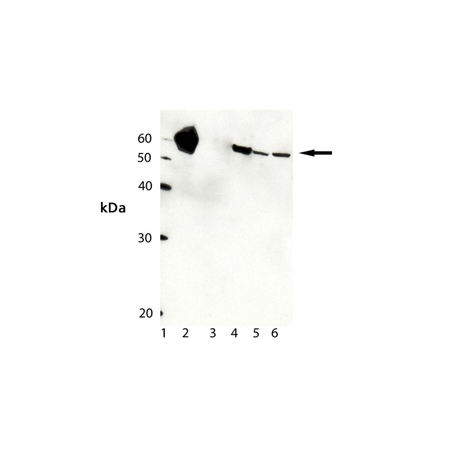
| Application Info | IP 1:100 WB 1:1000 (detects a ~60 kDa band) |
| Reference | Human U251MG glioma cells expressing the membrane form of macrophage colony-stimulating factor (mM-CSF) are killed by human monocytes in vitro and are rejected within immunodeficient mice via paraptosis that is associated with increased expression of three different heat shock proteins: M.R. Jadus, et al. ; Cancer Gene Ther. 10, 411 (2003), Application(s): IHC using human tissue, Abstract; |
|---|---|
| Gene Symbol | HSPD1 |
| Gene Full Name | heat shock protein family D (Hsp60) member 1 |
| Alias Symbols | 60 kDa chaperonin;60 kDa heat shock protein, mitochondrial;chaperonin 60;CPN60;epididymis secretory sperm binding protein;GROEL;heat shock 60kDa protein 1 (chaperonin);Heat shock protein 60;heat shock protein 65;HLD4;HSP60;HSP-60;HSP65;HuCHA60;mitochondrial matrix protein P1;P60 lymphocyte protein;short heat shock protein 60 Hsp60s1;SPG13. |
| NCBI Gene Id | 3329 |
| Protein Name | 60 kDa heat shock protein, mitochondrial |
| Description of Target | Chaperonin implicated in mitochondrial protein import and macromolecular assembly. Together with Hsp10, facilitates the correct folding of imported proteins. May also prevent misfolding and promote the refolding and proper assembly of unfolded polypeptides generated under stress conditions in the mitochondrial matrix (PubMed:1346131, PubMed:11422376). The functional units of these chaperonins consist of heptameric rings of the large subunit Hsp60, which function as a back-to-back double ring. In a cyclic reaction, Hsp60 ring complexes bind one unfolded substrate protein per ring, followed by the binding of ATP and association with 2 heptameric rings of the co-chaperonin Hsp10. This leads to sequestration of the substrate protein in the inner cavity of Hsp60 where, for a certain period of time, it can fold undisturbed by other cell components. Synchronous hydrolysis of ATP in all Hsp60 subunits results in the dissociation of the chaperonin rings and the release of ADP and the folded substrate protein (Probable). |
| Uniprot ID | P10809 |