APP Detection Antibody

Référence OAOA22126
Conditionnement : 50µg
Marque : Aviva Systems Biology
Contactez votre distributeur local :

Téléphone : +1 850 650 7790
APP Detection Antibody : Biotin (OAOA22126)
| Datasheets/Manuals | Printable datasheet for APP Detection Antibody : Biotin (OAOA22126) |
|---|
| Predicted Species Reactivity | Human|Mouse|Rat |
|---|---|
| Product Format | Stored in PBS (pH 7.4) with 0.05% sodium azide, 10mg/ml BSA, 50% glycerol |
| Clonality | Monoclonal |
| Clone | OTI1E6 |
| Isotype | IgG1 |
| Host | Mouse |
| Conjugation | Biotin |
| Application | MlpxA |
| Reconstitution and Storage | -20°C |
| Immunogen | Full length human recombinant protein of human APP (NM_201413) produced in HEK293T cell. |
| Concentration | 0.5 mg/ml |
| Dilution | 1:250 - 1:1000 |
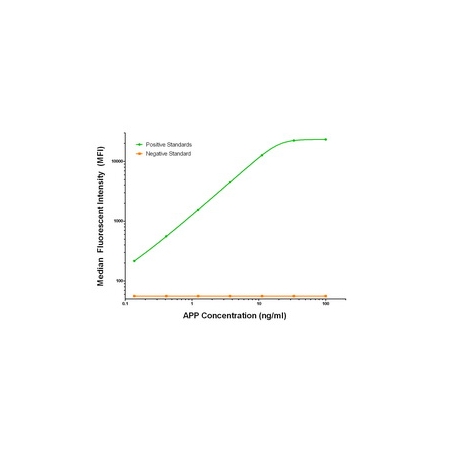
| Description | APP biotinylated mouse monoclonal detection antibody, validated for Luminex assays |
| Gene Symbol | APP |
|---|---|
| Gene Full Name | amyloid beta precursor protein |
| Alias Symbols | AAA, ABETA, ABPP, AD1, alpha-sAPP, alzheimer disease amyloid protein, amyloid beta (A4) precursor protein, amyloid beta A4 protein, amyloid precursor protein, amyloid-beta precursor protein, APPI, beta-amyloid peptide, beta-amyloid peptide(1-40), beta-amyloid peptide(1-42), beta-amyloid precursor protein, cerebral vascular amyloid peptide, CTFgamma, CVAP, peptidase nexin-II, PN-II, PN2, preA4, protease nexin-II, testicular tissue protein Li 2. |
| NCBI Gene Id | 351 |
| Protein Name | Amyloid-beta A4 protein|Homo sapiens amyloid beta precursor protein (APP), transcript variant 2, mRNA |
| Description of Target | Functions as a cell surface receptor and performs physiological functions on the surface of neurons relevant to neurite growth, neuronal adhesion and axonogenesis. Involved in cell mobility and transcription regulation through protein-protein interactions. Can promote transcription activation through binding to APBB1-KAT5 and inhibits Notch signaling through interaction with Numb. Couples to apoptosis-inducing pathways such as those mediated by G(O) and JIP. Inhibits G(o) alpha ATPase activity (By similarity). Acts as a kinesin I membrane receptor, mediating the axonal transport of beta-secretase and presenilin 1. Involved in copper homeostasis/oxidative stress through copper ion reduction. In vitro, copper-metallated APP induces neuronal death directly or is potentiated through Cu(2+)-mediated low-density lipoprotein oxidation. Can regulate neurite outgrowth through binding to components of the extracellular matrix such as heparin and collagen I and IV. The splice isoforms that contain the BPTI domain possess protease inhibitor activity. Induces a AGER-dependent pathway that involves activation of p38 MAPK, resulting in internalization of amyloid-beta peptide and leading to mitochondrial dysfunction in cultured cortical neurons. Provides Cu(2+) ions for GPC1 which are required for release of nitric oxide (NO) and subsequent degradation of the heparan sulfate chains on GPC1. |
| Uniprot ID | P05067 |
| Protein Accession # | NP_958816 |
| Nucleotide Accession # | https://www.ncbi.nlm.nih.gov/nuccore/NM_201413 |