

ATG7 Antibody (C-term)

Référence MBS9204169-5x0,4mL
Conditionnement : 5x0.4mL
Marque : MyBiosource
Contactez votre distributeur local :

Téléphone : +1 850 650 7790
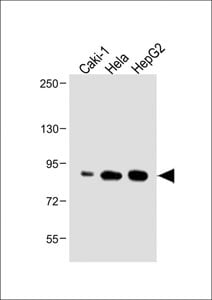
All lanes : Anti-ATG7 Antibody (C-term) at1:500 dilution Lane 1: Caki-1 whole cell lysateLane 2: Hela whole cell lysate Lane 3: HepG2whole cell lysate Lysates/proteins at 40 µg perlane. Secondary Goat Anti-Rabbit IgG, (H+L),Peroxidase conjugated at 1/10000 dilution.Predicted band size : 78 kDa Blocking/Dilutionbuffer: 5% NFDM/TBST.
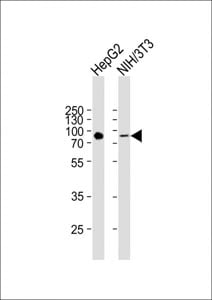
All lanes : Anti-ATG7 Antibody (C-term) at1:1000 dilution Lane 1: HepG2 whole cell lysateLane 2: NIH/3T3 whole cell lysateLysates/proteins at 20 µg per lane. SecondaryGoat Anti-Rabbit IgG, (H+L), Peroxidaseconjugated at 1/10000 dilution. Predicted bandsize : 78 kDa Blocking/Dilution buffer: 5%

Immunofluorescent analysis of U251 cells, using ATG7 Antibody (C-term). U251 cells(right) were treated with Chloroquine (50 uM,16h). MBS9204169 was diluted at 1:25 dilution. Alexa Fluor 488-conjugated goat anti-rabbit lgG at 1:400 dilution was used as the secondary antibody (green).DAPI was used to stain the cell nuclear (blue).
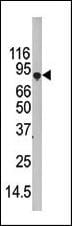
Western blot analysis of APG7L Pab in 293 cell line lysate (35ug/lane). APG7L (arrow) was detected using the purified Pab.

Formalin-fixed and paraffin-embedded human hepatocarcinoma tissue reacted with Autophagy APG7L antibody (C-term), which was peroxidase-conjugated to the secondary antibody, followed by DAB staining. This data demonstrates the use of this antibody for immunohistochemistry; clinical relevance has not been evaluated.
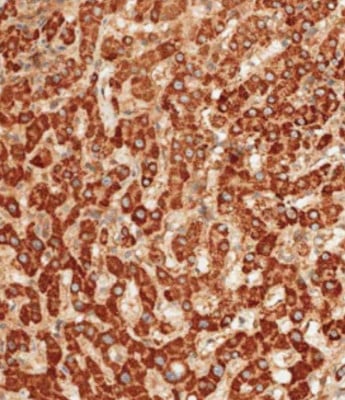
Immunohistochemical analysis of paraffin-embedded human liver tissue using MBS9204169 performed on the Leica® BOND RXm. Tissue was fixed with formaldehyde at room temperature; antigen retrieval was by heat mediation with a EDTA buffer (pH9. 0). Samples were incubated with primary antibody(1:1000) for 1 hours at room temperature. A undiluted biotinylated CRF Anti-Polyvalent HRP Polymer antibody was used as the secondary antibody.
ATG7 Antibody – Rabbit Polyclonal
For Research Use Only. Not for use in diagnostic procedures. Catalog #: MBS9204169E1-like activating enzyme involved in the 2 ubiquitin-like systems required for cytoplasm to vacuole transport (Cvt) and autophagy. Activates ATG12 for its conjugation with ATG5 as well as the ATG8 family proteins for their conjugation with… More details
Product Overview
Online Datasheet in PDFProduct Name
ATG7, Polyclonal Antibody
Full Product Name
ATG7 Antibody (C-term)
Product Gene Name
anti-ATG7 antibody
Product Synonym Names
Ubiquitin-like modifier-activating enzyme ATG7; ATG12-activating enzyme E1 ATG7; Autophagy-related protein 7; APG7-like; hAGP7; Ubiquitin-activating enzyme E1-like protein; ATG7; APG7L
Clonality
Polyclonal
Isotype
Rabbit Ig
Host
Rabbit
Species Reactivity
Human, Mouse
Predicted reactivity: Chicken, Rat
Predicted reactivity: Chicken, Rat
Form/Format
Purified polyclonal antibody supplied in PBS with 0.09% (W/V) sodium azide. This antibody is purified through a protein A column, followed by peptide affinity purification.
Purity/Purification
Purified Rabbit Polyclonal Antibody (Pab)
Specificity
This ATG7 antibody is generated from rabbits immunized with a KLH conjugated synthetic peptide between 540-569 amino acids from the C-terminal region of human ATG7.
Preparation and Storage
Maintain refrigerated at 2-8°C for up to 2 weeks. For long term storage store at -20°C in small aliquots to prevent freeze-thaw cycles.
Antibody/Peptide Pairs
ATG7 peptide (MBS9223171) is used for blocking the activity of ATG7 antibody (MBS9204169)
Immunogen Sequence Positions
540-569
OMIM
608760
Cellular location
Cytoplasm. Preautophagosomal structure.Note=Localizes also to discrete punctaealong the ciliary axoneme and to the base ofthe ciliary axoneme
Tissue location
Widely expressed, especially in kidney, liver,lymph nodes and bone marrow.
Product Categories/Family for anti-ATG7 antibody
Signal Transduction; Metabolism; Developmental Biology; Cell Biology; Cardiovascular; Cancer; Phospho Antibodies
Applications Tested/Suitable for anti-ATG7 antibody
Western Blot (WB), ELISA (EIA), ImmunohistochemistryParaffin-Leica (IHC), Immunofluorescence (IF)
Application Notes for anti-ATG7 antibody
WB~~1:500
IF~~1:25
IHC-P-Leica~~1:1000
IF~~1:25
IHC-P-Leica~~1:1000
Testing Data(TD) of anti-ATG7 antibody
All lanes : Anti-ATG7 Antibody (C-term) at1:500 dilution Lane 1: Caki-1 whole cell lysateLane 2: Hela whole cell lysate Lane 3: HepG2whole cell lysate Lysates/proteins at 40 µg perlane. Secondary Goat Anti-Rabbit IgG, (H+L),Peroxidase conjugated at 1/10000 dilution.Predicted band size : 78 kDa Blocking/Dilutionbuffer: 5% NFDM/TBST.
Testing Data (TD) of anti-ATG7 antibody
All lanes : Anti-ATG7 Antibody (C-term) at1:1000 dilution Lane 1: HepG2 whole cell lysateLane 2: NIH/3T3 whole cell lysateLysates/proteins at 20 µg per lane. SecondaryGoat Anti-Rabbit IgG, (H+L), Peroxidaseconjugated at 1/10000 dilution. Predicted bandsize : 78 kDa Blocking/Dilution buffer: 5%
Immunofluorescence (IF) of anti-ATG7 antibody
Immunofluorescent analysis of U251 cells, using ATG7 Antibody (C-term). U251 cells(right) were treated with Chloroquine (50 uM,16h). MBS9204169 was diluted at 1:25 dilution. Alexa Fluor 488-conjugated goat anti-rabbit lgG at 1:400 dilution was used as the secondary antibody (green).DAPI was used to stain the cell nuclear (blue).
Immunohistochemistry (IHC) of anti-ATG7 antibody
Formalin-fixed and paraffin-embedded human hepatocarcinoma tissue reacted with Autophagy APG7L antibody (C-term), which was peroxidase-conjugated to the secondary antibody, followed by DAB staining. This data demonstrates the use of this antibody for immunohistochemistry; clinical relevance has not been evaluated.
Immunohistochemistry (IHC) of anti-ATG7 antibody
Immunohistochemical analysis of paraffin-embedded human liver tissue using MBS9204169 performed on the Leica® BOND RXm. Tissue was fixed with formaldehyde at room temperature; antigen retrieval was by heat mediation with a EDTA buffer (pH9. 0). Samples were incubated with primary antibody(1:1000) for 1 hours at room temperature. A undiluted biotinylated CRF Anti-Polyvalent HRP Polymer antibody was used as the secondary antibody.
Product References and Citations for anti-ATG7 antibody
References for protein:
1.Baehrecke EH. Nat Rev Mol Cell Biol. 6(6):505-10. (2005)
2Lum JJ, et al. Nat Rev Mol Cell Biol. 6(6):439-48. (2005)
3.Greenberg JT. Dev Cell. 8(6):799-801. (2005)
4.Levine B. Cell. 120(2):159-62. (2005)
5.Shintani T and Klionsky DJ. Science. 306(5698):990-5. (2004)
6.Tanida I., et al. Biochem. Biophys. Res. Commun. 292:256-262(2002)
7.Tanida I., et al. J. Biol. Chem. 277:13739-13744(2002)
References for U251 cell line:
1. Westermark B.; Pontén J.; Hugosson R. (1973)." Determinants for the establishment of permanent tissue culture lines from human gliomas". Acta Pathol Microbiol Scand A. 81:791-805. [PMID: 4359449].
2. Pontén, J.,Westermark B. (1978)." Properties of Human Malignant Glioma Cells in Vitro". Medical Biology 56: 184-193.[PMID: 359950].
3. Geng Y.;Kohli L.; Klocke B.J.; Roth K.A.(2010). "Chloroquine-induced autophagic vacuole accumulation and cell death in glioma cells is p53 independent". Neuro Oncol. 12(5): 473-481.[ PMID: 20406898].
Other Notes
Small volumes of anti-ATG7 antibody vial(s) may occasionally become entrapped in the seal of the product vial during shipment and storage. If necessary, briefly centrifuge the vial on a tabletop centrifuge to dislodge any liquid in the container`s cap. Certain products may require to ship with dry ice and additional dry ice fee may apply.
Searchable Terms for ATG7 purchase
MBS9204169 is an antibody targeting ATG7. Also known as ATG7 Antibody (C-term). Reactive in Human, Mouse
Predicted reactivity: Chicken, Rat. Host: Rabbit.
Predicted reactivity: Chicken, Rat. Host: Rabbit.
Additional Details
NCBI/Uniprot data below describe general gene information for ATG7. It may not necessarily be applicable to this product.
NCBI GI #
NCBI GeneID
NCBI Accession #
NCBI Related Accession #
NCBI Official Full Name
ubiquitin-like modifier-activating enzyme ATG7 isoform b
NCBI Official Synonym Full Names
autophagy related 7
NCBI Official Symbol
ATG7
NCBI Official Synonym Symbols
GSA7; APG7L; APG7-LIKE
UniProt Protein Name
Ubiquitin-like modifier-activating enzyme ATG7
UniProt Synonym Protein Names
ATG12-activating enzyme E1 ATG7; Autophagy-related protein 7; APG7-like; hAGP7; Ubiquitin-activating enzyme E1-like protein
Protein Family
Ubiquitin-like modifier-activating enzyme
UniProt Gene Name
ATG7
UniProt Synonym Gene Names
APG7L; APG7-like; hAGP7
UniProt Entry Name
ATG7_HUMAN
NCBI Protein Information
ubiquitin-like modifier-activating enzyme ATG7
NCBI Summary for ATG7
This gene was identified based on homology to Pichia pastoris GSA7 and Saccharomyces cerevisiae APG7. In the yeast, the protein appears to be required for fusion of peroxisomal and vacuolar membranes. The protein shows homology to the ATP-binding and catalytic sites of the E1 ubiquitin activating enzymes. [provided by RefSeq, Jan 2009]
Show more UniProt Comments for ATG7
ATG7: Functions as an E1 enzyme essential for multisubstrates such as ATG8-like proteins and ATG12. Forms intermediate conjugates with ATG8-like proteins (GABARAP, GABARAPL1, GABARAPL2 or MAP1LC3A). PE-conjugation to ATG8-like proteins is essential for autophagy. Also acts as an E1 enzyme for ATG12 conjugation to ATG5 and ATG3. Homodimer. Interacts with ATG3 and ATG12. The complex, composed of ATG3 and ATG7, plays a role in the conjugation of ATG12 to ATG5. Widely expressed, especially in kidney, liver, lymph nodes and bone marrow. Belongs to the ATG7 family. 2 isoforms of the human protein are produced by alternative splicing.
Protein type: Autophagy; Ubiquitin conjugating system
Chromosomal Location of Human Ortholog: 3p25.3
Cellular Component: cytoplasm; axoneme; cytosol
Molecular Function: protein binding; protein homodimerization activity; APG8 activating enzyme activity; APG12 activating enzyme activity; ubiquitin activating enzyme activity; transcription factor binding
Biological Process: regulation of protein ubiquitination; positive regulation of apoptosis; protein ubiquitination; pyramidal neuron development; adult walking behavior; post-embryonic development; protein transport; cardiac muscle cell development; protein amino acid lipidation; protein catabolic process; positive regulation of autophagy; amino acid metabolic process; central nervous system neuron axonogenesis; cerebellar Purkinje cell layer development; protein modification process; C-terminal protein lipidation; liver development; cellular response to starvation; cellular response to nitrogen starvation; neurological system process; protein modification by small protein conjugation; mitochondrion degradation; positive regulation of protein catabolic process; positive regulation of protein modification process; cerebral cortex development; positive regulation of macroautophagy; negative regulation of apoptosis
Show more Protein type: Autophagy; Ubiquitin conjugating system
Chromosomal Location of Human Ortholog: 3p25.3
Cellular Component: cytoplasm; axoneme; cytosol
Molecular Function: protein binding; protein homodimerization activity; APG8 activating enzyme activity; APG12 activating enzyme activity; ubiquitin activating enzyme activity; transcription factor binding
Biological Process: regulation of protein ubiquitination; positive regulation of apoptosis; protein ubiquitination; pyramidal neuron development; adult walking behavior; post-embryonic development; protein transport; cardiac muscle cell development; protein amino acid lipidation; protein catabolic process; positive regulation of autophagy; amino acid metabolic process; central nervous system neuron axonogenesis; cerebellar Purkinje cell layer development; protein modification process; C-terminal protein lipidation; liver development; cellular response to starvation; cellular response to nitrogen starvation; neurological system process; protein modification by small protein conjugation; mitochondrion degradation; positive regulation of protein catabolic process; positive regulation of protein modification process; cerebral cortex development; positive regulation of macroautophagy; negative regulation of apoptosis
Precautions
All of MyBioSource's Products are for scientific laboratory research purposes and are not for diagnostic, therapeutics, prophylactic or in vivo use. Through your purchase, you expressly represent and warrant to MyBioSource that you will properly test and use any Products purchased from MyBioSource in accordance with industry standards. MyBioSource and its authorized distributors reserve the right to refuse to process any order where we reasonably believe that the intended use will fall outside of our acceptable guidelines.
Disclaimer
While every efforts were made to ensure the accuracy of the information provided in this datasheet, MyBioSource will not be liable for any omissions or errors contained herein. MyBioSource reserves the right to make changes to this datasheet at any time without prior notice.
It is the responsibility of the customer to report product performance issues to MyBioSource within 30 days of receipt of the product. Please visit our Terms & Conditions page for more information.
It is the responsibility of the customer to report product performance issues to MyBioSource within 30 days of receipt of the product. Please visit our Terms & Conditions page for more information.
Product Note
Select online data sheet information is drawn from bioinformatics databases, occasionally resulting in ambiguous or non-relevant product information. It is the responsibility of the customer to review, verify, and evaluate the information to make sure it matches their requirements before purchasing the kit. Our ELISA Kit assays are dynamic research tools and sometimes they may be updated and improved. If the format of this assay is important to you then please request the current manual or contact our technical support team with a presales inquiry before placing an order. We will confirm the current details of the assay. We cannot guarantee the sample manual posted online is the most current manual, it is intended to serve as an example only. Please refer to the instructions For Use provided with the assay kit for precise details.
Product PubMed Publications
Products associated with anti-ATG7 antibody
| Reference Product | PubMed Publications |
|---|---|
| ATG5 antibody | >278 publications with ATG7 and ATG5 |
| BECN1 antibody | >125 publications with ATG7 and BECN1 |
| ATG12 antibody | >93 publications with ATG7 and ATG12 |
| ATG3 antibody | >79 publications with ATG7 and ATG3 |
| MAP1LC3B antibody | >23 publications with ATG7 and MAP1LC3B |
| ATG10 antibody | >22 publications with ATG7 and ATG10 |
| MAP1LC3A antibody | >13 publications with ATG7 and MAP1LC3A |
| GABARAPL1 antibody | >9 publications with ATG7 and GABARAPL1 |
| GABARAPL2 antibody | >9 publications with ATG7 and GABARAPL2 |
Diseases associated with anti-ATG7 antibody
| Disease Name | Pubmed Publications |
|---|---|
| Nervous System Diseases Antibodies | >62 publications with ATG7 and Nervous System Diseases |
| Necrosis Antibodies | >58 publications with ATG7 and Necrosis |
| Inflammation Antibodies | >49 publications with ATG7 and Inflammation |
| Liver Diseases Antibodies | >39 publications with ATG7 and Liver Diseases |
| Breast Neoplasms Antibodies | >31 publications with ATG7 and Breast Neoplasms |
| Cardiovascular Diseases Antibodies | >30 publications with ATG7 and Cardiovascular Diseases |
| Adenocarcinoma Antibodies | >28 publications with ATG7 and Adenocarcinoma |
| Carcinoma, Hepatocellular Antibodies | >23 publications with ATG7 and Carcinoma, Hepatocellular |
| Liver Neoplasms Antibodies | >18 publications with ATG7 and Liver Neoplasms |
| Heart Diseases Antibodies | >15 publications with ATG7 and Heart Diseases |
Organs/Tissues associated with anti-ATG7 antibody
| Organ/Tissue Name | Pubmed Publications |
|---|---|
| Brain Antibodies | >85 publications with ATG7 and Brain |
| Muscle Antibodies | >79 publications with ATG7 and Muscle |
| Blood Antibodies | >76 publications with ATG7 and Blood |
| Liver Antibodies | >74 publications with ATG7 and Liver |
| Heart Antibodies | >47 publications with ATG7 and Heart |
| Lung Antibodies | >46 publications with ATG7 and Lung |
| Bone Antibodies | >23 publications with ATG7 and Bone |
| Kidney Antibodies | >23 publications with ATG7 and Kidney |
| Pancreas Antibodies | >19 publications with ATG7 and Pancreas |
| Intestine Antibodies | >18 publications with ATG7 and Intestine |
Vous serez peut-être également intéressé par les produits suivants :
Référence
Description
Cond.
Prix HT