

Calnexin

Référence MBS618627-0,05mg
Conditionnement : 0.05mg
Marque : MyBiosource
Contactez votre distributeur local :

Téléphone : +1 850 650 7790
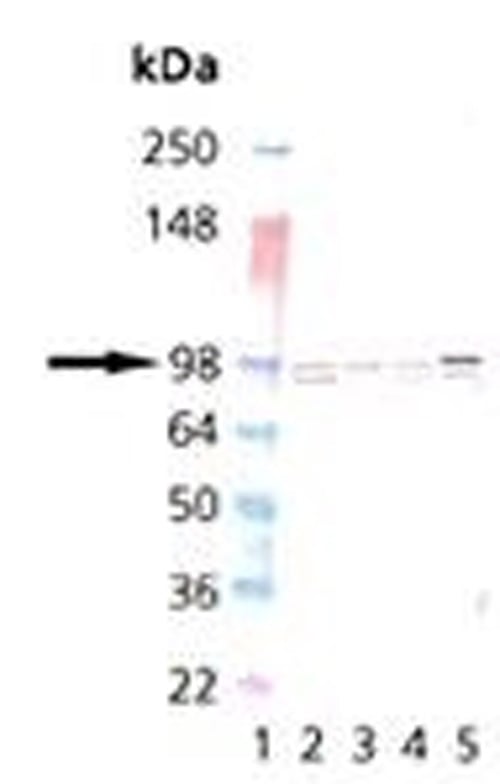
Western blot analysis:
Lane 1: MWM
Lane 2: Vero
Lane 3: 3T3
Lane 4: PC-12
Lane 5: HeLa cells
Lane 1: MWM
Lane 2: Vero
Lane 3: 3T3
Lane 4: PC-12
Lane 5: HeLa cells
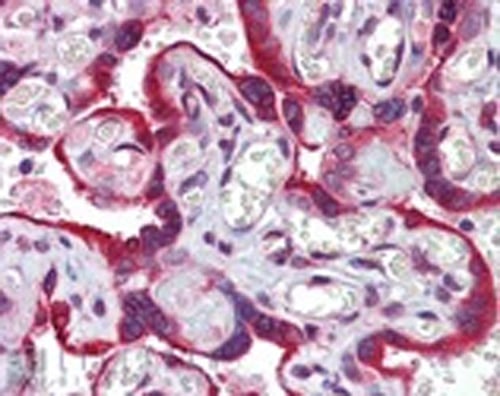
Immunohistochemistry analysis of human placenta tissue stained with MBS618627 at 5ug/ml.
Calnexin (CANX) Antibody – Rabbit Polyclonal
For Research Use Only. Not for use in diagnostic procedures. Catalog #: MBS618627Calnexin (CNX), an abundant ~90kD molecular chaperone, is a unglycosylated resident ER transmembrane protein. In mammalian cells, calnexin, together with calreticulin (CRT), plays a key role in glycoprotein folding and its control within the ER, by… More details
Product Overview
Online Datasheet in PDFProduct Name
Calnexin (CANX), Polyclonal Antibody
Full Product Name
Calnexin
Product Gene Name
anti-CANX antibody
Product Synonym Names
Anti -Calnexin
Clonality
Polyclonal
Isotype
IgG
Host
Rabbit
Species Reactivity
Human, Monkey, Mouse, Rat, Rabbit, Guinea pig, Hamster, Bovine, C. Elegans, Sheep, Chicken, Porcine and Xenopus.
Form/Format
Supplied as a liquid in PBS, pH 7.2, 0.09% sodium azide, 50% glycerol.
Purity/Purification
Purified by Protein A affinity chromatography.
Concentration
1 mg/ml (lot specific)
Specificity
Recognizes canine calnexin
Preparation and Storage
May be stored at 4°C for short-term only.
Aliquot to avoid repeated freezing and thawing.
Store at -20°C. Aliquots are stable for 12 months after receipt.
For maximum recovery of product, centrifuge the original vial after thawing and prior to removing the cap.
Aliquot to avoid repeated freezing and thawing.
Store at -20°C. Aliquots are stable for 12 months after receipt.
For maximum recovery of product, centrifuge the original vial after thawing and prior to removing the cap.
Chromosome Location
Chromosome: 5; NC_000005.9 (179125930..179158642). Location: 5q35
OMIM
114217
Immunogen
Synthetic peptide corresponding to the sequence near the N-terminus of canine calnexin.
Positive Control
Heat Shocked HeLa Cell Lysate
Product Categories/Family for anti-CANX antibody
Antibodies; Abs to Calnexin
Applications Tested/Suitable for anti-CANX antibody
Western Blot (WB), Immunohistochemistry (IHC), Immunocytochemistry (ICC), Immunoprecipitation (IP)
Application Notes for anti-CANX antibody
Western Blot (Colorimetric): 1:1000, detects a band of ~90kD
Immunohistochemistry: Paraffin sections
Optimal dilutions to be determined by researcher.
Immunohistochemistry: Paraffin sections
Optimal dilutions to be determined by researcher.
Other Notes
Small volumes of anti-CANX antibody vial(s) may occasionally become entrapped in the seal of the product vial during shipment and storage. If necessary, briefly centrifuge the vial on a tabletop centrifuge to dislodge any liquid in the container`s cap. Certain products may require to ship with dry ice and additional dry ice fee may apply.
Searchable Terms for CANX purchase
MBS618627 is an antibody targeting CANX. Also known as Calnexin. Reactive in Human, Monkey, Mouse, Rat, Rabbit, Guinea pig, Hamster, Bovine, C. Elegans, Sheep, Chicken, Porcine and Xenopus.. Host: Rabbit.
Additional Details
NCBI/Uniprot data below describe general gene information for CANX. It may not necessarily be applicable to this product.
NCBI Official Full Name
calnexin
NCBI Official Synonym Full Names
calnexin
NCBI Official Symbol
CANX
NCBI Official Synonym Symbols
CNX; P90; IP90; FLJ26570
UniProt Protein Name
Calnexin
UniProt Synonym Protein Names
IP90; Major histocompatibility complex class I antigen-binding protein p88; p90
Protein Family
Calnexin
UniProt Gene Name
CANX
UniProt Entry Name
CALX_HUMAN
NCBI Protein Information
calnexin; OTTHUMP00000161516; OTTHUMP00000223184; OTTHUMP00000223187; major histocompatibility complex class I antigen-binding protein p88
NCBI Summary for CANX
This gene encodes a member of the calnexin family of molecular chaperones. The encoded protein is a calcium-binding, endoplasmic reticulum (ER)-associated protein that interacts transiently with newly synthesized N-linked glycoproteins, facilitating protein folding and assembly. It may also play a central role in the quality control of protein folding by retaining incorrectly folded protein subunits within the ER for degradation. Alternatively spliced transcript variants encoding the same protein have been described. [provided by RefSeq]
Show more UniProt Comments for CANX
Calnexin: a calcium-binding protein of the calreticulin family. A type I membrane protein of the endoplasmic reticulum .Interacts with newly synthesized glycoproteins in the endoplasmic reticulum. May act in assisting protein assembly and/or in the retention within the ER of unassembled protein subunits. It seems to play a major role in the quality control apparatus of the ER by the retention of incorrectly folded proteins.
Protein type: Endoplasmic reticulum; Motility/polarity/chemotaxis; Membrane protein, integral; Calcium-binding
Chromosomal Location of Human Ortholog: 5q35
Cellular Component: dendrite cytoplasm; endoplasmic reticulum membrane; smooth endoplasmic reticulum; protein complex; rough endoplasmic reticulum; endoplasmic reticulum lumen; endoplasmic reticulum; dendritic spine; cell soma; membrane; axon; melanosome; ribosome
Molecular Function: ionotropic glutamate receptor binding; protein binding; unfolded protein binding; apolipoprotein binding; calcium ion binding; carbohydrate binding; glycoprotein binding
Biological Process: antigen processing and presentation of peptide antigen via MHC class I; cellular protein metabolic process; protein folding; synaptic vesicle endocytosis; protein secretion; antigen processing and presentation of exogenous peptide antigen via MHC class II; protein amino acid N-linked glycosylation via asparagine; post-translational protein modification; aging
Show more Protein type: Endoplasmic reticulum; Motility/polarity/chemotaxis; Membrane protein, integral; Calcium-binding
Chromosomal Location of Human Ortholog: 5q35
Cellular Component: dendrite cytoplasm; endoplasmic reticulum membrane; smooth endoplasmic reticulum; protein complex; rough endoplasmic reticulum; endoplasmic reticulum lumen; endoplasmic reticulum; dendritic spine; cell soma; membrane; axon; melanosome; ribosome
Molecular Function: ionotropic glutamate receptor binding; protein binding; unfolded protein binding; apolipoprotein binding; calcium ion binding; carbohydrate binding; glycoprotein binding
Biological Process: antigen processing and presentation of peptide antigen via MHC class I; cellular protein metabolic process; protein folding; synaptic vesicle endocytosis; protein secretion; antigen processing and presentation of exogenous peptide antigen via MHC class II; protein amino acid N-linked glycosylation via asparagine; post-translational protein modification; aging
Precautions
All of MyBioSource's Products are for scientific laboratory research purposes and are not for diagnostic, therapeutics, prophylactic or in vivo use. Through your purchase, you expressly represent and warrant to MyBioSource that you will properly test and use any Products purchased from MyBioSource in accordance with industry standards. MyBioSource and its authorized distributors reserve the right to refuse to process any order where we reasonably believe that the intended use will fall outside of our acceptable guidelines.
Disclaimer
While every efforts were made to ensure the accuracy of the information provided in this datasheet, MyBioSource will not be liable for any omissions or errors contained herein. MyBioSource reserves the right to make changes to this datasheet at any time without prior notice.
It is the responsibility of the customer to report product performance issues to MyBioSource within 30 days of receipt of the product. Please visit our Terms & Conditions page for more information.
It is the responsibility of the customer to report product performance issues to MyBioSource within 30 days of receipt of the product. Please visit our Terms & Conditions page for more information.
Product Note
Select online data sheet information is drawn from bioinformatics databases, occasionally resulting in ambiguous or non-relevant product information. It is the responsibility of the customer to review, verify, and evaluate the information to make sure it matches their requirements before purchasing the kit. Our ELISA Kit assays are dynamic research tools and sometimes they may be updated and improved. If the format of this assay is important to you then please request the current manual or contact our technical support team with a presales inquiry before placing an order. We will confirm the current details of the assay. We cannot guarantee the sample manual posted online is the most current manual, it is intended to serve as an example only. Please refer to the instructions For Use provided with the assay kit for precise details.
Product PubMed Publications
Products associated with anti-CANX antibody
| Reference Product | PubMed Publications |
|---|---|
| HLA-A antibody | >1 publications with CANX and HLA-A |
| PDIA3 antibody | >1 publications with CANX and PDIA3 |
Pathways associated with anti-CANX antibody
| Products by Pathway | Pathway Diagram |
|---|---|
| Adaptive Immunity Signaling Pathway antibodies | Adaptive Immunity Signaling Pathway Diagram |
| Antigen Presentation: Folding, Assembly And Peptide Loading Of Class I MHC Pathway antibodies | Antigen Presentation: Folding, Assembly And Peptide Loading Of Class I MHC Pathway Diagram |
| Antigen Processing And Presentation Pathway antibodies | Antigen Processing And Presentation Pathway Diagram |
| Antigen Processing And Presentation Pathway antibodies | Antigen Processing And Presentation Pathway Diagram |
| Asparagine N-linked Glycosylation Pathway antibodies | Asparagine N-linked Glycosylation Pathway Diagram |
| Assembly Of Viral Components At The Budding Site Pathway antibodies | Assembly Of Viral Components At The Budding Site Pathway Diagram |
| Calnexin/calreticulin Cycle Pathway antibodies | Calnexin/calreticulin Cycle Pathway Diagram |
| Class I MHC Mediated Antigen Processing & Presentation Pathway antibodies | Class I MHC Mediated Antigen Processing & Presentation Pathway Diagram |
| HTLV-I Infection Pathway antibodies | HTLV-I Infection Pathway Diagram |
| HTLV-I Infection Pathway antibodies | HTLV-I Infection Pathway Diagram |
Diseases associated with anti-CANX antibody
| Disease Name | Pubmed Publications |
|---|---|
| Adenocarcinoma Antibodies | >2 publications with CANX and Adenocarcinoma |
| Carcinoma Antibodies | >2 publications with CANX and Carcinoma |
| Neoplasms Antibodies | >2 publications with CANX and Neoplasms |
| Rectal Neoplasms Antibodies | >1 publications with CANX and Rectal Neoplasms |
| Lung Diseases, Interstitial Antibodies | >1 publications with CANX and Lung Diseases, Interstitial |
| Liver Neoplasms Antibodies | >1 publications with CANX and Liver Neoplasms |
| Pleural Effusion Antibodies | >1 publications with CANX and Pleural Effusion |
| Genital Diseases, Male Antibodies | >1 publications with CANX and Genital Diseases, Male |
| Colorectal Neoplasms Antibodies | >1 publications with CANX and Colorectal Neoplasms |
| Infertility, Male Antibodies | >1 publications with CANX and Infertility, Male |
Organs/Tissues associated with anti-CANX antibody
| Organ/Tissue Name | Pubmed Publications |
|---|---|
| Lung Antibodies | >2 publications with CANX and Lung |
| Liver Antibodies | >2 publications with CANX and Liver |
| Testis Antibodies | >2 publications with CANX and Testis |
| Epididymis Antibodies | >1 publications with CANX and Epididymis |
| Blood Antibodies | >1 publications with CANX and Blood |
| Kidney Antibodies | >1 publications with CANX and Kidney |
| Skin Antibodies | >1 publications with CANX and Skin |
| Uterus Antibodies | >1 publications with CANX and Uterus |
| Embryonic Tissue Antibodies | >1 publications with CANX and Embryonic Tissue |