



Quantibody® Canine Cytokine Array 1 Kit. Detects 10 Canine Cytokines. Suitable for all liquid sample types.
Canine Cytokine Array Q1
Canine Cytokine Array Q1
Contact Us for Bulk Request
Product Description
Specifications
| Size | 8 Sample Kit, 22 Sample Kit, 50 Sample Kit |
| Species | Canine (dog) |
| Compatible Sample Types | Cell Culture Supernatants, Plasma, Serum, Tissue Lysates, Cell Lysates |
| Quantitative/Semi-Quantitative | Quantitative |
| Number of Targets Detected | 10 |
| Solid Support | Glass Slide |
| Design Principle | Sandwich-based |
| Method Of Detection | Fluorescence Laser Scanner |
| Shipping Type | Blue ice |
| Storage | -20°C |
Product Features
- More cost-effective than traditional ELISA
- High specificity and system reproducibility
- Suitable for diverse sample types
- Low sample volume requirement: 50 µL or less
- Get results same day (6-hour processing time)
- Well-suited for high throughput assays
- Q Analyzer software provides one-step computation
Target Names
| Scroll over each target protein for more information | ||||
|---|---|---|---|---|
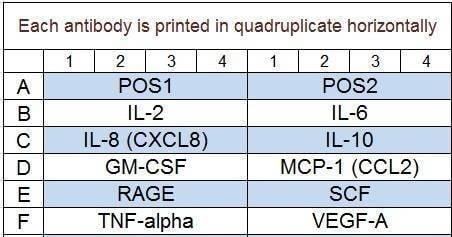
IL-2
| IL-6
| IL-8 (CXCL8)
| IL-10
| GM-CSF
|
MCP-1 (CCL2)
| RAGE
| SCF
| TNF alpha
| VEGF-A
|
Application Notes
Suggested Application
Multiplexed Protein Detection; Biomarker Screening; Identifying Key Factors; Confirming Biological Process; Biomarker Validation; Validation of Antibody Array Results; Quantitative Protein Detection; Establishing Normal Range
Kit Components
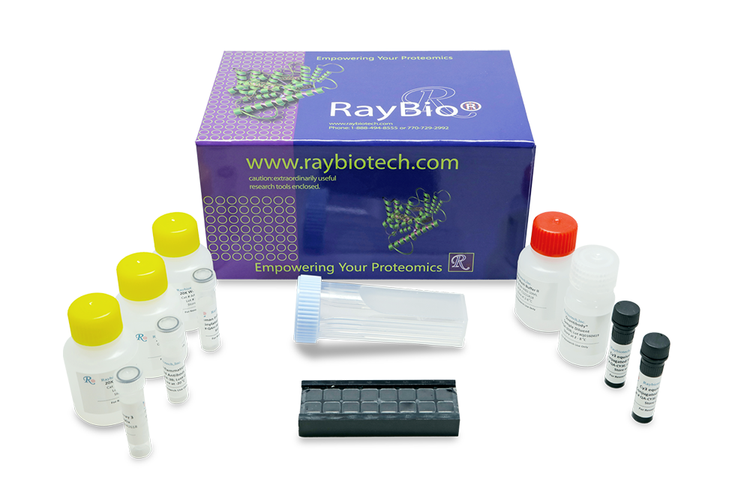
- Canine Cytokine Array Q1 Slide(s)
- Blocking Buffer
- Wash Buffer 1
- Wash Buffer 2
- Lyophilized Standard Mix
- Biotinylated Detection Antibody Cocktail
- Streptavidin-Conjugated Fluor
- Slide Washer/Dryer
- Adhesive Plastic Strips
- Manual
Other Materials Required
- Distilled or deionized water
- Small plastic boxes or containers
- Pipettors, pipette tips and other common lab consumables
- Orbital shaker or oscillating rocker
- Aluminum foil
- Gene microarray scanner or similar laser fluorescence scanner
View Compatible Laser Scanners
Don't have a compatible scanner? RayBiotech now offers FREE scanning service for all RayBio glass slide antibody arrays! Learn More
Protocol Outline
- Dry the glass slide
- Prepare Standards
- Block array surface
- Incubate with Samples and Standards
- Incubate with Biotinylated Detection Antibody Cocktail
- Incubate with Streptavidin-Conjugated Fluor
- Disassemble the glass slide
- Scan with a gene microarray laser scanner
- Perform densitometry and analysis
Storage/Stability
For best results, store the entire kit frozen at -20°C upon arrival. Stored frozen, the kit will be stable for at least 6 months which is the duration of the product warranty period. Once thawed, store array slide(s), standard mix, detection antibody cocktail, and Cy3-Conjugated Streptavidin at -20°C and all other reagents undiluted at 4°C for no more than 3 months.
documents
GAL (GAL-QAC-CYT-1.gal)
Excel (QAC-CYT-1_Analysis_Tool.xls)
citations
Placenta-derived multipotent mesenchymal stromal cells: a promising potential cell-based therapy for canine inflammatory brain disease
- Species:
- Canine
- Sample Type:
- Cell Culture Supernatant (supernatants from LSA co-cultures)
- Year:
- 2020
- Journal Name:
- Stem Cell Research & Therapy
- PubMed ID:
- 32698861
Glioma-associated microglia/macrophages augment tumorigenicity in canine astrocytoma, a naturally occurring model of human glioma
- Species:
- Canine
- Sample Type:
- Tissue Lysate / Homogenate (high-grade canine astrocytoma tissue, normal canine cortex)
- Year:
- 2021
- Journal Name:
- Neuro-oncology advances
- PubMed ID:
- 34131649
Intra- and Intertumoral Microglia/Macrophage Infiltration and Their Associated Molecular Signature Is Highly Variable in Canine Oligodendroglioma: A Preliminary Evaluation
- Species:
- Dog
- Sample Type:
- canine tissue
- Year:
- 2023
- Journal Name:
- Veterinary sciences
Isolation and characterization of canine placentaderived mesenchymal stromal cells for the treatment of neurological disorders in dogs.
- Species:
- Canine
- Sample Type:
- Tissue lysate (placenta tissue)
- Year:
- 2018
- PubMed ID:
- 28715613
Comparison of Properties of Stem Cells Isolated from Adipose Tissue and Lipomas in Dogs
- Species:
- Canine
- Sample Type:
- Cell Culture Supernatant (conditioned medium from ADSCs, LDSCs)
- Year:
- 2019
- Journal Name:
- Stem Cells International
- PubMed ID:
- 31827523
Serum Concentration of Inflammatory Cytokines in Dogs with Suspected Acute Pancreatitis
- Species:
- Canine
- Sample Type:
- Serum (suspected acute pancreatitis vs healthy)
- Year:
- 2021
- Journal Name:
- Veterinary Sciences
- PubMed ID:
- 33803665
Plasma Erythropoietin, IL-17A, and IFNγ as Potential Biomarkers of Motor Function Recovery in a Canine Model of Spinal Cord Injury
- Species:
- Canine
- Sample Type:
- Plasma (pre-injury to 21 days post-SCI)
- Year:
- 2020
- Journal Name:
- Journal of Molecular Neuroscience
- PubMed ID:
- 32418163