

Canine Fibroblast Growth Factor 23 (FGF23) ELISA Kit

Référence MBS2603786-96
Conditionnement : 96-Strip-Wells
Marque : MyBiosource
Contactez votre distributeur local :

Téléphone : +1 850 650 7790
Fibroblast Growth Factor 23 (FGF23) ELISA Kit for Canine
For Research Use Only. Not for use in diagnostic procedures. Catalog #: MBS2603786Principle of the Assay: As mentioned above, this kit utilizes the Double Antibody Sandwich ELISA technique. The pre-coated antibody is an anti-Canine FGF23 monoclonal antibody, while the detection antibody is a biotinylated polyclonal antibody. Samples and… More details
Product Overview
Online Datasheet in PDFProduct Name
Fibroblast Growth Factor 23 (FGF23), ELISA Kit
Full Product Name
Canine Fibroblast Growth Factor 23 (FGF23) ELISA Kit
Product Gene Name
FGF23 elisa kit
Species Reactivity
Canine
Assay Type
Sandwich
Detection Range
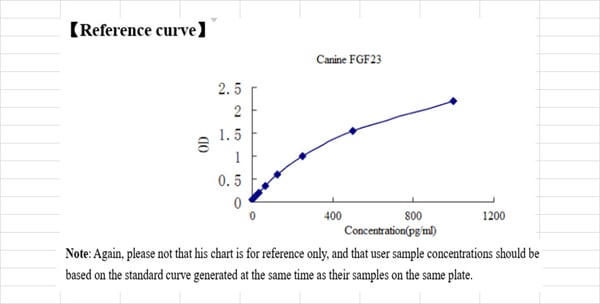
1000 pg/mL-15.6 pg/mL
Sensitivity
Up to 5 pg/mL
Specificity
No cross-reaction with other factors.
Preparation and Storage
Store all reagents at 2-8 degree C.
Inter-assay Precision
<= 12%
Intra-assay Precision
<= 8%
Molecular Weight
27,954 Da
OMIM
193100
ISO Certification
Manufactured in an ISO 9001:2015 Certified Laboratory.
Other Notes
Small volumes of FGF23 elisa kit vial(s) may occasionally become entrapped in the seal of the product vial during shipment and storage. If necessary, briefly centrifuge the vial on a tabletop centrifuge to dislodge any liquid in the container`s cap. Certain products may require to ship with dry ice and additional dry ice fee may apply.
Searchable Terms for FGF23 purchase
MBS2603786 is a ready-to-use microwell, strip plate ELISA (enzyme-linked immunosorbent assay) Kit for analyzing the presence of the Fibroblast Growth Factor 23 (FGF23) ELISA Kit target analytes in biological samples. The concentration gradients of the kit standards or positive controls render a theoretical kit detection range in biological research samples containing FGF23. The ELISA analytical biochemical technique of the MBS2603786 kit is based on FGF23 antibody-FGF23 antigen interactions (immunosorbency) and an HRP colorimetric detection system to detect FGF23 antigen targets in samples. The ELISA Kit is designed to detect native, not recombinant, FGF23. Appropriate sample types may include undiluted body fluids and/or tissue homogenates, secretions. Quality control assays assessing reproducibility identified the intra-assay CV (%) and inter-assay CV(%).
Additional Details
NCBI/Uniprot data below describe general gene information for FGF23. It may not necessarily be applicable to this product.
NCBI Official Full Name
fibroblast growth factor 23
NCBI Official Synonym Full Names
fibroblast growth factor 23
NCBI Official Symbol
FGF23
NCBI Official Synonym Symbols
ADHR; FGFN; HYPF; HPDR2; PHPTC
UniProt Protein Name
Fibroblast growth factor 23
UniProt Synonym Protein Names
Phosphatonin; Tumor-derived hypophosphatemia-inducing factor
Protein Family
Fibroblast growth factor
UniProt Gene Name
FGF23
UniProt Synonym Gene Names
HYPF; FGF-23
UniProt Entry Name
FGF23_HUMAN
NCBI Protein Information
fibroblast growth factor 23
NCBI Summary for FGF23
This gene encodes a member of the fibroblast growth factor family of proteins, which possess broad mitogenic and cell survival activities and are involved in a variety of biological processes. The product of this gene regulates phosphate homeostasis and transport in the kidney. The full-length, functional protein may be deactivated via cleavage into N-terminal and C-terminal chains. Mutation of this cleavage site causes autosomal dominant hypophosphatemic rickets (ADHR). Mutations in this gene are also associated with hyperphosphatemic familial tumoral calcinosis (HFTC). [provided by RefSeq, Feb 2013]
Show more UniProt Comments for FGF23
FGF23: Regulator of phosphate homeostasis. Inhibits renal tubular phosphate transport by reducing SLC34A1 levels. Upregulates EGR1 expression in the presence of KL. Acts directly on the parathyroid to decrease PTH secretion. Regulator of vitamin-D metabolism. Negatively regulates osteoblast differentiation and matrix mineralization. Defects in FGF23 are the cause of autosomal dominant hypophosphataemic rickets (ADHR). ADHR is characterized by low serum phosphorus concentrations, rickets, osteomalacia, leg deformities, short stature, bone pain and dental abscesses. Defects in FGF23 are a cause of hyperphosphatemic familial tumoral calcinosis (HFTC). HFTC is a severe autosomal recessive metabolic disorder that manifests with hyperphosphatemia and massive calcium deposits in the skin and subcutaneous tissues. Belongs to the heparin-binding growth factors family.
Protein type: Secreted, signal peptide; Secreted; Cytokine
Chromosomal Location of Human Ortholog: 12p13.3
Cellular Component: extracellular region; extracellular space; intracellular
Molecular Function: growth factor activity; type 1 fibroblast growth factor receptor binding
Biological Process: activation of MAPKK activity; axon guidance; cellular phosphate ion homeostasis; epidermal growth factor receptor signaling pathway; fibroblast growth factor receptor signaling pathway; innate immune response; insulin receptor signaling pathway; MAPKKK cascade; negative regulation of bone mineralization; negative regulation of hormone secretion; negative regulation of osteoblast differentiation; nerve growth factor receptor signaling pathway; phosphate ion homeostasis; phosphoinositide-mediated signaling; positive regulation of transcription, DNA-dependent; Ras protein signal transduction; response to magnesium ion; small GTPase mediated signal transduction; vascular endothelial growth factor receptor signaling pathway; vitamin D catabolic process
Disease: Hypophosphatemic Rickets, Autosomal Dominant
Show more Protein type: Secreted, signal peptide; Secreted; Cytokine
Chromosomal Location of Human Ortholog: 12p13.3
Cellular Component: extracellular region; extracellular space; intracellular
Molecular Function: growth factor activity; type 1 fibroblast growth factor receptor binding
Biological Process: activation of MAPKK activity; axon guidance; cellular phosphate ion homeostasis; epidermal growth factor receptor signaling pathway; fibroblast growth factor receptor signaling pathway; innate immune response; insulin receptor signaling pathway; MAPKKK cascade; negative regulation of bone mineralization; negative regulation of hormone secretion; negative regulation of osteoblast differentiation; nerve growth factor receptor signaling pathway; phosphate ion homeostasis; phosphoinositide-mediated signaling; positive regulation of transcription, DNA-dependent; Ras protein signal transduction; response to magnesium ion; small GTPase mediated signal transduction; vascular endothelial growth factor receptor signaling pathway; vitamin D catabolic process
Disease: Hypophosphatemic Rickets, Autosomal Dominant
Precautions
All of MyBioSource's Products are for scientific laboratory research purposes and are not for diagnostic, therapeutics, prophylactic or in vivo use. Through your purchase, you expressly represent and warrant to MyBioSource that you will properly test and use any Products purchased from MyBioSource in accordance with industry standards. MyBioSource and its authorized distributors reserve the right to refuse to process any order where we reasonably believe that the intended use will fall outside of our acceptable guidelines.
Disclaimer
While every efforts were made to ensure the accuracy of the information provided in this datasheet, MyBioSource will not be liable for any omissions or errors contained herein. MyBioSource reserves the right to make changes to this datasheet at any time without prior notice.
It is the responsibility of the customer to report product performance issues to MyBioSource within 30 days of receipt of the product. Please visit our Terms & Conditions page for more information.
It is the responsibility of the customer to report product performance issues to MyBioSource within 30 days of receipt of the product. Please visit our Terms & Conditions page for more information.
Product Note
Select online data sheet information is drawn from bioinformatics databases, occasionally resulting in ambiguous or non-relevant product information. It is the responsibility of the customer to review, verify, and evaluate the information to make sure it matches their requirements before purchasing the kit. Our ELISA Kit assays are dynamic research tools and sometimes they may be updated and improved. If the format of this assay is important to you then please request the current manual or contact our technical support team with a presales inquiry before placing an order. We will confirm the current details of the assay. We cannot guarantee the sample manual posted online is the most current manual, it is intended to serve as an example only. Please refer to the instructions For Use provided with the assay kit for precise details.
Product PubMed Publications
Products associated with FGF23 elisa kit
| Reference Product | PubMed Publications |
|---|---|
| PTH elisa kit | >312 publications with FGF23 and PTH |
| PHEX elisa kit | >117 publications with FGF23 and PHEX |
| FGFR1 elisa kit | >57 publications with FGF23 and FGFR1 |
| GALNT3 elisa kit | >51 publications with FGF23 and GALNT3 |
| FGFR4 elisa kit | >15 publications with FGF23 and FGFR4 |
| FGFR3 elisa kit | >14 publications with FGF23 and FGFR3 |
| FGFR2 elisa kit | >11 publications with FGF23 and FGFR2 |
| FGF1 elisa kit | >8 publications with FGF23 and FGF1 |
| FGF9 elisa kit | >5 publications with FGF23 and FGF9 |
Pathways associated with FGF23 elisa kit
| Products by Pathway | Pathway Diagram |
|---|---|
| ARMS-mediated Activation Pathway antibodies | ARMS-mediated Activation Pathway Diagram |
| Activated Point Mutants Of FGFR2 Pathway antibodies | Activated Point Mutants Of FGFR2 Pathway Diagram |
| Adaptive Immune System Pathway antibodies | Adaptive Immune System Pathway Diagram |
| Axon Guidance Pathway antibodies | Axon Guidance Pathway Diagram |
| Constitutive Signaling By Aberrant PI3K In Cancer Pathway antibodies | Constitutive Signaling By Aberrant PI3K In Cancer Pathway Diagram |
| Cytokine Signaling In Immune System Pathway antibodies | Cytokine Signaling In Immune System Pathway Diagram |
| DAP12 Interactions Pathway antibodies | DAP12 Interactions Pathway Diagram |
| DAP12 Signaling Pathway antibodies | DAP12 Signaling Pathway Diagram |
| Developmental Biology Pathway antibodies | Developmental Biology Pathway Diagram |
| Disease Pathway antibodies | Disease Pathway Diagram |
Diseases associated with FGF23 elisa kit
| Disease Name | Pubmed Publications |
|---|---|
| Kidney Diseases Antibodies | >561 publications with FGF23 and Kidney Diseases |
| Rickets Antibodies | >309 publications with FGF23 and Rickets |
| Phosphorus Metabolism Disorders Antibodies | >307 publications with FGF23 and Phosphorus Metabolism Disorders |
| Renal Insufficiency Antibodies | >266 publications with FGF23 and Renal Insufficiency |
| Hyperphosphatemia Antibodies | >180 publications with FGF23 and Hyperphosphatemia |
| Calcinosis Antibodies | >132 publications with FGF23 and Calcinosis |
| Hypertension Antibodies | >104 publications with FGF23 and Hypertension |
| Hypertrophy Antibodies | >59 publications with FGF23 and Hypertrophy |
| Death Antibodies | >55 publications with FGF23 and Death |
| Osteoporosis Antibodies | >42 publications with FGF23 and Osteoporosis |
Organs/Tissues associated with FGF23 elisa kit
| Organ/Tissue Name | Pubmed Publications |
|---|---|
| Embryonic Tissue Antibodies | >17 publications with FGF23 and Embryonic Tissue |
| Testis Antibodies | >2 publications with FGF23 and Testis |