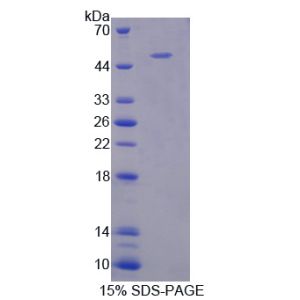
CD80 Antibody

Référence OAEE00979
Conditionnement : 100tests(T100)
Marque : Aviva Systems Biology
Contactez votre distributeur local :

Téléphone : +1 850 650 7790

| Datasheets/Manuals | Printable datasheet for CD80 Antibody |
|---|
| Predicted Species Reactivity | Human |
|---|---|
| Product Format | Stabilizing phosphate buffered saline (PBS), pH 7.4, 15 mM sodium azide |
| Clonality | Monoclonal |
| Clone | MEM-233 |
| Isotype | IgG1 |
| Host | Mouse |
| Conjugation | PerCP |
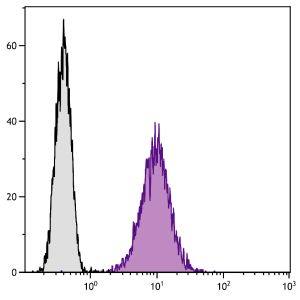
| Application | FC |
| Reconstitution and Storage | 2°C to 8°C |
| Immunogen | Extracellular domain of human CD80 fused to human IgG1(Fc) |
| Purification | Purified by size-exclusion chromatography |
| Concentration | 10 ul / test |
| Specificity | The antibody MEM-233 reacts with CD80 (B7-1), a 60 kDa single chain type I glycoprotein of immunoglobulin supergene family, expressed on professional antigen-presenting cells, such as dendritic cells, macrophages or activated B lymphocytes. |
| Formulation | PerCP |
| Storage Buffer | The reagent is provided in phosphate buffered saline (PBS) containing 15 mM sodium azide and 0.2% (w/v) high-grade protease free Bovine Serum Albumin (BSA) as a stabilizing agent. |
| Reference | Silk KM, Leishman AJ, Nishimoto KP, Reddy A, Fairchild PJ: Rapamycin Conditioning of dendritic cells differentiated from human ES cells promotes a tolerogenic phenotype. J. Biomed. Biotechnol., vol. 2012, article ID 172420, 11 pages, doi:10.1155/2012/172420 Immunolipoplexes: an efficient, nonviral alternative for transfection of human dendritic cells with potential for clinical vaccination. Mol Ther. 2005 May;11(5):790-800. Hovden AO, Karlsen M, Jonsson R, Aarstad HJ, Appel S: Maturation of monocyte derived dendritic cells with OK432 boosts IL-12p70 secretion and conveys strong T-cell responses. BMC Immunol. 2011 Jan 5;12:2. Campioni D, Moretti S, Ferrari L, Punturieri M, Castoldi GL, Lanza F: Immunophenotypic heterogeneity of bone marrow-derived mesenchymal stromal cells from patients with hematologic disorders: correlation with bone marrow microenvironment. Haematologica. 2006 Mar;91(3):364-8. Lee DJ, Sieling PA, Ochoa MT, Krutzik SR, Guo B, Hernandez M, Rea TH, Cheng G, Colonna M, Modlin RL: LILRA2 activation inhibits dendritic cell differentiation and antigen presentation to T cells. J Immunol. 2007 Dec 15;179(12):8128-36. Kolar GR, Mehta D, Pelayo R, Capra JD: A novel human B cell subpopulation representing the initial germinal centerpopulation to express AID. Blood. 2007 Mar 15;109(6):2545-52. Zhan H, Towler HM, Calder VL: The immunomodulatory role of human conjunctival epithelial cells. Invest Ophthalmol Vis Sci. 2003 Sep;44(9):3906-10. Vasilevko V, Ghochikyan A, Holterman MJ, Agadjanyan MG: CD80 (B7-1) and CD86 (B7-2) are functionally equivalent in the initiation and maintenance of CD4+ T-cell proliferation after activation with suboptimal dosesof PHA. DNA Cell Biol. 2002 Mar;21(3):137-49. Eri R, Kodumudi KN, Summerlin DJ, Srinivasan M. Suppression of colon inflammation by CD80 blockade: Evaluation in two murine models of inflammatory bowel disease. Inflamm Bowel Dis. 2008 Jan 9 Thomas IJ, Petrich de Marquesini LG, Ravanan R, Smith RM, Guerder S, Flavell RA, Wraith DC, Wen L, Wong FS. CD86 has sustained costimulatory effects on CD8 T cells.J Immunol. 2007 Nov 1;179(9):5936-46. Yadav D, Judkowski V, Flodstrom-Tullberg M, Sterling L, Redmond WL, Sherman L, Sarvetnick N. B7-2 (CD86) controls the priming of autoreactive CD4 T cell response against pancreatic islets. J Immunol. 2004 Sep 15;173(6):3631-9. |
|---|---|
| Gene Symbol | CD80 |
| Gene Full Name | CD80 molecule |
| Alias Symbols | activation B7-1 antigen, B-lymphocyte activation antigen B7, B7, B7-1, B7.1, BB1, CD28LG, CD28LG1, CD80 antigen (CD28 antigen ligand 1, B7-1 antigen), costimulatory factor CD80, costimulatory molecule variant IgV-CD80, CTLA-4 counter-receptor B7.1, LAB7, T-lymphocyte activation antigen CD80. |
| NCBI Gene Id | 941 |
| Protein Name | T-lymphocyte activation antigen CD80 |
| Description of Target | Involved in the costimulatory signal essential for T-lymphocyte activation. T-cell proliferation and cytokine production is induced by the binding of CD28, binding to CTLA-4 has opposite effects and inhibits T-cell activation. |
| Uniprot ID | P33681 |
| Protein Accession # | NP_005182.1 |
| Nucleotide Accession # | NM_005191.3 |