Biovalley > CTNNB1 Capture Antibody
CTNNB1 Capture Antibody

Référence OAOA21489
Conditionnement : 100µg
Contactez votre distributeur local :

Téléphone : +1 850 650 7790
Marque : Aviva Systems Biology
Contactez votre distributeur local :
Téléphone : +1 850 650 7790
Bulk
Order
Order
Aviva's
Satisfaction
Guarantee
Satisfaction
Guarantee
Contact Us:
- Toll Free: 888-880-0001
- Phone: 858-552-6979
- Email: info@avivasysbio.com
Shipping Info:
- : Antibody & Protein in US
- + /Kit in US
- Contact us for international orders.
CTNNB1 Capture Antibody (OAOA21489)
| Datasheets/Manuals | Printable datasheet for CTNNB1 Capture Antibody (OAOA21489) |
|---|
| Predicted Species Reactivity | Dog|Human|Monkey|Mouse|Rat |
|---|---|
| Product Format | Stored in PBS (pH 7.4) containing 0.05% sodium azide and up to 5% trehalose |
| Clonality | Monoclonal |
| Clone | OTI2H3 |
| Isotype | IgG2a |
| Host | Mouse |
| Application | ELISA|MlpxA |
| Additional Information | Matched ELISA Pair: OAOA21950 |
| Reconstitution and Storage | -20°C |
| Immunogen | Full length human recombinant protein of human CTNNB1 (NP_001895) produced in HEK293T cell. |
| Concentration | 0.5 mg/ml |
| Dilution | 1:100 - 1:1000 |
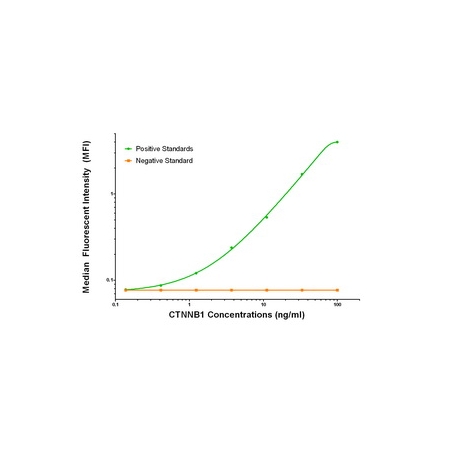
| Description | CTNNB1 mouse monoclonal capture antibody, validated for Luminex assays |
| Gene Symbol | CTNNB1 |
|---|---|
| Gene Full Name | catenin beta 1 |
| Alias Symbols | armadillo, Beta-catenin, catenin (cadherin-associated protein), beta 1, 88kDa, catenin beta-1, CTNNB, EVR7, MRD19, NEDSDV. |
| NCBI Gene Id | 1499 |
| Protein Name | Catenin beta-1|Homo sapiens catenin beta 1 (CTNNB1), transcript variant 1, mRNA |
| Description of Target | Key downstream component of the canonical Wnt signaling pathway. In the absence of Wnt, forms a complex with AXIN1, AXIN2, APC, CSNK1A1 and GSK3B that promotes phosphorylation on N-terminal Ser and Thr residues and ubiquitination of CTNNB1 via BTRC and its subsequent degradation by the proteasome. In the presence of Wnt ligand, CTNNB1 is not ubiquitinated and accumulates in the nucleus, where it acts as a coactivator for transcription factors of the TCF/LEF family, leading to activate Wnt responsive genes. Involved in the regulation of cell adhesion, as component of an E-cadherin:catenin adhesion complex. Acts as a negative regulator of centrosome cohesion. Involved in the CDK2/PTPN6/CTNNB1/CEACAM1 pathway of insulin internalization. Blocks anoikis of malignant kidney and intestinal epithelial cells and promotes their anchorage-independent growth by down-regulating DAPK2. Disrupts PML function and PML-NB formation by inhibiting RANBP2-mediated sumoylation of PML (PubMed:17524503, PubMed:18077326, PubMed:18086858, PubMed:18957423, PubMed:21262353, PubMed:22647378, PubMed:22699938, PubMed:22155184). Promotes neurogenesis by maintaining sympathetic neuroblasts within the cell cycle (By similarity). |
| Uniprot ID | P35222 |
| Protein Accession # | NP_001895 |
| Nucleotide Accession # | https://www.ncbi.nlm.nih.gov/nuccore/NM_001904 |