

Dithiothreitol (DTT)

Référence MBS6085050-25g
Conditionnement : 25g
Marque : MyBiosource
Contactez votre distributeur local :
 Téléphone : +1 850 650 7790
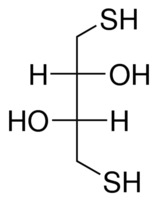
Cleland's reagent;; (2R,3R)-rel-1,4-Dimercapto-2,3-butanediol; (±)-1,4-Dimercapto-2,3-butanediol; (±)-Dithiothreitol; 1,4-Dithio-DL-threitol; 1,4-Dithiothreitol; DL-1,4-Dimercapto-2,3-dihydroxybutane; DL-1,4-Dithiothreitol; DL-Dithiothreitol; Sputolysin; WR 34678; threo-1,4-Dimercapto-2,3-butanediol; threo-2,3-Dihydroxy-1,4-butanedithiol; threo-2,3-Dihydroxy-1,4-dithiolbutane
Dithiothreitol (DTT)
For Research Use Only. Not for use in diagnostic procedures. Catalog #: MBS6085050Dithiothreitol (DTT) is the common name for a small-molecule redox reagent known as Cleland's reagent. DTT's oxidized form is a disulfide-bonded 6-membered ring. Its name derives from the four-carbon sugar, threose. DTT has an epimeric ('sister') compound,… More details
Product Overview
Product Name
Dithiothreitol, Biochemical
Full Product Name
Dithiothreitol (DTT)
Form/Format
White crystalline powder
Purity/Purification
Molecular Biology Grade
0.99
0.99
Preparation and Storage
4 degree C
Molecular Weight
154.24
CAS Number
3483-12-3
Molecular Formula
C4H10O2S2
Melting Point
39.5-44 degree C
Product Categories/Family for Dithiothreitol biochemical
Application Notes for Dithiothreitol biochemical
A common use of DTT is as a reducing or "deprotecting" agent for thiolated DNA. The terminal sulfur atoms of thiolated DNA have a tendency to form dimers in solution, especially in the presence of oxygen. Dimerization greatly lowers the efficiency of subsequent coupling reactions such as DNA immobilization on gold in biosensors. Typically DTT is mixed with a DNA solution and allowed to react, and then is removed by filtration (for the solid catalyst) or by chromatography (for the liquid form). The DTT removal procedure is often called "desalting.", DTT is frequently used to reduce the disulfide bonds of proteins and, more generally, to prevent intramolecular and intermolecular disulfide bonds from forming between cysteine residues of proteins. However, even DTT cannot reduce buried (solvent-inaccessible) disulfide bonds, so reduction of disulfide bonds is sometimes carried out under denaturing conditions (e.g., at high temperatures, or in the presence of a strong denaturant such as 6M guanidinium hydrochloride, 8M urea, or 1% sodium dodecylsulfate). Conversely, the solvent exposure of different disulfide bonds can be assayed by their rate of reduction in the presence of DTT., DTT can also be used as an oxidizing agent. Its principal advantage is that effectively no mixed-disulfide species are populated, in contrast to other agents such as glutathione. In very rare cases, a DTT adduct may be formed, i.e., the two sulfur atoms of DTT may form disulfide bonds to different sulfur atoms; in such cases, DTT cannot cyclize since it has no remaining free thiols., Due to air oxidation, DTT is a relatively unstable compound whose useful life can be extended by refrigeration and handling in an inert atmosphere. Since protonated sulfurs have lowered nucleophilicities, DTT becomes less potent as the pH lowers. Tris(2-carboxyethyl)phosphine HCl (TCEP hydrochloride) is an alternative which is more stable and works even at low pH.
Testing Data of Dithiothreitol biochemical
Cleland's reagent;; (2R,3R)-rel-1,4-Dimercapto-2,3-butanediol; (±)-1,4-Dimercapto-2,3-butanediol; (±)-Dithiothreitol; 1,4-Dithio-DL-threitol; 1,4-Dithiothreitol; DL-1,4-Dimercapto-2,3-dihydroxybutane; DL-1,4-Dithiothreitol; DL-Dithiothreitol; Sputolysin; WR 34678; threo-1,4-Dimercapto-2,3-butanediol; threo-2,3-Dihydroxy-1,4-butanedithiol; threo-2,3-Dihydroxy-1,4-dithiolbutane
Other Notes
Small volumes of Dithiothreitol biochemical vial(s) may occasionally become entrapped in the seal of the product vial during shipment and storage. If necessary, briefly centrifuge the vial on a tabletop centrifuge to dislodge any liquid in the container`s cap. Certain products may require to ship with dry ice and additional dry ice fee may apply.
Searchable Terms for Dithiothreitol purchase
MBS6085050 is a biochemical targeting Dithiothreitol. Also known as Dithiothreitol (DTT).