ERBB2 Detection Antibody

Référence OAOA22083
Conditionnement : 50µg
Marque : Aviva Systems Biology
Contactez votre distributeur local :

Téléphone : +1 850 650 7790
ERBB2 Detection Antibody : Biotin (OAOA22083)
| Datasheets/Manuals | Printable datasheet for ERBB2 Detection Antibody : Biotin (OAOA22083) |
|---|
| Predicted Species Reactivity | Human|Mouse|Rat |
|---|---|
| Product Format | Stored in PBS (pH 7.4) with 0.05% sodium azide, 10mg/ml BSA, 50% glycerol |
| Clonality | Monoclonal |
| Clone | OTI3F11 |
| Isotype | IgG1 |
| Host | Mouse |
| Conjugation | Biotin |
| Application | MlpxA |
| Additional Information | Matched ELISA Pair: OAOA21624 |
| Reconstitution and Storage | -20°C |
| Immunogen | Full length human recombinant protein of human ERBB2 (NM_004448) produced in HEK293T cell. |
| Concentration | 0.5 mg/ml |
| Dilution | 1:250 - 1:1000 |
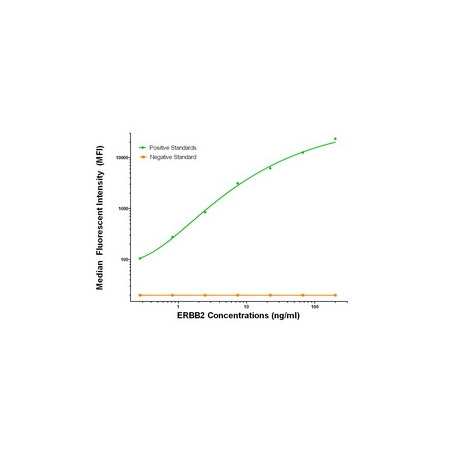
| Description | ERBB2 biotinylated mouse monoclonal detection antibody, validated for Luminex assays |
| Gene Symbol | ERBB2 |
|---|---|
| Gene Full Name | erb-b2 receptor tyrosine kinase 2 |
| Alias Symbols | c-erb B2/neu protein, CD340, HER-2, HER-2/neu, HER2, herstatin, human epidermal growth factor receptor 2, metastatic lymph node gene 19 protein, MLN 19, NEU, neuro/glioblastoma derived oncogene homolog, neuroblastoma/glioblastoma derived oncogene homolog, NGL, p185erbB2, proto-oncogene c-ErbB-2, proto-oncogene Neu, receptor tyrosine-protein kinase erbB-2, TKR1, tyrosine kinase-type cell surface receptor HER2, v-erb-b2 avian erythroblastic leukemia viral oncogene homolog 2, v-erb-b2 avian erythroblastic leukemia viral oncoprotein 2, v-erb-b2 erythroblastic leukemia viral oncogene homolog 2, neuro/glioblastoma derived oncogene homolog, VSCN2. |
| NCBI Gene Id | 2064 |
| Protein Name | Homo sapiens erb-b2 receptor tyrosine kinase 2 (ERBB2), transcript variant 1, mRNA|Receptor tyrosine-protein kinase erbB-2 |
| Description of Target | Protein tyrosine kinase that is part of several cell surface receptor complexes, but that apparently needs a coreceptor for ligand binding. Essential component of a neuregulin-receptor complex, although neuregulins do not interact with it alone. GP30 is a potential ligand for this receptor. Regulates outgrowth and stabilization of peripheral microtubules (MTs). Upon ERBB2 activation, the MEMO1-RHOA-DIAPH1 signaling pathway elicits the phosphorylation and thus the inhibition of GSK3B at cell membrane. This prevents the phosphorylation of APC and CLASP2, allowing its association with the cell membrane. In turn, membrane-bound APC allows the localization of MACF1 to the cell membrane, which is required for microtubule capture and stabilization. |
| Uniprot ID | P04626 |
| Protein Accession # | NP_004439 |
| Nucleotide Accession # | https://www.ncbi.nlm.nih.gov/nuccore/NM_004448 |