



Inquiry
Dispatch Time: About 3 working days
- Product Name
- FineTest®700 Anti-Mouse CD1d Antibody(19G11)
- Catalogue No.
- F700-30200
- Form
- liquid
- Conjugation
- FineTest®700
- Conjugation Information
- FineTest® 700 is designed to be excited by the Red laser (627-640 nm) and detected using an optical filter centered near 719 nm (e.g., a 725/40 nm bandpass filter).
- Clonality
- Monoclonal
- Isotype
- IgG2b, κ
- Clone ID
- 19G11
- Storage
- PBS with 0. 1% sodium azide, 1%BSA, pH 7.3, 2-8℃ for 12 months (Avoid repeated freeze / thaw cycles.)
Immunogen
- Alternative Names
- Antigen-presenting glycoprotein CD1d1|CD1d.1|Cd1.1|Cd1d1 antibody
- UniProt ID
- P11609
Application
- Tested Applications
- FC
- Recommended dilution
- Volume per test: 5μL. Each lot of this antibody is quality control tested by flow cytometric analysis. The amount of the reagent is suggested to be used 5 µL of antibody per test (million cells in 100 µL staining volume or per 100 µL of whole blood). Please check your vial before the experiment. Since applications vary, the appropriate dilutions must be determined for individual use.
Validated Images
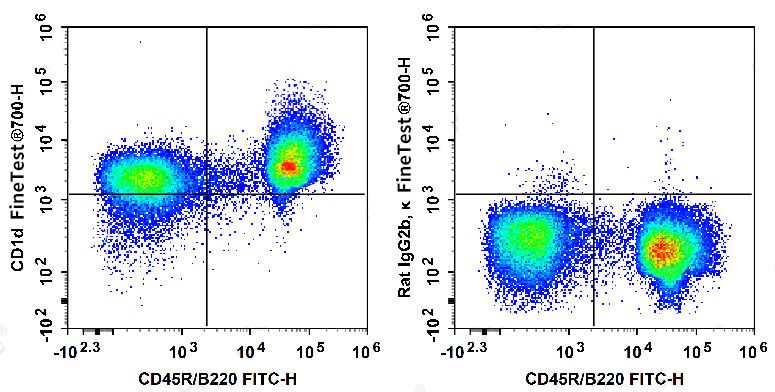 Staining of C57BL/6 murine splenocytes with FITC Anti-Mouse CD45R/B220 Antibody(RA3.3A 1/6.1) and FineTest®700 Anti-Mouse CD1d Antibody(19G11)(left) or FineTest®700 Rat IgG2b, κ Isotype Control(right). Total viable cells were used for analysis.
 - Background
- CD1d is a type I transmembrane protein and member of the MHC family, with a molecular weight ranging from 43-49 kD, depending on the glycosylation degree. CD1d is expressed by antigen presenting cells such as dendritic cells, monocytes, macrophages and B cells; also expressed by thymocytes and intestinal epithelial cells. CD1d present glycolipids to iNKT cells that recognize them by their Vα14i TCR.