

High Mobility Group Protein B1 (HMGB1) (Biotin)

Référence MBS6249005-5x0,1mL
Conditionnement : 5x0.1mL
Marque : MyBiosource
Contactez votre distributeur local :

Téléphone : +1 850 650 7790
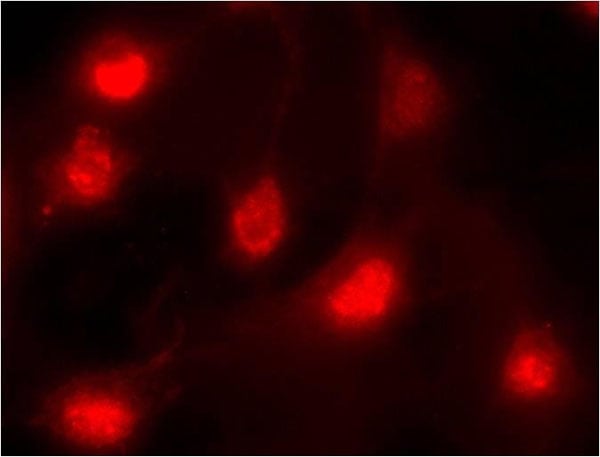
mmunofluorescence staining of PFA fixed permeablized NIH-3T3 cells with Hamster anti Mouse high mobility group protein B1, signal was visualized using Goat anti Hamster IgG:biotin followed by streptavidin:
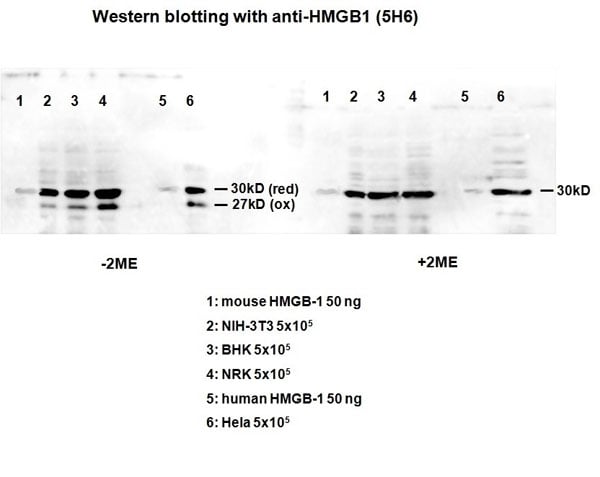
Western Blotting analysis of proteins and cell line lysates probed with Hamster anti Mouse high mobility group protein B1
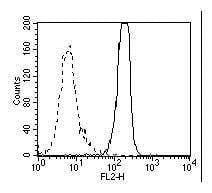
Staining of permeablized RAW264.7 cells with Hamster anti Mouse high mobility group protein B1 followed by Goat anti Hamster IgG:PE
High Mobility Group Protein B1 (HMGB1) Antibody – Hamster Monoclonal
For Research Use Only. Not for use in diagnostic procedures. Catalog #: MBS6249005MBS6249005 is an antibody targeting HMGB1. Also known as High Mobility Group Protein B1 (HMGB1) (Biotin). Reactive in Hamster, Human, Mouse, Rat. Host: Hamster. More details
Product Overview
Online Datasheet in PDFProduct Name
High Mobility Group Protein B1 (HMGB1), Monoclonal Antibody
Full Product Name
High Mobility Group Protein B1 (HMGB1) (Biotin)
Product Gene Name
anti-HMGB1 antibody
Clonality
Monoclonal
Isotype
IgG
Clone Number
HMG1-5H6
Host
Hamster
Species Reactivity
Hamster, Human, Mouse, Rat
Form/Format
Supplied as a liquid in PBS, pH 7.2. Labeled with Biotin.
Purity/Purification
Purified by Protein G Affinity Chromatography
Specificity
Recognizes mouse High Mobility Group Protein B1. Species Crossreactivity: Rat, human and hamster
Preparation and Storage
Store at -20 degree C.
Applications Tested/Suitable for anti-HMGB1 antibody
Flow Cytometry (FC/FACS), Immunofluorescence (IF), Western Blot (WB)
Product References and Citations for anti-HMGB1 antibody
1. Lange, S.S. et al (2009) HMGB1: the jack-of-all-trades protein is a master DNA repair mechanic. Mol Carcinog. 48: 571-80.
Other Notes
Small volumes of anti-HMGB1 antibody vial(s) may occasionally become entrapped in the seal of the product vial during shipment and storage. If necessary, briefly centrifuge the vial on a tabletop centrifuge to dislodge any liquid in the container`s cap. Certain products may require to ship with dry ice and additional dry ice fee may apply.
Additional Details
NCBI/Uniprot data below describe general gene information for HMGB1. It may not necessarily be applicable to this product.
NCBI Official Full Name
high mobility group protein B1
NCBI Official Synonym Full Names
high mobility group box 1
NCBI Official Symbol
Hmgb1
NCBI Official Synonym Symbols
p30; Hmg1; HMG-1; SBP-1
UniProt Protein Name
High mobility group protein B1
UniProt Synonym Protein Names
High mobility group protein 1; HMG-1
Protein Family
High mobility group B protein
UniProt Gene Name
Hmgb1
UniProt Synonym Gene Names
Hmg-1; Hmg1; HMG-1
NCBI Protein Information
high mobility group protein B1
NCBI Summary for HMGB1
This gene encodes a protein that belongs to the High Mobility Group-box superfamily. The encoded non-histone, nuclear DNA-binding protein regulates transcription, and is involved in organization of DNA. This protein plays a role in several cellular processes, including inflammation, cell differentiation and tumor cell migration. Multiple pseudogenes of this gene have been identified. Alternative splicing results in multiple transcript variants that encode the same protein. [provided by RefSeq, Sep 2015]
Show more UniProt Comments for HMGB1
Multifunctional redox sensitive protein with various roles in different cellular compartments. In the nucleus is one of the major chromatin-associated non-histone proteins and acts as a DNA chaperone involved in replication, transcription, chromatin remodeling, V(D)J recombination, DNA repair and genome stability. Proposed to be an universal biosensor for nucleic acids. Promotes host inflammatory response to sterile and infectious signals and is involved in the coordination and integration of innate and adaptive immune responses. In the cytoplasm functions as sensor and/or chaperone for immunogenic nucleic acids implicating the activation of TLR9-mediated immune responses, and mediates autophagy. Acts as danger associated molecular pattern (DAMP) molecule that amplifies immune responses during tissue injury. Released to the extracellular environment can bind DNA, nucleosomes, IL-1 beta, CXCL12, AGER isoform 2/sRAGE, lipopolysaccharide (LPS) and lipoteichoic acid (LTA), and activates cells through engagement of multiple surface receptors. In the extracellular compartment fully reduced HMGB1 (released by necrosis) acts as a chemokine, disulfide HMGB1 (actively secreted) as a cytokine, and sulfonyl HMGB1 (released from apoptotic cells) promotes immunological tolerance (PubMed:23519706, PubMed:23446148, PubMed:23994764, PubMed:25048472). Has proangiogenic activity (PubMed:16365390). May be involved in platelet activation. Binds to phosphatidylserine and phosphatidylethanolamide. Bound to RAGE mediates signaling for neuronal outgrowth. May play a role in accumulation of expanded polyglutamine (polyQ) proteins ().
Show more Precautions
All of MyBioSource's Products are for scientific laboratory research purposes and are not for diagnostic, therapeutics, prophylactic or in vivo use. Through your purchase, you expressly represent and warrant to MyBioSource that you will properly test and use any Products purchased from MyBioSource in accordance with industry standards. MyBioSource and its authorized distributors reserve the right to refuse to process any order where we reasonably believe that the intended use will fall outside of our acceptable guidelines.
Disclaimer
While every efforts were made to ensure the accuracy of the information provided in this datasheet, MyBioSource will not be liable for any omissions or errors contained herein. MyBioSource reserves the right to make changes to this datasheet at any time without prior notice.
It is the responsibility of the customer to report product performance issues to MyBioSource within 30 days of receipt of the product. Please visit our Terms & Conditions page for more information.
It is the responsibility of the customer to report product performance issues to MyBioSource within 30 days of receipt of the product. Please visit our Terms & Conditions page for more information.
Product Note
Select online data sheet information is drawn from bioinformatics databases, occasionally resulting in ambiguous or non-relevant product information. It is the responsibility of the customer to review, verify, and evaluate the information to make sure it matches their requirements before purchasing the kit. Our ELISA Kit assays are dynamic research tools and sometimes they may be updated and improved. If the format of this assay is important to you then please request the current manual or contact our technical support team with a presales inquiry before placing an order. We will confirm the current details of the assay. We cannot guarantee the sample manual posted online is the most current manual, it is intended to serve as an example only. Please refer to the instructions For Use provided with the assay kit for precise details.
Product PubMed Publications
Products associated with anti-HMGB1 antibody
| Reference Product | PubMed Publications |
|---|---|
| Tlr4 antibody | >547 publications with HMGB1 and Tlr4 |
| Hmgb2 antibody | >260 publications with HMGB1 and Hmgb2 |
| Ager antibody | >44 publications with HMGB1 and Ager |
| Rela antibody | >39 publications with HMGB1 and Rela |
| S100b antibody | >30 publications with HMGB1 and S100b |
| Ikbkb antibody | >17 publications with HMGB1 and Ikbkb |
| Trp53 antibody | >16 publications with HMGB1 and Trp53 |
| Chuk antibody | >5 publications with HMGB1 and Chuk |
| Nfkb1 antibody | >5 publications with HMGB1 and Nfkb1 |
| Nfkb2 antibody | >1 publications with HMGB1 and Nfkb2 |
Pathways associated with anti-HMGB1 antibody
| Products by Pathway | Pathway Diagram |
|---|---|
| Activated TLR4 Signalling Pathway antibodies | Activated TLR4 Signalling Pathway Diagram |
| Activation Of DNA Fragmentation Factor Pathway antibodies | Activation Of DNA Fragmentation Factor Pathway Diagram |
| Advanced Glycosylation Endproduct Receptor Signaling Pathway antibodies | Advanced Glycosylation Endproduct Receptor Signaling Pathway Diagram |
| Apoptosis Pathway antibodies | Apoptosis Pathway Diagram |
| Apoptosis Induced DNA Fragmentation Pathway antibodies | Apoptosis Induced DNA Fragmentation Pathway Diagram |
| Apoptotic Execution Phase Pathway antibodies | Apoptotic Execution Phase Pathway Diagram |
| Base Excision Repair Pathway antibodies | Base Excision Repair Pathway Diagram |
| Base Excision Repair Pathway antibodies | Base Excision Repair Pathway Diagram |
| Cytosolic Sensors Of Pathogen-associated DNA Pathway antibodies | Cytosolic Sensors Of Pathogen-associated DNA Pathway Diagram |
| DEx/H-box Helicases Activate Type I IFN And Inflammatory Cytokines Production Pathway antibodies | DEx/H-box Helicases Activate Type I IFN And Inflammatory Cytokines Production Pathway Diagram |
Diseases associated with anti-HMGB1 antibody
| Disease Name | Pubmed Publications |
|---|---|
| Inflammation Antibodies | >1884 publications with HMGB1 and Inflammation |
| Necrosis Antibodies | >975 publications with HMGB1 and Necrosis |
| Sepsis Antibodies | >610 publications with HMGB1 and Sepsis |
| Disease Models, Animal Antibodies | >564 publications with HMGB1 and Disease Models, Animal |
| Nervous System Diseases Antibodies | >351 publications with HMGB1 and Nervous System Diseases |
| Liver Diseases Antibodies | >264 publications with HMGB1 and Liver Diseases |
| Heart Diseases Antibodies | >186 publications with HMGB1 and Heart Diseases |
| Myocardial Ischemia Antibodies | >145 publications with HMGB1 and Myocardial Ischemia |
| Kidney Diseases Antibodies | >127 publications with HMGB1 and Kidney Diseases |
| Fibrosis Antibodies | >124 publications with HMGB1 and Fibrosis |
Organs/Tissues associated with anti-HMGB1 antibody
| Organ/Tissue Name | Pubmed Publications |
|---|---|
| Liver Antibodies | >550 publications with HMGB1 and Liver |
| Lung Antibodies | >526 publications with HMGB1 and Lung |
| Brain Antibodies | >432 publications with HMGB1 and Brain |
| Heart Antibodies | >249 publications with HMGB1 and Heart |
| Muscle Antibodies | >244 publications with HMGB1 and Muscle |
| Kidney Antibodies | >223 publications with HMGB1 and Kidney |
| Bone Antibodies | >182 publications with HMGB1 and Bone |
| Intestine Antibodies | >127 publications with HMGB1 and Intestine |
| Thymus Antibodies | >106 publications with HMGB1 and Thymus |
| Bone Marrow Antibodies | >99 publications with HMGB1 and Bone Marrow |