Hsp25/Hsp27 Antibody

Référence OASE00024
Conditionnement : 100ug
Marque : Aviva Systems Biology
Contactez votre distributeur local :

Téléphone : +1 850 650 7790
Hsp25/Hsp27 Antibody (OASE00024)
| Datasheets/Manuals | Printable datasheet for Hsp25/Hsp27 Antibody (OASE00024) |
|---|---|
| COA Datasheet | A 1:5000 dilution of SMC-114 was sufficient for detection of HSP27 in 20 µg of HeLa cell lysate by ECL immunoblot analysis. |
| Predicted Species Reactivity | Bovine|Dog|Guinea Pig|Hamster|Human|Mouse|Rat|Sheep |
|---|---|
| Product Format | Liquid. In PBS, 50% glycerol. |
| Clonality | Monoclonal |
| Clone | 8A7 |
| Isotype | IgG1 Kappa |
| Host | Mouse |
| Conjugation | Unconjugated |
| Application | FACS,FC,ICC,IF,IHC,IP,WB |
| :: | Certificate of Analysis: A 1:5000 dilution was sufficient for detection of hsp27 in 20ug of HeLa cell lysate by ECL immunoblot analysis. |
| Reconstitution and Storage | -20°C |
| Immunogen | Human HSP27 peptide |
| Purification | Protein G Purified |
| Concentration | 1 mg/ml |
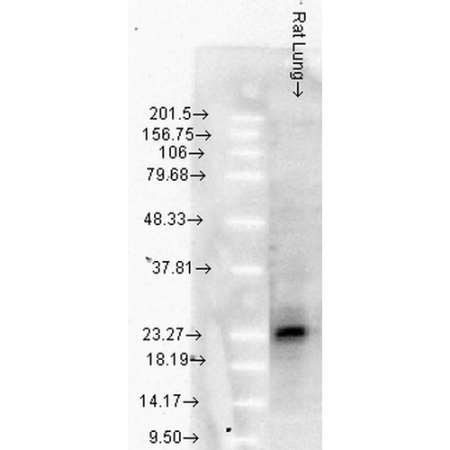
| Specificity | Detects ~25kDa or ~27kDa. Recognizes HSP25 and HSP27, cross reacts with alpha B crystallin. |
| Dilution | WB (1:5000), ICC/IF (1:200), IHC (1:100); optimal dilutions for assays should be determined by the user. |
| Storage Buffer | PBS, 50% glycerol, 0.09% sodium azide |
| Description | HSP25 is the mouse homologue of the human HSP27 protein, a member of the small heat shock protein family comprised of a diverse group of proteins from ~15 to >30kDa(1). The basic structure of most sHSPs is a homologous and highly conserved amino acid sequence, with an α-crystallin-domain at the C-terminus and the WD/EPF domain at the less conserved N-terminus. This N-terminus is essential for the development of high molecular oligomers (2, 3). HSP27-oligomers consist of stable dimers formed by as many as 8-40 HSP27 protein monomers (4). The oligomerization status is connected with the chaperone activity: aggregates of large oligomers have high chaperone activity, whereas dimers have no chaperone activity (5). HSP27 is localized to the cytoplasm of unstressed cells but can redistribute to the nucleus in response to stress, where it may function to stabilize DNA and/or the nuclear membrane. It can be rapidly phosphorylated in response to physiological stimuli relevant to the cell type examined. Thus, HSP27 has been suggested to be an important intermediate in second messenger-mediated signaling pathways (6). Other functions include chaperone activity (as mentioned above), thermo-tolerance in vivo, inhibition of apoptosis, and signal transduction. Specifically, in vitro, it acts as an ATP-independent chaperone by inhibiting protein aggregation and by stabilizing partially denatured proteins, which ensures refolding of the HSP70 complex. HSP27 is also involved in the apoptotic signaling pathway because it interferes with the activation of cytochrome c/Apaf-1/dATP complex, thereby inhibiting the activation of procaspase-9. It is also hypothesized that HSP27 may serve some role in cross-bridge formation between actin and myosin (7). And finally, HSP27 is also thought to be involved in the process of cell differentiation. The up-regulation of HSP27 correlates with the rate of phosphorylation and with an increase of large oligomers. It is possible that HSP27 may play a crucial role in termination of growth (8). For more information visit our HSP27 Scientific Resource Guide at http://www.HSP27.com. |
| Reference | 1. Welch W.J. (1985) J Biol. Chem. 260: 3058-3062. 2.Kim K.K., Kim R., and Kim S. (1998) Nature 394(6693): 595-599. 3. Van Montfort R., Slingsby C., and Vierling E. (2001) Addv Protein Chem. 59: 105-56. 4. Ehrnsperger M., Graber S., Gaestel M. and Buchner J. (1997) EMBO J. 16: 221-229. 5. Ciocca D.R., Oesterreich S., Chamness G.C., McGuire W.L., and Fugua S.A. (1993) J Natl Cancer Inst. 85 (19): 1558-70. 6. Welsh M.J., Wu W., Parvinem M., and Gilmont R.R. (1996) Biol. Of Reprod. 55: 141-151. 7. Sarto C. Binnz P.A. and Mocarelli P. (2000) Electrophoresis. 21(6): 1218-26. 8. Arrigo A.P. (2005) J Cell Biochem. 94(2): 241-6. 9. Jia, Y. et al. (2001) J. Biol. Chem. 276(43):39911-39918. |
|---|---|
| Gene Symbol | HSPB1 |
| Gene Full Name | heat shock protein family B (small) member 1 |
| Alias Symbols | 28 kDa heat shock protein, CMT2F, epididymis secretory protein Li 102, estrogen-regulated 24 kDa protein, heat shock 27 kDa protein, heat shock 27kD protein 1, heat shock 27kDa protein 1, heat shock protein beta-1, HEL-S-102, HMN2B, HS.76067, Hsp25, HSP27, HSP28, putative heat shock protein family B member 1 isoform, SRP27, stress-responsive protein 27. |
| NCBI Gene Id | 3315 |
| Protein Name | Heat shock protein beta-1|heat shock protein beta-2 [Homo sapiens] |
| Description of Target | Small heat shock protein which functions as a molecular chaperone probably maintaining denatured proteins in a folding-competent state (PubMed:10383393, PubMed:20178975). Plays a role in stress resistance and actin organization (PubMed:19166925). Through its molecular chaperone activity may regulate numerous biological processes including the phosphorylation and the axonal transport of neurofilament proteins (PubMed:23728742). |
| Uniprot ID | P04792 |
| Protein Accession # | https://www.ncbi.nlm.nih.gov/protein/NP_001532.1 |
| Molecular Weight | 25 or 27 kD |