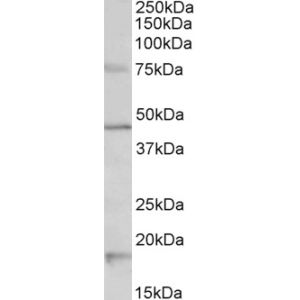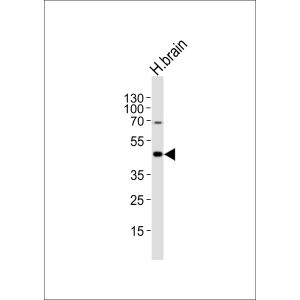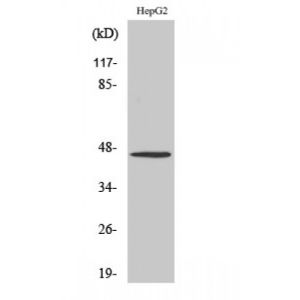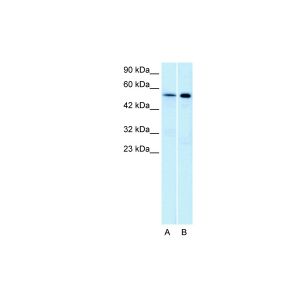

HTR1A Antibody - middle region

Référence OAGA02367
Conditionnement : 100ul
Marque : Aviva Systems Biology
Contactez votre distributeur local :
 Téléphone : +1 850 650 7790
HTR1A Antibody - middle region (OAGA02367)
| Datasheets/Manuals | Printable datasheet for HTR1A Antibody - middle region (OAGA02367) |
|---|
| Predicted Species Reactivity | Human|Mouse |
|---|---|
| Product Format | Liquid |
| Clonality | Polyclonal |
| Isotype | IgG |
| Host | Rabbit |
| Conjugation | Unconjugated |
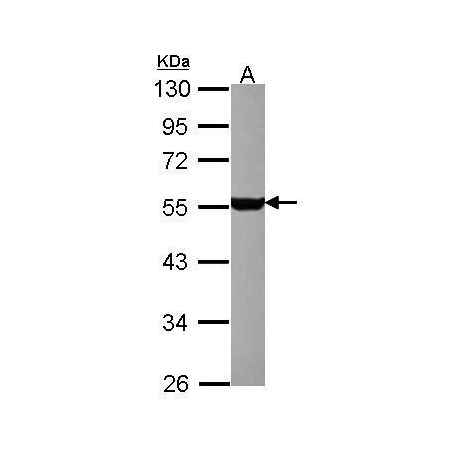
| Application | ICC|IF|IHC-Fr|WB |
| Reconstitution and Storage | -20°C or -80°C|2°C to 8°C |
| Immunogen | Synthetic peptide encompassing a sequence within the Intracellular domain of human 5HT1A Receptor. The exact sequence is proprietary. |
| Purification | Affinity Purified |
| Concentration | 1.03 mg/ml |
| Application Info | WB: 1:500~3000 ICC/IF: 1:100~1000 IHC-P: 1:100~1000 IHC-F: 1:100~1000 |
| Gene Symbol | HTR1A |
|---|---|
| Gene Full Name | 5-hydroxytryptamine (serotonin) receptor 1A, G protein-coupled |
| Alias Symbols | 5-HT-1A, 5-HT1A, 5-HT1a receptor, 5-hydroxytryptamine (serotonin) receptor 1A, G protein-coupled, 5-hydroxytryptamine receptor 1A, 5HT1a, ADRB2RL1, ADRBRL1, G-21, guanine nucleotide-binding regulatory protein-coupled receptor, PFMCD, Serotonin receptor 1A. |
| NCBI Gene Id | 3350 |
| Protein Name | 5-hydroxytryptamine receptor 1A |
| Description of Target | G-protein coupled receptor for 5-hydroxytryptamine (serotonin). Also functions as a receptor for various drugs and psychoactive substances. Ligand binding causes a conformation change that triggers signaling via guanine nucleotide-binding proteins (G proteins) and modulates the activity of down-stream effectors, such as adenylate cyclase. Beta-arrestin family members inhibit signaling via G proteins and mediate activation of alternative signaling pathways. Signaling inhibits adenylate cyclase activity and activates a phosphatidylinositol-calcium second messenger system that regulates the release of Ca(2+) ions from intracellular stores. Plays a role in the regulation of 5-hydroxytryptamine release and in the regulation of dopamine and 5-hydroxytryptamine metabolism. Plays a role in the regulation of dopamine and 5-hydroxytryptamine levels in the brain, and thereby affects neural activity, mood and behavior. Plays a role in the response to anxiogenic stimuli. |
| Uniprot ID | P08908 |
| Molecular Weight | 46 kDa |