Human BAD Antibody : APC (Phospho-Ser112)

Référence OAAQ00150-10tests
Conditionnement : 10Tests
Marque : Aviva Systems Biology
Contactez votre distributeur local :

Téléphone : +1 850 650 7790
Human BAD Antibody : APC (Phospho-Ser112)
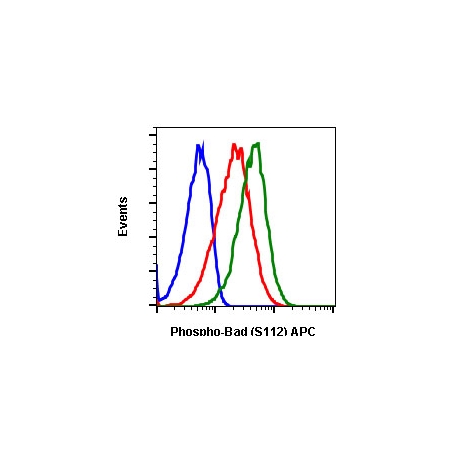
Human BAD Antibody : APC (Phospho-Ser112) (OAAQ00150)
| Datasheets/Manuals | Printable datasheet for OAAQ00150 |
|---|
| Tested Species Reactivity | Human, Mouse, Rat |
|---|---|
| Predicted Species Reactivity | Mouse, Rat, and other homologues |
| Product Format | Liquid 1X PBS with 0.2% BSA and 0.09% sodium azide |
| Clonality | Monoclonal |
| Clone | BADS112-B9 |
| Isotype | Rabbit IgG1L |
| Host | Rabbit |
| Conjugation | APC: Allophycocyanin |
| Application | FC |
| Reconstitution and Storage | Store at 2-8°C |
| Immunogen | A synthetic phospho-peptide corresponding to residues surrounding Ser112 of human phospho BAD |
| Purification | Protein A+G |
| Target Post-Translational Modification | Phospho-Ser112 |
| Application Info | For flow cytometric staining, the suggested use of this reagent is 5 uL per million cells or 5 uL per 100 uL of staining volume. It is recommended that the reagent be titrated for optimal performance for each application. |
| Reference | Czabotar PE., et al., (2014) Nat Rev Mol Cell Biol 15:49-63. Polzien L., et al., (2009) J Biol Chem 284:28004-28020. Masters SC., et al., (2001) Mol Pharmacol 60: 1325-1331. Datta SR., et al., (1997) Cell 91:231-241. Harada H., et al., (1999) Mol Cell 3:413-422. Chiang CW et al., (2001) Blood 97:1289-1297. |
|---|---|
| Gene Symbol | BAD |
| Gene Full Name | BCL2 associated agonist of cell death |
| Alias Symbols | BBC2, BCL2L8 |
| NCBI Gene Id | 572 |
| Protein Name | bcl2-associated agonist of cell death |
| Description of Target | Human BCL-2-assocaited death promoter (BAD) regulates apoptosis by binding to anti-apoptotic members of BCL family including BCL-2, BCL-xL, and BCL-w. The BAD protein signal transduction activity is regulated by multiple kinases and phosphatases. Non-phosphorylated BAD protein selectively dimerizes with Bcl-xL and Bcl-2 displacing Bax, which is then free to initiate mitochondrial membrane permeability, initiating apoptosis. When phosphorylated, BAD is unable to heterodimerize with Bcl-2 or Bcl-xL and is sequestered into the cytosolic compartment by binding to 14-3-3 protein. BAD protein has been shown to phosphorylated at multiple sites. The phosphorylation of 3 serine residues (Ser112, Ser136 and Ser155) effects the activity of the BAD. Multiple kinases phosphorylate BAD at these serine site. Ribosomal protein S6 kinase alpha-1 (RPS6KA1/RSK) and cAMP-dependent protein kinase phosphorylated BAD at Ser112 while protein kinase B (PKB/Akt) phosphorylates BAD at Ser136 residue. Phosphorylation of BAD at Ser-155 is preferentially carried out by Protein Kinase A. Other BAD phosphorylation sites may regulation cellular localization of BAD. Phosphorylation of both Ser75 and Ser99 increases sequestration of BAD by 14-3-3 protein which leads to translocation of BAD from the mitochondria to the cytosol. This prevents BAD from binding to anti-apoptotic proteins. Phosphorylation at Ser99 also prevents BAD from binding to the hydrophobic groove of Bcl-2 and Bcl-XL. |
| Uniprot ID | Q92934 |
| Protein Accession # | NP_004313.1 |
| Nucleotide Accession # | NM_004322.3 |