Human CRKL Antibody : PE (Phospho-Tyr207)

Référence OAAQ00082-100tests
Conditionnement : 100Tests
Marque : Aviva Systems Biology
Contactez votre distributeur local :

Téléphone : +1 850 650 7790
Human CRKL Antibody : PE (Phospho-Tyr207)
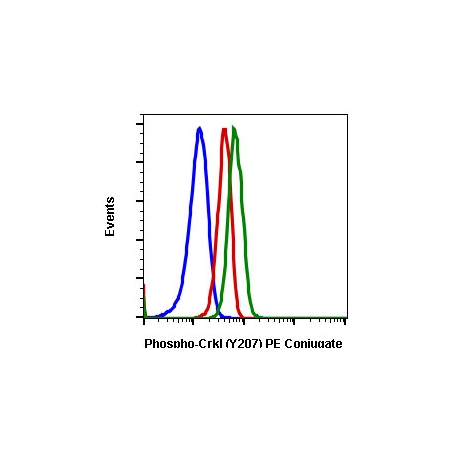
Human CRKL Antibody : PE (Phospho-Tyr207) (OAAQ00082)
| Datasheets/Manuals | Printable datasheet for OAAQ00082 |
|---|
| Tested Species Reactivity | Human, Mouse |
|---|---|
| Predicted Species Reactivity | Mouse, Rat |
| Product Format | Liquid. 1X PBS, 0.09% NaN3, 0.2% BSA. |
| Clonality | Monoclonal |
| Clone | CrkLY207-G4 |
| Isotype | Rabbit IgG1k |
| Host | Rabbit |
| Conjugation | PE: Phycoerythrin |
| Application | FC |
| Reconstitution and Storage | 2-8C |
| Immunogen | A synthetic phospho-peptide corresponding to residues surrounding Tyr207 of human phospho CrkL |
| Purification | Protein A+G |
| Target Post-Translational Modification | Phospho-Tyr207 |
| Application Info | For flow cytometric staining, the suggested use of this reagent is 5 uL per million cells or 5 uL per 100 uL of staining volume. It is recommended that the reagent be titrated for optimal performance for each application. |
| Reference | (1) ten Hoeve, J., C. Morris, N. Heisterkamp, and J. Groffen. 1993. Isolation and chromosomal localization of CRKL, a human Crk-like gene. Oncogene 82469-2474. (2) Rosen MK, Yamazaki T, Gish GD, Kay CM, Pawson T, Kay LE: Direct demonstration of an intramolecular SH2-phosphotyrosine interaction in the Crk protein. Nature. 1995, 374: 477-479. (3) Kobashigawa Y, Sakai M, Naito M, Yokochi M, Kumeta H, Makino Y, Ogura K, Tanaka S, Inagaki F: Structural basis for the transforming activity of human cancer-related signaling adaptor protein CRK. Nat Struct Mol Biol. 2007, 14: 503-510. |
|---|---|
| Gene Symbol | CRKL |
| Gene Full Name | CRK like proto-oncogene, adaptor protein |
| NCBI Gene Id | 1399 |
| Protein Name | crk-like protein |
| Description of Target | This gene encodes a protein kinase containing SH2 and SH3 (src homology) domains which has been shown to activate the RAS and JUN kinase signaling pathways and transform fibroblasts in a RAS-dependent fashion. It is a substrate of the BCR-ABL tyrosine kinase, plays a role in fibroblast transformation by BCR-ABL, and may be oncogenic. |
| Uniprot ID | P46109 |
| Protein Accession # | NP_005198.1 |
| Nucleotide Accession # | NM_005207.3 |