Human EIF4EBP1 Antibody : APC (Phospho-Thr37/46)

Référence OAAQ00049-10tests
Conditionnement : 10Tests
Marque : Aviva Systems Biology
Contactez votre distributeur local :

Téléphone : +1 850 650 7790
Human EIF4EBP1 Antibody : APC (Phospho-Thr37/46)
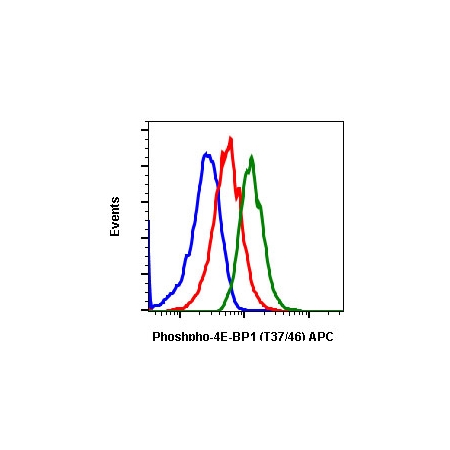
Human EIF4EBP1 Antibody : APC (Phospho-Thr37/46) (OAAQ00049)
| Datasheets/Manuals | Printable datasheet for OAAQ00049 |
|---|
| Tested Species Reactivity | Human, Mouse, Rat |
|---|---|
| Predicted Species Reactivity | Mouse, Rat |
| Product Format | Liquid. 1X PBS, 0.09% NaN3, 0.2% BSA. |
| Clonality | Monoclonal |
| Clone | 4EB1T37T46-A5 |
| Isotype | Rabbit IgG1k |
| Host | Rabbit |
| Conjugation | APC: Allophycocyanin |
| Application | FC |
| Reconstitution and Storage | 2-8C |
| Immunogen | A synthetic phospho-peptide corresponding to residues surrounding Thr37/46 of human phospho 4E-BP1 |
| Purification | Protein A+G |
| Target Post-Translational Modification | Phospho-Thr37/46 |
| Application Info | For flow cytometric staining, the suggested use of this reagent is 5 uL per million cells or 5 uL per 100 uL of staining volume. It is recommended that the reagent be titrated for optimal performance for each application. |
| Reference | Hay N. Sonenberg N, (2004) Gens Dev. 18: 1926-1945. Aitken CE, and Lorsch JR, (2012), Nat Struc Mol Biol 19 : 568-576. Peter D., et al., (2015) Mol Cell, 57:1074-1087. Pain VM, (1996) Eur J Biochem 236: 747-771. Fadden P, Haystead TA, Lawrence Jr JC, (1997) J Biol Chem 272: 10240-10247. Kimball SR et al., (1999) J Biol Chem 274: 11647-1152. Kleijn M and Proud CG, (2000) Biochem J, 347: 399-406. Lang CH et al., (2000) Clin Exp Res 24: 322-331. Shah OJ, Kimbell SR., Jefferson LS., (2000), Am J Physiol Endocrinol Metab 278: E76-E82. |
|---|---|
| Gene Symbol | EIF4EBP1 |
| Gene Full Name | eukaryotic translation initiation factor 4E binding protein 1 |
| Alias Symbols | BP-1, 4EBP1, 4E-BP1, PHAS-I |
| NCBI Gene Id | 1978 |
| Protein Name | eukaryotic translation initiation factor 4E-binding protein 1 |
| Description of Target | This gene encodes one member of a family of translation repressor proteins. The protein directly interacts with eukaryotic translation initiation factor 4E (eIF4E), which is a limiting component of the multisubunit complex that recruits 40S ribosomal subunits to the 5' end of mRNAs. Interaction of this protein with eIF4E inhibits complex assembly and represses translation. This protein is phosphorylated in response to various signals including UV irradiation and insulin signaling, resulting in its dissociation from eIF4E and activation of mRNA translation. |
| Uniprot ID | Q13541 |
| Protein Accession # | NP_004086.1 |
| Nucleotide Accession # | NM_004095.3 |