Human MET Antibody : APC (Phospho-Tyr1234/1235)

Référence OAAQ00129-100tests
Conditionnement : 100Tests
Marque : Aviva Systems Biology
Contactez votre distributeur local :

Téléphone : +1 850 650 7790
Human MET Antibody : APC (Phospho-Tyr1234/1235)
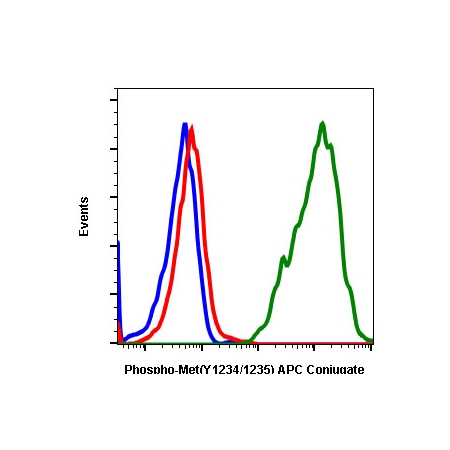
Human MET Antibody : APC (Phospho-Tyr1234/1235) (OAAQ00129)
| Datasheets/Manuals | Printable datasheet for OAAQ00129 |
|---|
| Tested Species Reactivity | Human, Mouse |
|---|---|
| Predicted Species Reactivity | Mouse, Rat |
| Product Format | Liquid. 1X PBS, 0.09% NaN3, 0.2% BSA. |
| Clonality | Monoclonal |
| Clone | MetY12341235-6F11 |
| Isotype | Rabbit IgG1k |
| Host | Rabbit |
| Conjugation | APC: Allophycocyanin |
| Application | FC |
| Reconstitution and Storage | 2-8C |
| Immunogen | A synthetic phospho-peptide corresponding to residues surrounding Tyr1234/Tyr1235 of human phospho Met |
| Purification | Protein A+G |
| Target Post-Translational Modification | Phospho-Tyr1234/1235 |
| Application Info | For flow cytometric staining, the suggested use of this reagent is 5 uL per million cells or 5 uL per 100 uL of staining volume. It is recommended that the reagent be titrated for optimal performance for each application. |
| Reference | Cooper CS (January 1992). "The met oncogene: from detection by transfection to transmembrane receptor for hepatocyte growth factor". Oncogene. 7 (1): 3-7. Johnson M, Koukoulis G, Kochhar K, Kubo C, Nakamura T, Iyer A (Sep 1995). "Selective tumorigenesis in non-parenchymal liver epithelial cell lines by hepatocyte growth factor transfection". Cancer Letters. 96 (1): 37-48. Kochhar KS, Johnson ME, Volpert O, Iyer AP (1995). "Evidence for autocrine basis of transformation in NIH-3T3 cells transfected with met/HGF receptor gene". Growth Factors. 12 (4): 303-13. |
|---|---|
| Gene Symbol | MET |
| Gene Full Name | MET proto-oncogene, receptor tyrosine kinase |
| Alias Symbols | HGFR, AUTS9, RCCP2, c-Met, DFNB97 |
| NCBI Gene Id | 4233 |
| Protein Name | hepatocyte growth factor receptor |
| Description of Target | This gene encodes a member of the receptor tyrosine kinase family of proteins and the product of the proto-oncogene MET. The encoded preproprotein is proteolytically processed to generate alpha and beta subunits that are linked via disulfide bonds to form the mature receptor. Further processing of the beta subunit results in the formation of the M10 peptide, which has been shown to reduce lung fibrosis. Binding of its ligand, hepatocyte growth factor, induces dimerization and activation of the receptor, which plays a role in cellular survival, embryogenesis, and cellular migration and invasion. Mutations in this gene are associated with papillary renal cell carcinoma, hepatocellular carcinoma, and various head and neck cancers. Amplification and overexpression of this gene are also associated with multiple human cancers. |
| Uniprot ID | P08581 |
| Protein Accession # | NP_000236.2 |
| Nucleotide Accession # | NM_000245.3 |