Liquid 1X PBS with 0.2% BSA and 0.09% sodium azide
Clonality
Monoclonal
Clone
PDK1S241-F7
Isotype
Rabbit IgG1k
Host
Rabbit
Conjugation
PE: Phycoerythrin
Application
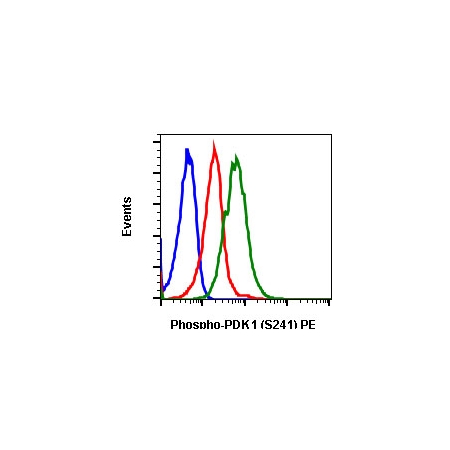
FC
Reconstitution and Storage
Store at 2-8°C. Stable for one year from date of receipt.
Immunogen
A synthetic phospho-peptide corresponding to residues surrounding Ser241 of human phospho PDK1
Purification
Protein A+G
Target Post-Translational Modification
Phospho-Ser241
Application Info
For flow cytometric staining, the suggested use of this reagent is 5 uL per million cells or 5 uL per 100 uL of staining volume. It is recommended that the reagent be titrated for optimal performance for each application.
PDK1 is a Ser/Thr kinase that is ubiquitously expressed throughout human tissues. PDK1 phosphorylates protein kinase B (PKB or Akt) at both Thr308 and Ser473 in vivo. PDK1 is active and phosphorylated in basal conditions, where it exists predominantly in the cytosol with a small fraction at the plasma membrane. This membrane association is likely mediated by PDK1 binding to phospholipids through its PH domain, which has been found to have strong affinity to specific phospholipids. PDK1 is a master regulator of at least 23 related protein kinases, and more than 50% of all human cancers show significant overstimulation of the PDK1 pathway. Most small-molecule inhibitors of PDK1 target the ATP binding site.