



Use code ELISA25-262 for 25% off all ELISAs through November.
25% off all ELISA kits

Human PPAR-gamma Activity Assay Kit
Human PPAR-gamma Activity Assay Kit
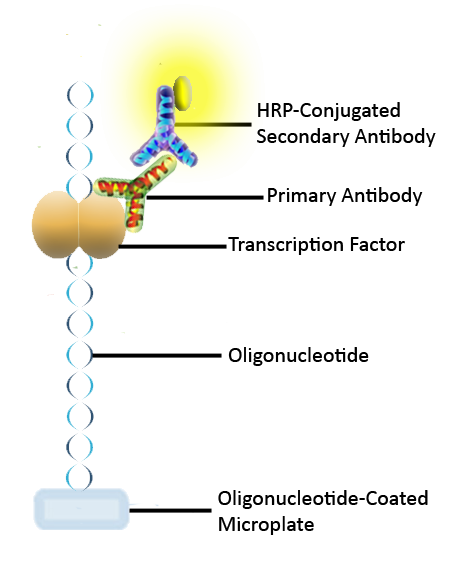
RayBio® Human PPAR-gamma Transcription Factor Activity Assay. This assay uses a dsDNA coated plate with canonical PPAR-gamma binding sequences to semi-quantitatively detect active PPAR-gamma in lysates or nuclear extracts. Dry ice shipment (additional fee).
Contact Us for Bulk Request
Product Description
Specifications
| Size | 1 Plate Kit, 2 Plate Kit, 5 Plate Kit |
| Species | Human |
| Specificity | The olionucleotide/antibody pair provided in this kit recognizes human PPAR-gamma in whole lysates and nuclear extracts. |
| Compatible Sample Types | Cell Lysates, Nuclear Extracts |
| Accession Number | P37231 |
| Gene Id | 5468 |
| Gene Symbols | PPARG, NR1C3 |
| Protein Name / Synonyms | Peroxisome proliferator-activated receptor gamma(PPAR-gamma), Nuclear receptor subfamily 1 group C member 3 |
| Quantitative/Semi-Quantitative | Semi-Quantitative |
| Solid Support | 96-well Microplate |
| Design Principle | Sandwich-based |
| Method Of Detection | Colorimetric |
| Research Area | Angiogenesis, Cancer, Inflammation, PPAR Signaling |
| Shipping Type | Dry ice (additional shipping fee) |
| Storage | -20°C |
Related Products
Human Adipokine Profiling Array L182 (Glass Slide)
As low as $524.00
Human Adipokine Profiling Array L182 (Membrane)
As low as $709.00
Introduction
Peroxisome proliferator-activated receptors (PPARs) are ligand-activated transcription factors of the nuclear hormone receptor superfamily. It includes three subtypes PPAR-alpha, PPAR-gamma, and PPAR-delta. Each one mediates the physiological actions of a large variety of fatty acids (FAs) and FA-derived molecules. The PPARs contain the canonical domain structure common to other nuclear receptor family members, including the amino-terminal AF-1 trans activation domain, a DNA-binding domain, and a dimerization and ligand-binding domain with a ligand-dependent trans activation function AF-2 at the carboxy-terminal region. PPAR-alpha, PPAR-delta, and PPAR-gamma play an essential role in energy metabolism, however, they differ in the spectrum of their activity. PPAR-alpha is highly expressed in hepatocytes, enterocytes, vascular and immune cell types. PPAR-alpha plays a central role in lipid and lipoprotein metabolism, and thereby decreases dyslipidemia associated with metabolic syndrome. PPAR-gamma has been known to regulate adipocyte differentiation, FA storage and glucose metabolism, and is a target of antidIκBetic drugs. PPAR-gamma also enhances the expression of a number of genes involved in glucose and lipid metabolism. PPAR-delta is expressed almost ubiquitously with the highest level of expression found in colon, small intestine, liver and keratinocytes. It is a general regulator of fatty acid oxidation in many tissues, where it promotes FA metabolism and suppresses macrophage derived inflammation. The PPARs form heterodimers with the RXRs in cellular nucleus and can regulate gene expression through binding either PPAR ligands or RXR ligands. The formed heterodimers bind to PPAR-responsive elements (PPREs) that consist of direct repeats (DRs) with the core sequence AGG(A/T)CA separated by one or two base-pairs, designated DR1 and DR2, respectively. In the absence of ligand, the heterodimer retains in the nucleus binding to PPREs in a complex with transcriptional co-repressors. Upon ligand binding to PPARs or RXR, the complex makes conformational transfer that facilitates PPARs/RXR heterodimers binding with co-activator from co-repressors. The activated complex therefore starts transcriptional activation of target genes.
Product Features
- Specific transcription factor-DNA binding assay
- Perfect alternative to EMSA
- Easy to perform in an ELISA format
- Non-radioactive assay
- High throughput (96-well plate format)
- Assay can be completed within 5 hours
Application Notes
Kit Components
- 96-well Strip Microplate pre-coated with DNA probes
- DNA Binding Buffer
- Positive Control Sample
- Specific Competitor DNA probe
- Non-specific Competitor DNA probe
- Assay Reagent
- DTT
- Wash Buffer
- Primary Antibody
- HRP-conjugated Secondary Antibody
- Antibody Diluent Buffer
- TMB One-Step Substrate Reagent
- Stop Solution
Other Materials Required
- Distilled or deionized water
- 100 ml and 1 liter graduated cylinders
- Tubes to prepare sample dilutions
- Absorbent paper
- Precision pipettes to deliver 2 µl to 1 ml volumes
- Adjustable 1-25 ml pipettes for reagent preparation <lIκBenchtop rocker or shaker
- Microplate reader capable of measuring absorbance at 450 nm
Protocol Outline
- Prepare all reagents and samples as instructed in the manual.
- Add 100 µl of sample or positive control to each well.
- Incubate 2 h at RT or O/N at 4 °C.
- Add 100 µl of prepared primary antibody to each well.
- Incubate 1 h at RT.
- Add 100 µl of prepared HRP-secondary antibody to each well.
- Incubate 1 h at RT.
- Add 100 µl of TMB One-Step Substrate Reagent to each well.
- Incubate 30 min at RT.
- Add 50 µl of Stop Solution to each well.
- Read at 450 nm immediately.
Typical Data
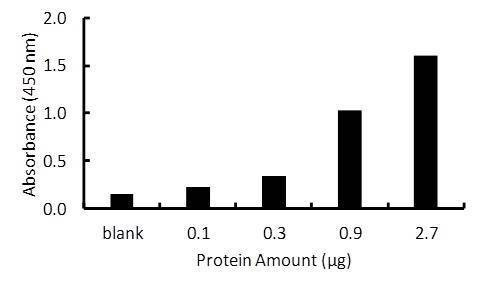
Figure 1
Transcription factor assay of PPAR-gamma from purified recombinate PPAR-gamma protein with the RayBio PPAR-gamma TF Activity Assay Kit.
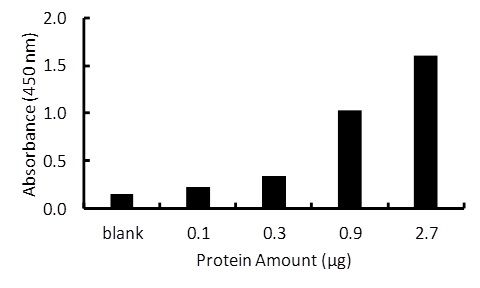
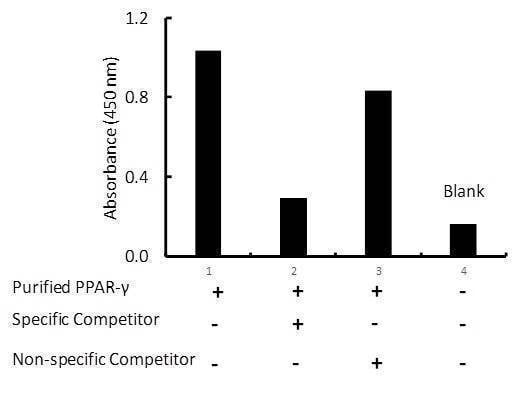
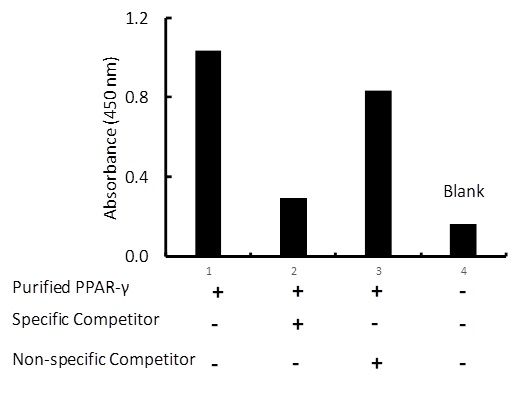
Figure 2
Transcription factor assay of PPAR-gamma from 0.3 ug purified recombinate PPAR-gamma protein with the specific competitor or non-specific competitor. The result shows specific binding of PPAR-gamma to the PPAR-gamma DNA binding site.
Storage/Stability
Upon receipt, the positive control should be removed and stored at -20° or -80°C. The remainder of the kit can be stored for up to 6 months at 2-8°C from the date of shipment. Opened Microplate Wells or reagents may be stored for up to 1 month at 2° to 8°C. Return unused wells to the pouch containing desiccant pack, reseal along entire edge.
Note: The kit can be used within one year if the whole kit is stored at -20°C upon receipt. Avoid repeated freeze-thaw cycles.
Note: The kit can be used within one year if the whole kit is stored at -20°C upon receipt. Avoid repeated freeze-thaw cycles.
citations
Novel PPAR-γ agonists as potential neuroprotective agents against Alzheimer's disease: rational design, synthesis, in silico evaluation, PPAR-γ binding assay and transactivation and expression studies
- Species:
- Human
- Sample Type:
- Other / Unspecified (SH-SY5Y cell line nuclear extract)
- Year:
- 2024
- Journal Name:
- RSC Advances
- PubMed ID:
- 39434987
Computational studies, synthesis, in-vitro binding and transcription analysis of novel imidazolidine-2,4‑dione and 2-thioxo thiazolidine-4-one based glitazones for central PPAR-γ agonism
- Species:
- Human
- Sample Type:
- SHSY5Y cell
- Year:
- 2023
- Journal Name:
- Journal of Molecular Structure
Development of novel thiazolidine-2,4-dione derivatives as PPAR-γ agonists through design, synthesis, computational docking, MD simulation, and comprehensive in vitro and in vivo evaluation
- Species:
- Mouse
- Sample Type:
- C2C12 cell
- Year:
- 2023
- Journal Name:
- RSC medicinal chemistry
Partial Activation of PPAR-γ by Synthesized Quercetin Derivatives Modulates TGF-β1-Induced EMT in Lung Cancer Cells
- Species:
- Human
- Sample Type:
- A549 cell
- Year:
- 2023
- Journal Name:
- Advanced Biology
Molecular dynamics articulated multilevel virtual screening protocol to discover novel dual PPAR α/γ agonists for anti-diabetic and metabolic applications
- Species:
- Mouse
- Sample Type:
- 3T3-L1 cell
- Year:
- 2022
- Journal Name:
- Molecular Diversity