Human PTPN11 Antibody : FITC (Phospho-Tyr580)

Référence OAAQ00088-100tests
Conditionnement : 100Tests
Marque : Aviva Systems Biology
Contactez votre distributeur local :

Téléphone : +1 850 650 7790
Human PTPN11 Antibody : FITC (Phospho-Tyr580)
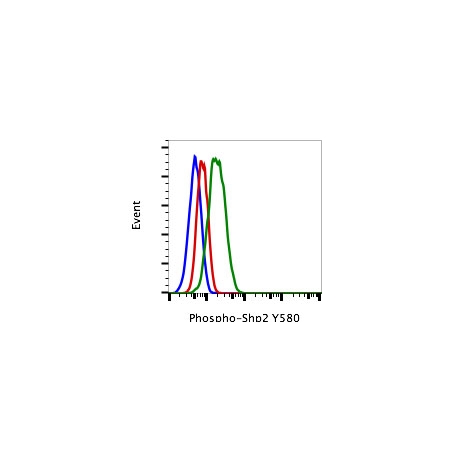
Human PTPN11 Antibody : FITC (Phospho-Tyr580) (OAAQ00088)
| Datasheets/Manuals | Printable datasheet for OAAQ00088 |
|---|
| Tested Species Reactivity | Human, Mouse |
|---|---|
| Predicted Species Reactivity | Mouse, Rat |
| Product Format | Liquid. 1X PBS, 0.09% NaN3, 0.2% BSA. |
| Clonality | Monoclonal |
| Clone | Shp2Y580-4A2 |
| Isotype | Rabbit IgG1k |
| Host | Rabbit |
| Conjugation | FITC: Fluorescein Isothiocyanate |
| Application | FC |
| Reconstitution and Storage | 2-8C |
| Immunogen | A synthetic phospho-peptide corresponding to residues surrounding Tyr580 of human phospho Shp2 |
| Purification | Protein A+G |
| Target Post-Translational Modification | Phospho-Tyr580 |
| Application Info | For flow cytometric staining, the suggested use of this reagent is 5 uL per million cells or 5 uL per 100 uL of staining volume. It is recommended that the reagent be titrated for optimal performance for each application. |
| Reference | 1. Bennett AM et al., (1994) Proc Natl Acad Sci USA. 91:7335-9. 2. Feng GS et al., (1994) Trends Genet. 10:54-8. 3. Mohi MG et al., (2007) Curr Opin Genet Dev. 17:23-30. 4. Vogel W et al., (1996) Cell Growth Differ. 7:1589-97 5. Ahmed Z et al., (2013) J Cell Biol. 200:493-504. 6. Hu ZQ et al., (2014) Oncol Rep 32:205-212. |
|---|---|
| Gene Symbol | PTPN11 |
| Gene Full Name | protein tyrosine phosphatase non-receptor type 11 |
| Alias Symbols | CFC, NS1, JMML, SHP2, BPTP3, PTP2C, METCDS, PTP-1D, SH-PTP2, SH-PTP3 |
| NCBI Gene Id | 5781 |
| Protein Name | tyrosine-protein phosphatase non-receptor type 11 |
| Description of Target | The protein encoded by this gene is a member of the protein tyrosine phosphatase (PTP) family. PTPs are known to be signaling molecules that regulate a variety of cellular processes including cell growth, differentiation, mitotic cycle, and oncogenic transformation. This PTP contains two tandem Src homology-2 domains, which function as phospho-tyrosine binding domains and mediate the interaction of this PTP with its substrates. This PTP is widely expressed in most tissues and plays a regulatory role in various cell signaling events that are important for a diversity of cell functions, such as mitogenic activation, metabolic control, transcription regulation, and cell migration. Mutations in this gene are a cause of Noonan syndrome as well as acute myeloid leukemia. |
| Uniprot ID | Q06124 |
| Protein Accession # | NP_001317366.1 |
| Nucleotide Accession # | NM_001330437.1 |