Human RELB Antibody : FITC (Phospho-Ser552)

Référence OAAQ00124-10tests
Conditionnement : 10Tests
Marque : Aviva Systems Biology
Contactez votre distributeur local :

Téléphone : +1 850 650 7790
Human RELB Antibody : FITC (Phospho-Ser552)
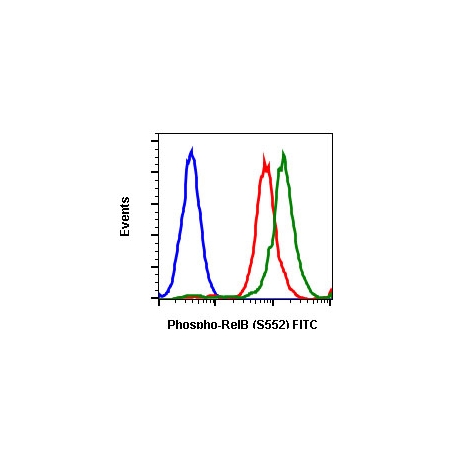
Human RELB Antibody : FITC (Phospho-Ser552) (OAAQ00124)
| Datasheets/Manuals | Printable datasheet for OAAQ00124 |
|---|
| Tested Species Reactivity | Human, Mouse |
|---|---|
| Predicted Species Reactivity | Mouse, Rat |
| Product Format | Liquid. 1X PBS, 0.09% NaN3, 0.2% BSA. |
| Clonality | Monoclonal |
| Clone | RelBS552-A7 |
| Isotype | Rabbit IgG1k |
| Host | Rabbit |
| Conjugation | FITC: Fluorescein Isothiocyanate |
| Application | FC |
| Reconstitution and Storage | 2-8C |
| Immunogen | A synthetic phospho-peptide corresponding to residues surrounding Ser552 of human phospho RelB |
| Purification | Protein A+G |
| Target Post-Translational Modification | Phospho-Ser552 |
| Application Info | For flow cytometric staining, the suggested use of this reagent is 5 uL per million cells or 5 uL per 100 uL of staining volume. It is recommended that the reagent be titrated for optimal performance for each application. |
| Reference | 1. Ryseck R P et al., (1992), Cell. Biol. 12, 674-684. 2. Vallabhapurapu S., and Karin M. (2009), Annu. Rev. Immunol. 27, 693-733. 3. McCall C E and Yoza B K, (2007) Am. J. Respir. Crit. Care Med. 175, 763-767. 4. Yoza B K et al., (2006) J. Immunol. 177, 4080-4085. 5. Liu T F et al., (2011) J. Biol. Chem. 286, 9856-9864. 5. Moorthy AK et al., (2007) J. Mol. Biol. 373, 723-734. 6. Bours V et al., (1994) Oncogene 9, 1699-1702. 7. Baldwin A. S., Jr., (1996) Annu. Rev. Immunol. 14, 649-683. 8. Alber T. (1992), Curr. Opin. Genet. Dev. 2, 205-210. 9. Dobrzanski P et al., (1993), Mol. Cell. Biol. 13, 1572-1582. 10 Marienfeld R et al., (2001), Oncogene 20, 8142-8147. 11. Neumann M. Et al., (2011), Oncogene 30, 2485-2492. 12 Maier HJ et al., (2003), J. Biol. Chem. 278, 39242-39250. |
|---|---|
| Gene Symbol | RELB |
| Gene Full Name | RELB proto-oncogene, NF-kB subunit |
| Alias Symbols | IREL, I-REL, IMD53, REL-B |
| NCBI Gene Id | 5971 |
| Protein Name | transcription factor RelB |
| Uniprot ID | Q01201 |
| Protein Accession # | NP_006500.2 |
| Nucleotide Accession # | NM_006509.3 |