


- A micro ELISA plate ---The 96-well plate has been pre-coated with an anti-human S100B antibody. This dismountable microplate can be divided into 12 x 8 strip plates.
- Two vials lyophilized standard ---Dilute a bottle of the standard at dilution series, read the OD values, and then draw a standard curve.
- One vial Biotin-labeled S100B antibody (100 x concentrate) (120 μl/bottle) ---Act as the detection antibody.
- One vial HRP-avidin (100 x concentrate) (120 μl/bottle) ---Bind to the detection antibody and react with the TMB substrate to make the solution chromogenic.
- One vial Biotin-antibody Diluent (15 ml/bottle) ---Dilute the Biotin-antibody.
- One vial HRP-avidin Diluent (15 ml/bottle) ---Dilute the HRP-avidin solution.
Human Soluble protein-100B,S-100B ELISA Kit
Référence CSB-E08065h-96T
Conditionnement : 96T
Marque : Cusabio
Contactez votre distributeur local :

Téléphone : +1 850 650 7790
 SDS
| Size | 96T,5×96T,10×96T |
Product Details
Target Name
S100 calcium binding protein B
Associated names
NEF ELISA Kit; Protein S100 B ELISA Kit; Protein S100-B ELISA Kit; S 100 calcium binding protein beta chain ELISA Kit; S 100 protein beta chain ELISA Kit; S-100 protein beta chain ELISA Kit; S-100 protein subunit beta ELISA Kit; S100 ELISA Kit; S100 calcium binding protein beta (neural) ELISA Kit; S100 calcium-binding protein B ELISA Kit; S100 protein beta chain ELISA Kit; S100B ELISA Kit; S100B_HUMAN ELISA Kit; S100beta ELISA Kit
Abbreviation
Uniprot No.
Species
Homo sapiens (Human)
Sample Types
serum, plasma, tissue homogenates, cerebrospinal fluid (CSF)
Detection Range
78 pg/mL-5000 pg/mL
Sensitivity
19.5 pg/mL
Assay Time
1-5h
Sample Loading Volume
50-100ul
Detection Wavelength
450 nm
Research Area
Signal Transduction
Assay Principle
quantitative
Measurement
Sandwich
Precision
| Intra-assay Precision (Precision within an assay): CV%<8% | ||||||
| Three samples of known concentration were tested twenty times on one plate to assess. | ||||||
| Inter-assay Precision (Precision between assays): CV%<10% | ||||||
| Three samples of known concentration were tested in twenty assays to assess. | ||||||
Linearity
| To assess the linearity of the assay, samples were spiked with high concentrations of human S-100B in various matrices and diluted with the Sample Diluent to produce samples with values within the dynamic range of the assay. | ||||||
| Sample | Serum(n=4) | |||||
| 1:1 | Average % | 84 | ||||
| Range % | 80-95 | |||||
| 1:2 | Average % | 89 | ||||
| Range % | 85-94 | |||||
| 1:4 | Average % | 95 | ||||
| Range % | 92-100 | |||||
| 1:8 | Average % | 90 | ||||
| Range % | 85-98 | |||||
Recovery
| The recovery of human S-100B spiked to levels throughout the range of the assay in various matrices was evaluated. Samples were diluted prior to assay as directed in the Sample Preparation section. | ||||||
| Sample Type | Average % Recovery | Range | ||||
| Serum (n=5) | 95 | 85-99 | ||||
| EDTA plasma (n=4) | 96 | 92-100 | ||||
Typical Data
| These standard curves are provided for demonstration only. A standard curve should be generated for each set of samples assayed. | |||||||||||||||||||||||||||||||||||||||||||||||||||||||||||||||
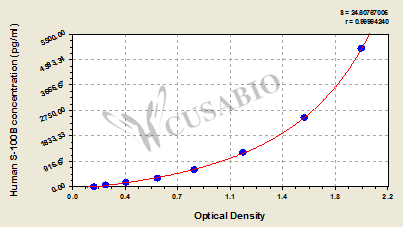
| |||||||||||||||||||||||||||||||||||||||||||||||||||||||||||||||
Materials provided
Materials not provided
- A microplate reader capable of measuring absorbance at 450 nm, with the correction wavelength set at 540 nm or 570 nm.
- An incubator can provide stable incubation conditions up to 37°C±5°C.
- Centrifuge
- Vortex
- Squirt bottle, manifold dispenser, or automated microplate washer
- Absorbent paper for blotting the microtiter plate
ELISA Data Analysis
Troubleshooting
and FAQs
and FAQs
Storage
Store at 2-8°C. Please refer to protocol.
Shelf Life
6 months
Description
S100 calcium binding protein B (S100B) is a small acidic protein belonging to the S100 family of calcium-binding proteins. Glial cells and Schwann cells of the nervous system primarily express S100B, where it plays important roles in intracellular calcium homeostasis, cell cycle regulation, and cytoskeletal dynamics. Under pathological conditions, S100B is released into extracellular spaces and can serve as a biomarker for neuronal damage. This makes it valuable in research examining brain injury, neurodegenerative diseases, and neuroinflammation. The Human Soluble protein-100B,S-100B ELISA...
Citations
- S Árnason,Thesis & Dissertation,2025
- Ö Elif Eda,Turk J Oncol,2023
- F Zhou,Neuropsychiatric disease and treatment,2024
- J Wang,/,2024
- L Wang,Journal of intensive care,2023
- M Mao,BMC geriatrics,2022
- B Dinc,Transplantation Proceedings,2020
- RC Catherine,The Indian Journal of Pediatrics,2020
- MohsenAfarideh, et al,Canadian Journal of Diabetes,2019
- Zhou S.et al,Neurol Res.,2016
Customer Reviews and Q&A
There are currently no reviews for this product.
■ Q&A
Q:
1.Hi I am wondering if there is a recommended starting dilution for plasma for S100B ELISA CSB-E08065h ?
2.Is the assay compatible with sodium citrate as anticoagulant for plasma ?
A:
Thanks for your inquiry. The concentration of S-100β in cerebrospinal fluid was a useful marker for investigating
the degree of brain damage after head injury, cerebral hemorrhage and ischemic stroke. Recently another
report described that the increasing of S-100β in blood correlated to the degree of brain damage after
cerebral ischemia, infarction, hemorrhage and severe head...
the degree of brain damage after head injury, cerebral hemorrhage and ischemic stroke. Recently another
report described that the increasing of S-100β in blood correlated to the degree of brain damage after
cerebral ischemia, infarction, hemorrhage and severe head...
Target Background
Function
(From Uniprot)
(From Uniprot)
Weakly binds calcium but binds zinc very tightly-distinct binding sites with different affinities exist for both ions on each monomer. Physiological concentrations of potassium ion antagonize the binding of both divalent cations, especially affecting high-affinity calcium-binding sites. Binds to and initiates the activation of STK38 by releasing autoinhibitory intramolecular interactions within the kinase. Interaction with AGER after myocardial infarction may play a role in myocyte apoptosis by activating ERK1/2 and p53/TP53 signaling. Could assist ATAD3A cytoplasmic processing, preventing...
Gene References into Functions
- rs9722, a functional SNP in the 3'-UTR of the S100B gene, was strongly associated with age of onset of Parkinson's disease.
- The S100B gene rs9722 polymorphism may contribute to the susceptibility of IS.
- It is unclear if the higher S100B concentration in football players playing at least 50 plays was caused by exercise or impacts. Therefore, if serum S100B is to be used as a biomarker of impacts, and possible brain injury in sport, exercise time and intensity should be taken into account as confounding variables.
- High S100B expression is associated with chemoresistance in ovarian cancer.
- The serum levels of S100B in Groups A and B rose after the injury and reached a peak on the 4th day of injury. Serum levels of NSE and S100B protein can reflect the degree of spinal cord injury.
- Serum levels of S100B (and neuron-specific enolase) at admission were related to initial Glasgow Coma Scale (GSC) scores, and these levels one week after traumatic brain injury were related to six month GSC scores.
- Studied use of serum S100B as a biomarker to predict injury in patients with mild head injury. Found patients with cranial injury detected by CT, had higher S100B protein levels than those without cranial injury.
- The expression of serum S100beta in patients with postoperative cognitive dysfunction was significantly increased
- A high S100B expression is associated with a good prognosis in patients with p53 mutant and p53 wild-type breast cancers.
- S100B may have a role in pathogenesis of schizophrenia; patients show higher plasma levels of S100B than healthy controls
- We investigated the possible correlation between TCD results and S100B, NSE and LDH levels as well as between NSE-LDH and S100B-LDH levels by regression analysis. We found a statistically significant relationship for both NSE, S100B with LDH.
- Results showed that our prepared S100B mAbs were suitable for detecting S100B expression in human tissues, furnishing promising tools for further functional investigation and clinical applications.
- In this study demonstrated that S100b is elevated in Alzheimer disease cases. and the increased levels in African Americans here may be indicative of increased severity in specific populations.
- In neonates, NSE and s100B levels increase after bypass surgery and return below preoperative baseline levels by postoperative day seven. The levels of s100B were positively correlated with circulatory arrest time and negatively correlated with age at time of surgery.
- the serum levels of S100B protein mediated the association between S100B gene polymorphism and scene selectivity in the retrosplenial cortex
- There is a significant correlation between mortality in the critically ill patients in the intensive care unit and increased serum concentration of S100B and NSE.
- Our findings showed that both S100beta and NSE levels similarly increased during CPB and immediately after CPB during sevoflurane and propofol based anesthesia.
- This study demonstrated that S100A12 mRNA levels were significantly decreased in the new cases of untreated MS patients in comparison to healthy controls.
- Increased serum levels of S100B protein (and NSE) were observed postoperatively in patients with postoperative cognitive dysfunction.
- high S100B expression in Multiple Sclerosis (MS) patient samples suggests its usefulness as a diagnostic biomarker for MS.
- the underlying mechanism of S100B-mediated effects on cancer stem-like cell stemness was not dependent on its binding with a receptor for advanced glycation end products (RAGE), but might be through intracellular regulation, through the inhibition of p53 expression and phosphorylation.
- Data show that a high serum S100beta protein level, hypertension, and high low density lipoprotein-cholesterol (LDL-C) level were the independent risk factors for cerebral small vessel disease (SVD).
- the serum concentrations of S100B are increased in bipolar disorder patients.
- Levels of NSE and S100B are still elevated 1 year postpartum in women who have had preeclampsia in contrast to women with previous normal pregnancies.
- In vitro experiments using repeated freeze-thaw procedures showed an intracellular up-regulation of S100B in normal and vitiligo melanocytes before an extensive release in the environment.
- Acute paranoid schizophrenia inpatients present a day/night change of S100B serum levels at admission that disappears at discharge.
- Results show that S100beta protein levels are increased in childhood-onset SLE with cognitive impairment suggesting that elevated S100beta protein levels were associated with cognitive impairment.
- Compared to the control, the S100B/GAPDH mRNA ratio was significantly decreased in chronic liver diseases (p = 0.006) and most decreased in chronic hepatitis C patients (p = 0.023). We here evaluated S100B expression as a marker of hepatic nerves in patients with various chronic liver diseases, topographically and semi-quantitatively.
- results indicate there were decreased S100B serum levels in bipolar patients in a manic phase after treatment.
- Studies indicate that S100 calcium binding protein B protein (S100B) has high affinity for zinc (Zn2+).
- S100beta has potential as a new surveillance tool for patients with ER-positive breast cancer to monitor endocrine therapy.
- For patients recruited