Human STAT3 Antibody : PE (Phospho-Tyr705)

Référence OAAQ00006-100tests
Conditionnement : 100Tests
Marque : Aviva Systems Biology
Contactez votre distributeur local :

Téléphone : +1 850 650 7790
Human STAT3 Antibody : PE (Phospho-Tyr705)
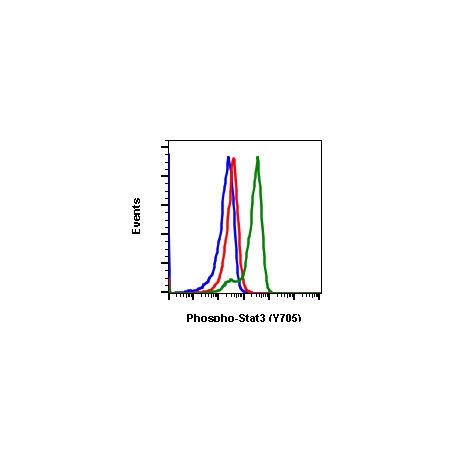
Human STAT3 Antibody : PE (Phospho-Tyr705) (OAAQ00006)
| Datasheets/Manuals | Printable datasheet for OAAQ00006 |
|---|
| Tested Species Reactivity | Human, Mouse |
|---|---|
| Predicted Species Reactivity | Mouse, Rat |
| Product Format | Liquid. 1X PBS, 0.09% NaN3, 0.2% BSA. |
| Clonality | Monoclonal |
| Clone | Stat3Y705-B12 |
| Isotype | Rabbit IgG1k |
| Host | Rabbit |
| Conjugation | PE: Phycoerythrin |
| Application | FC |
| Reconstitution and Storage | 2-8C |
| Immunogen | A synthetic phospho-peptide corresponding to residues surrounding Tyr705 of human phospho Stat3 |
| Purification | Protein A+G |
| Target Post-Translational Modification | Phospho-Tyr705 |
| Application Info | For flow cytometric staining, the suggested use of this reagent is 5 uL per million cells or 5 uL per 100 uL of staining volume. It is recommended that the reagent be titrated for optimal performance for each application. |
| Reference | Avalle L, Pensa S, Regis G, Novelli F, and Poli V. (2012) JAK-STAT. 1: 65-72. Yu H, Pardoll D, and Jove R. (2009) Nature Review Cancer. 9: 798-809. Sakaguchi M, Oka M, Iwasaki T, Fukami Y, and Nishigori C. (2012) Journal of Investigative Dermatology. 132: 1877-1885. |
|---|---|
| Gene Symbol | STAT3 |
| Gene Full Name | signal transducer and activator of transcription 3 |
| Alias Symbols | APRF, HIES, ADMIO, ADMIO1 |
| NCBI Gene Id | 6774 |
| Protein Name | signal transducer and activator of transcription 3 |
| Description of Target | The protein encoded by this gene is a member of the STAT protein family. In response to cytokines and growth factors, STAT family members are phosphorylated by the receptor associated kinases, and then form homo- or heterodimers that translocate to the cell nucleus where they act as transcription activators. This protein is activated through phosphorylation in response to various cytokines and growth factors including IFNs, EGF, IL5, IL6, HGF, LIF and BMP2. This protein mediates the expression of a variety of genes in response to cell stimuli, and thus plays a key role in many cellular processes such as cell growth and apoptosis. The small GTPase Rac1 has been shown to bind and regulate the activity of this protein. PIAS3 protein is a specific inhibitor of this protein. Mutations in this gene are associated with infantile-onset multisystem autoimmune disease and hyper-immunoglobulin E syndrome. Alternative splicing results in multiple transcript variants encoding distinct isoforms. |
| Uniprot ID | P40763 |
| Protein Accession # | NP_003141.2 |
| Nucleotide Accession # | NM_003150.3 |