

Inulin [9005-80-5]

Référence T6544-10g
Conditionnement : 10g
Marque : TargetMol
Contactez votre distributeur local :

Téléphone : +1 850 650 7790
Inulin
Copy Product Info
Inulin(Inulin and sodium chloride), a starch found in the tubers and roots of many plants. Since it is hydrolyzable to fructose, it is classified as a fructosan.
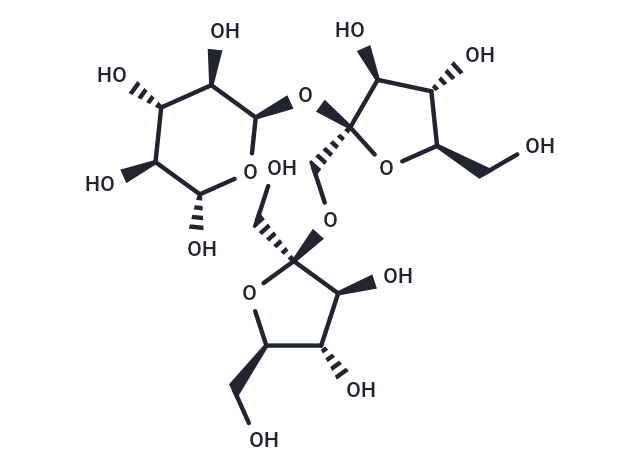
Cas No. 9005-80-5
For research use only—not for human use. No sales to individuals. Use as intended only.
Select Batch
Purity:99%
Color:White
Product Information
Bioactivity
Chemical Properties
Storage & Solubility Information
| Description | Inulin(Inulin and sodium chloride), a starch found in the tubers and roots of many plants. Since it is hydrolyzable to fructose, it is classified as a fructosan. |
| In vitro | Inulin causes (20 g/d and 40 g/d) a significant increase in bifidobacterial counts in feces.[1] Inulin exerts a preferential stimulatory effect on numbers of the health-promoting genus Bifidobacterium, whilst maintaining populations of potential pathogens (Escherichia coli, Clostridium) at relatively low levels. [2] Inulin combined with Bifidobacterium Result in more potent inhibition of aberrant crypt foci (ACF) than administration of the two separately, achieving 80% inhibition of small ACF. [3] Inulin is made by a set of linear chains of fructose molecules, with a degree of polymerization (DP) ranging between 3 and 65, it can be fractionated into a slowly fermentable long-chain fraction (DP ranging from 10 to 65, average 25) or in a rapidly fermentable fraction made of oligofructose (DP ranging from 3 to 8, average 4). [4] Long-chain inulin combined with short-chain oligofructose Result in larger numbers of caecal, colonic and faecal bacteria of the Clostridium coccoides-Eubacterium rectale cluster than Control in rats, whereas OF alone does not affect this bacterial group in caecum, colon or faeces. [5] |
| In vivo | Inulin Result in an increase in caecal wt and beta-glucosidase activity and a decrease in caecal pH were observed in rats given inulin-containing diets (with or without B. longum). [3] |
| Kinase Assay | Affinity determination: In general, in vitro kinase assays are performed using purified kinase and synthetic substrates under standard conditions using the Kinase Profiling service of Upstate Biotechnology. Briefly, for each assay 5–10 mU of purified kinase is used. For GSK3β, cdk1, cdk2, cdk3, cdk5, the kinase is incubated with 1 μM GW5074 in a buffer containing 8 mM MOPS, pH 7.2, 0.2 mM EDTA, 10 mM magnesium acetate and [c- 33P-ATP] for 40 min at room temperature. Kinase activity is quantified by measuring 33P incorporation by spotting an aliquot on P30 filters, washing in 50 mM phosphoric acid and scintillation counting. The buffer composition for c-Raf, JNK1, JNK2, JNK3, MEK1, MKK6, MKK7 is 50 mM Tris pH 7.5, 0.1 mM EGTA, 10 mM magnesium acetate and [c- 33P-ATP]. The peptide substrates used are as follows: For c-Raf, 0.66 mg/mL MBP; for cdks, 0.1 mg/mL histone H1; for JNKs, 3 μM ATF2; for MEK1, 1 μM MAPK2; for MKK6, 1 μM of SAPK2a and for MKK7, 2 μM JNK1α. |
| Molecular Weight | 490.4105 |
| Formula | C17H30O16 |
| Cas No. | 9005-80-5 |
| Smiles | OC[C@H]1O[C@@](CO)(OC[C@@]2(O[C@H]3O[C@H](O)[C@@H](O)[C@H](O)[C@H]3O)O[C@H](CO)[C@@H](O)[C@@H]2O)[C@@H](O)[C@@H]1O |
| Relative Density. | 1.35 g/cm3 |
| Storage | Keep away from direct sunlight,Store under nitrogen,Keep away from moisture Powder: -20°C for 3 years | In solvent: -80°C for 1 year Shipping with blue ice/Shipping at ambient temperature. | |||||||||||||||||||||||||||||||||||
| Solubility Information | Ethanol: < 1 mg/mL (insoluble or slightly soluble) H2O: 95.00 mg/mL (193.72 mM), Sonication is recommended. DMSO: 105.00 mg/mL (214.11 mM), Sonication is recommended.  | |||||||||||||||||||||||||||||||||||
| In Vivo Formulation | 10% DMSO+40% PEG300+5% Tween 80+45% Saline: 2.00 mg/mL (4.08 mM), Sonication is recommended. 10% DMSO+90% Saline: 10.00 mg/mL (20.39 mM), Solution. Please add the solvents sequentially, clarifying the solution as much as possible before adding the next one. Dissolve by heating and/or sonication if necessary. Working solution is recommended to be prepared and used immediately. The formulation provided above is for reference purposes only. In vivo formulations may vary and should be modified based on specific experimental conditions. | |||||||||||||||||||||||||||||||||||
Solution Preparation Table | ||||||||||||||||||||||||||||||||||||
H2O/DMSO
Note : The dilution table applies only to solid products. For liquid products, please calculate the stock solution based on the stated concentration and/or density. | ||||||||||||||||||||||||||||||||||||