
IP-10 ELISA Kit (Rat)

Référence OKAG00110
Conditionnement : 1plate
Marque : Aviva Systems Biology
Contactez votre distributeur local :
 Téléphone : +1 850 650 7790
IP-10 ELISA Kit (Rat) : 96 Wells (OKAG00110)
| Datasheets/Manuals | Printable datasheet for IP-10 ELISA Kit (Rat) : 96 Wells (OKAG00110) |
|---|
| Predicted Species Reactivity | Rat|Rattus norvegicus | ||||||||||||||||||||||
|---|---|---|---|---|---|---|---|---|---|---|---|---|---|---|---|---|---|---|---|---|---|---|---|
| Product Format | 1 x 96-Well Plate or 12 x 8-Well Strips | ||||||||||||||||||||||
| Application | ELISA-Sandwich | ||||||||||||||||||||||
| ELISA Kit Detection Method | Colorimetric 450 nm | ||||||||||||||||||||||
| ELISA Kit Duration | 4.5 hours | ||||||||||||||||||||||
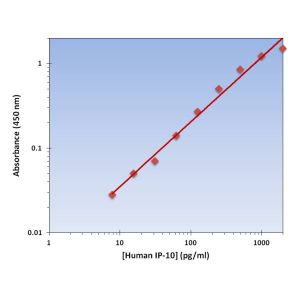
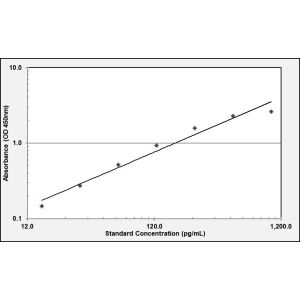
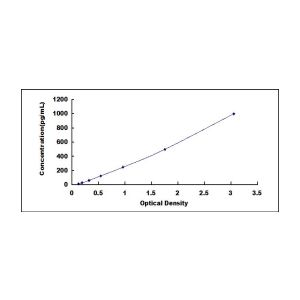
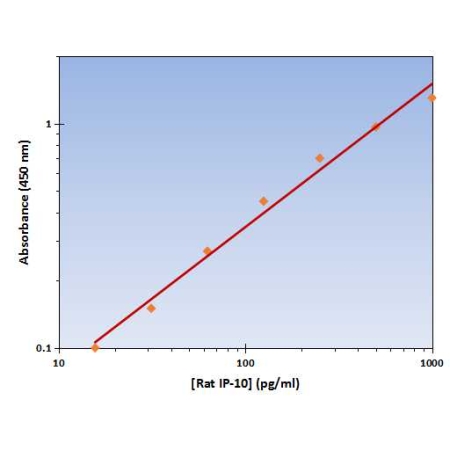
| ELISA Kit Principle | The Aviva Rat IP-10ELISA Kit contains the components necessary for quantitative determination of natural or recombinant rIP-10concentrations within any experimental sample including cell lysates, serum and plasma. This particular immunoassay utilizes the quantitative technique of a "Sandwich" Enzyme-Linked Immunosorbent Assay (ELISA) where the target protein (antigen) is bound in a "sandwich" format by the primary capture antibodies coated to each well-bottom and the secondary detection antibodies added subsequently by the investigator.The capture antibodies coated to the bottom of each well are specific for a particular epitope on theRatIP-10cytokine while the user-added detection antibodies bind to epitopes on the captured target protein. Amid each step of the procedure, a series of wash steps must be performed to ensure the elimination of non-specific binding between proteins to other proteins or to the solid phase. After incubation and "sandwiching" of the target antigen, a peroxidase enzyme is conjugated to the constant heavy chain of the secondary antibody (either covalently or via Avidin/Streptavidin-Biotin interactions), allowing for a colorimetricreaction to ensue upon substrate addition. When the substrate TMB (3, 3’, 5, 5’-Tetramethylbenzidine) is added, the reaction catalyzed by peroxidase yields a blue color that is representative of the antigen concentration. Upon sufficient color development, the reaction can be terminated through addition of Stop Solution (2 N Sulfuric Acid) where the color of the solution will turn yellow. The absorbance of each well can then be read by a spectrophotometer, allowing for generation of a standard curve and subsequent determination of protein concentration. | ||||||||||||||||||||||
| ELISA Kit Range | 16-1000 pg/mL | ||||||||||||||||||||||
| ELISA Kit Component |
| ||||||||||||||||||||||
| Reconstitution and Storage | 2°C to 8°C | ||||||||||||||||||||||
| Sample Type | Cell lysates, sera and plasma | ||||||||||||||||||||||
| Sensitivity | 16 pg/mL | ||||||||||||||||||||||
| Specificity | The Rat IP-10 ELISA is capable of recognizing both recombinant and naturally produced Rat IP-10 proteins. The antigens listed below were tested at 50 ng/ml and exhibited less than 2% cross reactivity. • Murine: IP-10 The antigens listed below were tested at 50 ng/ml and did not exhibit significant cross reactivity or interference. • Human: ENA-78, GCP-2, IL-8 (72 aa), IL-8 (77 aa), IP-10, I-TAC, MIG, NAP-2 • Murine: BCA-1/BLC, I-TAC, MIG, SDF-1α, SDF-1β • Rat: KC | ||||||||||||||||||||||
| Assay Info | Quantitative Colorimentric Sandwich ELISA |
| Gene Symbol | Cxcl10 |
|---|---|
| Gene Full Name | C-X-C motif chemokine ligand 10 |
| Alias Symbols | 10 kDa interferon gamma-induced protein, C-X-C motif chemokine 10, chemokine (C-X-C motif) ligand 10, gamma-IP10, interferon-inducible cytokine IP-10, interferon-inducible protein 10, IP-10, protein Mob-1, Scyb10, small inducible cytokine B subfamily (Cys-X-Cys) member 10, small inducible cytokine B subfamily (Cys-X-Cys), member 10, small-inducible cytokine B10. |
| NCBI Gene Id | 245920 |
| Protein Name | C-X-C motif chemokine 10 |
| Description of Target | In addition to its role as a proinflammatory cytokine, may participate in T-cell effector function and perhaps T-cell development. |
| Uniprot ID | P48973 |
| Protein Accession # | NP_620789.1 |
| Nucleotide Accession # | NM_139089.1 |