



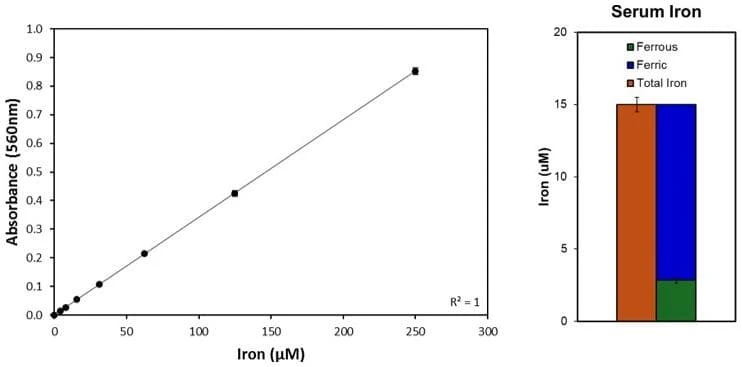
The Iron Colorimetric Assay Kit provides a quick, reproducible, and straightforward method for measuring iron concentration in plasma, serum, and cell lysates.
Iron Assay Kit (Colorimetric)
Iron Assay Kit (Colorimetric)
Contact Us for Bulk Request
Product Description
Specifications
| Size | 1 Plate Kit, 2 Plate Kit, 5 Plate Kit |
| Sensitivity | 0.27 µM |
| Detection Range | 3.91 µM - 250 µM |
| Compatible Sample Types | Plasma, Serum, Cell Lysates |
| Quantitative/Semi-Quantitative | Quantitative |
| Solid Support | 96-well Microplate |
| Method Of Detection | Colorimetric |
| Research Area | Oxidative Stress, Inorganic Ions, Ferroptosis, Energy Metabolism |
| Shipping Type | Blue ice |
| Storage | 4°C |
Related Products
Magnesium Assay Kit (Colorimetric)
As low as $219.00
Copper Assay Kit (Colorimetric)
As low as $219.00
Zinc Assay Kit (Colorimetric)
As low as $249.00
Introduction
In biological systems, iron plays many essential roles, ranging from oxygen transport and activation to electron transfer chemistries and various other redox reactions. Iron is vital to all living organisms, existing in several different forms, including heme groups, iron-sulfur clusters, and nonheme mononuclear and dinuclear iron centers. A deficiency in this essential element, often referred to as iron deficiency anemia, leads to fatigue, mental decline, and, with increasing severity, the development of various neurological disorders. Furthermore, the accumulation of excess iron leads to the production of reactive oxygen species, causing a myriad of other health issues.
The Iron Colorimetric Assay Kit provides a quick, reproducible, and straightforward method for measuring iron concentration in plasma, serum, and cell lysates. In this assay, ferrous iron (Fe2+) reacts with a detector to produce a magenta complex with absorbance at 560 nm. Ferric iron (Fe3+) can be reduced to ferrous iron (Fe2+) with a mild reductant, enabling the measurement of total iron (Fe2+ and Fe3+). The level of ferric iron (Fe3+) can be calculated by subtracting ferrous iron (Fe2+) from total iron.
Kit Components
| Component | Size / Description |
|---|---|
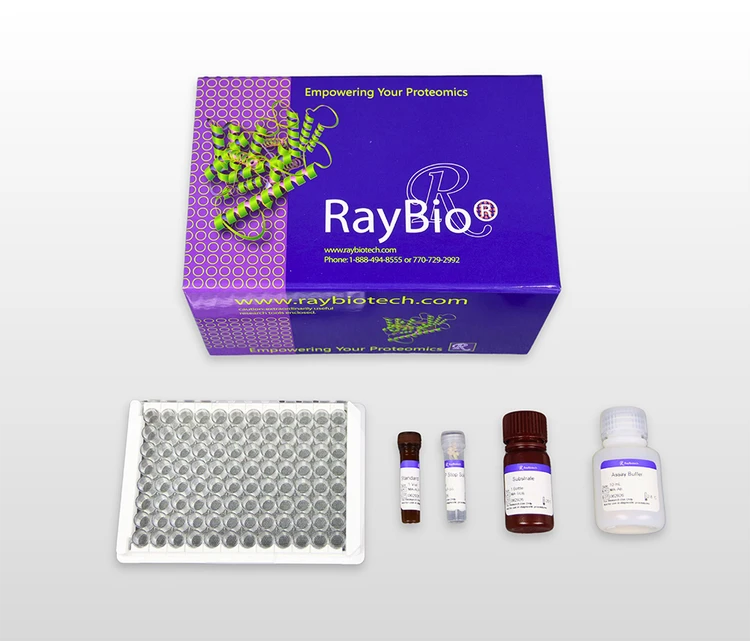
| Microplate | A 96-well (12 strips x 8 wells) plate |
| Assay Buffer | 25 mL |
| Iron (III) Standard | 1 vial |
| Reductant | 2 vials |
| Detector | 2 vials |
Additional Materials Required
- Microplate reader capable of measuring absorbance at 560 nm
- Precision pipettes to deliver 2 μL to 1 mL volumes
- Multi-channel pipettes to deliver 20 µL to 200 µL volumes
- Tubes to prepare sample dilutions
- MilliQ water or other type of double distilled water (ddH2O)
Assay Procedure Summary
- Add the diluted Iron (III) standards or samples to the microtiter plate.
- For Total Iron Content: Add Reductant Working Solution to each well.
For Ferrous Iron Content: Add Assay Buffer to sample wells and Reductant Working Solution to standards wells. - Cover the plate and shake gently to mix.
- Incubate for 10 minutes at room temperature in the dark.
- Add Detector Working Solution to each well.
- Cover the plate and shake gently to mix.
- Incubate for 20 minutes at room temperature in the dark.
- Measure absorbance at 560 nm using a plate reader.
Storage/Stability
The entire kit may be stored at 4°C for up to 6 months from the date of shipment.
documents
citations
Dysregulated iron metabolism in remodeling of aging asthmatic human airways
- Year:
- 2026
- Journal Name:
- American Journal of Physiology-Cell Physiology
- PubMed ID:
- 42526057