KLRK1 Antibody

Référence OAEE00806
Conditionnement : 100tests(T100)
Marque : Aviva Systems Biology
Contactez votre distributeur local :

Téléphone : +1 850 650 7790

| Datasheets/Manuals | Printable datasheet for KLRK1 Antibody |
|---|
| Predicted Species Reactivity | Human |
|---|---|
| Product Format | Stabilizing phosphate buffered saline (PBS), pH 7.4, 15 mM sodium azide |
| Clonality | Monoclonal |
| Clone | 1D11 |
| Isotype | IgG1 |
| Host | Mouse |
| Conjugation | APC |
| Application | FC |
| Reconstitution and Storage | 2°C to 8°C |
| Immunogen | NKL cell line |
| Purification | Purified by size-exclusion chromatography |
| Concentration | 10 ul / test |
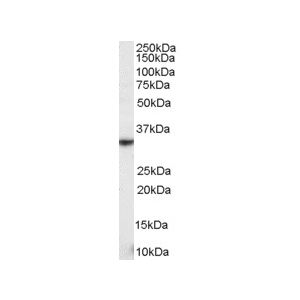
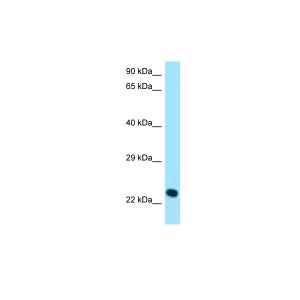
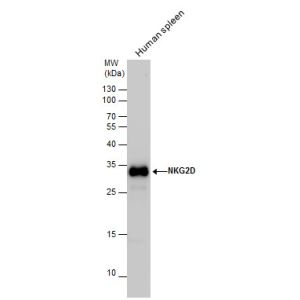
| Specificity | The mouse monoclonal antibody 1D11 recognizes CD314 / NKG2D, a 42 kDa C-type lectin-like activating receptor expressed by NK cells, gamma/delta T cells, and CD8+ T cells. |
| Formulation | APC |
| Storage Buffer | The reagent is provided in phosphate buffered saline (PBS) containing 15 mM sodium azide and 0.2% (w/v) high-grade protease free Bovine Serum Albumin (BSA) as a stabilizing agent. |
| Reference | Valencia J, Hernández-López C, Martínez VG, Hidalgo L, Zapata AG, Vicente A, Varas A, Sacedón R: Transient beta-catenin stabilization modifies lineage output from human thymic CD34+CD1a- progenitors. J Leukoc Biol. 2010 Mar;87(3):405-14. Ebert LM, Meuter S, Moser B: Homing and function of human skin gammadelta T cells and NK cells: relevance for tumor surveillance. J Immunol. 2006 Apr 1;176(7):4331-6. Hasenkamp J, Borgerding A, Uhrberg M, Falk C, Chapuy B, Wulf G, Jung W, Trümper L, Glass B: Self-tolerance of human natural killer cells lacking self-HLA-specific inhibitoryreceptors. Scand J Immunol. 2008 Mar;67(3):218-29. Sangiolo D, Martinuzzi E, Todorovic M, Vitaggio K, Vallario A, Jordaney N, Carnevale-Schianca F, Capaldi A, Geuna M, Casorzo L, Nash RA, Aglietta M, Cignetti A: Alloreactivity and anti-tumor activity segregate within two distinct subsets of cytokine-induced killer (CIK) cells: implications for their infusion across major HLA barriers. Int Immunol. 2008 Jul;20(7):841-8. Wu J, Groh V, Spies T: T cell antigen receptor engagement and specificity in the recognition of stress-inducible MHC class I-related chains by human epithelial gamma delta T cells. J Immunol. 2002 Aug 1;169(3):1236-40. Wu J, Cherwinski H, Spies T, Phillips JH, Lanier LL: DAP10 and DAP12 form distinct, but functionally cooperative, receptor complexes in natural killer cells. J Exp Med. 2000 Oct 2;192(7):1059-68. Bauer S, Groh V, Wu J, Steinle A, Phillips JH, Lanier LL, Spies T: Activation of NK cells and T cells by NKG2D, a receptor for stress-inducible MICA. Science. 1999 Jul 30;285(5428):727-9. |
|---|---|
| Gene Symbol | KLRC4-KLRK1|KLRK1 |
| Gene Full Name | killer cell lectin like receptor K1|KLRC4-KLRK1 readthrough |
| Alias Symbols | CD314, D12S2489E, killer cell lectin-like receptor subfamily K member 1, killer cell lectin-like receptor subfamily K, member 1, KLR, NK cell receptor D, NKG2-D, NKG2-D type II integral membrane protein, NKG2-D-activating NK receptor, NKG2D. |
| NCBI Gene Id | 100528032|22914 |
| Protein Name | NKG2-D type II integral membrane protein |
| Description of Target | Function as an activating and costimulatory receptor involved in immunosurveillance upon binding to various cellular stress-inducible ligands displayed at the surface of autologous tumor cells and virus-infected cells. Provides both stimulatory and costimulatory innate immune responses on activated killer (NK) cells, leading to cytotoxic activity. Acts as a costimulatory receptor for T-cell receptor (TCR) in CD8(+) T-cell-mediated adaptive immune responses by amplifying T-cell activation. Stimulates perforin-mediated elimination of ligand-expressing tumor cells. Signaling involves calcium influx, culminating in the expression of TNF-alpha. Participates in NK cell-mediated bone marrow graft rejection. May play a regulatory role in differentiation and survival of NK cells. Binds to ligands belonging to various subfamilies of MHC class I-related glycoproteins including MICA, MICB, RAET1E, RAET1G, RAET1L/ULBP6, ULBP1, ULBP2, ULBP3 (ULBP2>ULBP1>ULBP3) and ULBP4. |
| Uniprot ID | P26718 |
| Protein Accession # | NP_001186734.1; NP_031386.2 |
| Nucleotide Accession # | NM_001199805.1; NM_007360.3 |