

Major Pollen Allergen Cor a 1, Isoforms 5, 6, 11 and 16, Recombinant, Corylus Avellana, aa2-160, His-SUMO-Tag

Référence 374126-20ug
Conditionnement : 20ug
Marque : US Biological
Contactez votre distributeur local :
 Téléphone : +1 850 650 7790
374126 Major Pollen Allergen Cor a 1, Isoforms 5, 6, 11 and 16, Recombinant, Corylus Avellana, aa2-160, His-SUMO-Tag
Swiss Prot
Q08407Grade
PurifiedShipping Temp
Blue IceStorage Temp
-20°CCauses an allergic reaction in human. The Cor a 1 isoforms display different antigenic and allergenic properties.
Source:
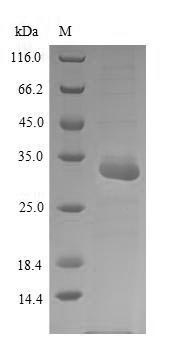
Recombinant protein corresponding to aa2-160 from Corylus avellana Major pollen allergen Cor a 1 isoforms 5, 6, 11 and 16, fused to 6xHis-SUMO-Tag at N-terminal, expressed in E. coli.
Molecular Weight:
~33.4kD
Amino Acid Sequence:
GVFNYEVETPSVIPAARLFKSYVLDGDKLIPKVAPQAITSVENVEGNGGPGTIKNITFGEGSRYKYVKERVDEVDNTNFTYSYTVIEGDVLGDKLEKVCHELKIVAAPGGGSILKISSKFHAKGDHEINAEEMKGAKEMAEKLLRAVETYLLAHSAEYN
Storage and Stability:
Lyophilized and reconstituted products are stable for 6 months after receipt at -20°C. Reconstitute with sterile ddH2O. Aliquot to avoid repeated freezing and thawing. Store at -20°C. For maximum recovery of product, centrifuge the original vial after thawing and prior to removing the cap. Further dilutions can be made in assay buffer.