

Minocycline hydrochloride [13614-98-7]

Référence T1101-50mg
Conditionnement : 50mg
Marque : TargetMol
Contactez votre distributeur local :
 Téléphone : +1 850 650 7790
Minocycline hydrochloride
(Synonyms: Minocycline HCl) Copy Product Info

Minocycline hydrochloride (Minocycline HCl) is a tetracycline antibiotic with excellent absorption and tissue penetration that is used for several bacterial infections as well as treatment of acne. Minocycline hydrochloride can cause both an acute hepatitis-like syndrome occurring within 1 to 3 months of starting therapy or a more insidious chronic hepatitis with autoimmune features typically after long-term treatment.
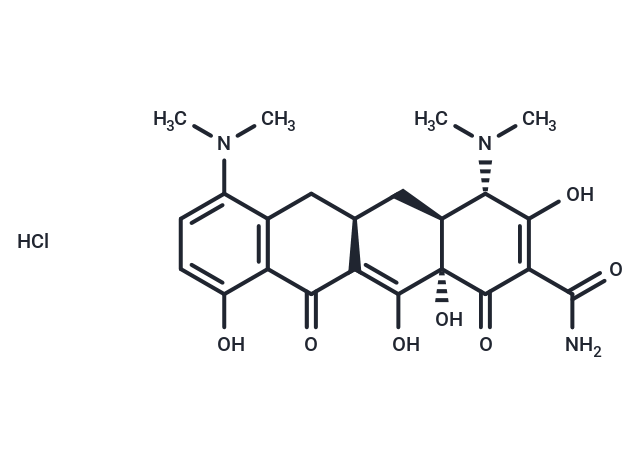
Cas No. 13614-98-7
For research use only—not for human use. No sales to individuals. Use as intended only.
Select Batch
Purity:99.89%
Color:White to Yellow
COA HNMR HPLC
Product Introduction
Bioactivity
Chemical Properties
Storage & Solubility Information
| Description | Minocycline hydrochloride (Minocycline HCl) is a tetracycline antibiotic with excellent absorption and tissue penetration that is used for several bacterial infections as well as treatment of acne. Minocycline hydrochloride can cause both an acute hepatitis-like syndrome occurring within 1 to 3 months of starting therapy or a more insidious chronic hepatitis with autoimmune features typically after long-term treatment. |
| Targets & IC50 | NO production (LPS-induced BV2 cells):9.07 ± 0.86 μM, MCF-7 cells viability:36.10 µM, Ih amplitude:41 μM, NO production (LPS-induced RAW246.7 macrophages):34.81 μM |
| In vitro | Minocycline exhibits significant neuroprotective effects in models of cerebral ischemia, traumatic brain injury, Huntington's disease, and Parkinson's disease. Its neuroprotective properties may involve the inhibition of 5-lipoxygenase (an inflammatory enzyme associated with brain aging). Additionally, Minocycline's activity is linked to the inhibition of protein synthesis. |
| In vivo | Minocycline inhibits the release of cytochrome c mediated by the permeability transition in mitochondria. This inhibition by minocycline on cytochrome c release has been demonstrated in vivo, in cells, and isolated mitochondria. Additionally, minocycline suppresses the activity of inducible caspase-1 and caspase-3, inducible nitric oxide synthase (iNOS), and p38 mitogen-activated protein kinase (MAPK). Following experimental focal ischemia, minocycline reduces the upregulation of caspase-1 and iNOS, thereby decreasing infarct size. |
| Synonyms | Minocycline HCl |
| Molecular Weight | 493.94 |
| Formula | C23H28ClN3O7 |
| Cas No. | 13614-98-7 |
| Smiles | Cl.[C@@H]12[C@](C(=C3[C@H](C2)Cc2c(C3=O)c(ccc2N(C)C)O)O)(C(=O)C(=C([C@H]1N(C)C)O)C(=O)N)O |
| Relative Density. | no data available |
| Storage | Powder: -20°C for 3 years | In solvent: -80°C for 1 year Shipping with blue ice/Shipping at ambient temperature. | ||||||||||||||||||||||||||||||||||||||||
| Solubility Information | H2O: 5 mg/mL (10.12 mM), Sonication is recommended.  DMSO: 257.5 mg/mL (521.32 mM), Sonication is recommended. | ||||||||||||||||||||||||||||||||||||||||
| In Vivo Formulation | Saline: < 1 mg/mL (insoluble) Please add the solvents sequentially, clarifying the solution as much as possible before adding the next one. Dissolve by heating and/or sonication if necessary. Working solution is recommended to be prepared and used immediately. The formulation provided above is for reference purposes only. In vivo formulations may vary and should be modified based on specific experimental conditions. | ||||||||||||||||||||||||||||||||||||||||
Solution Preparation Table | |||||||||||||||||||||||||||||||||||||||||
H2O/DMSO
DMSO
Note : The dilution table applies only to solid products. For liquid products, please calculate the stock solution based on the stated concentration and/or density. | |||||||||||||||||||||||||||||||||||||||||