Biovalley > Mouse CD45.1/Ly-5.1 Antibody : APC/CY7
Mouse CD45.1/Ly-5.1 Antibody : APC/CY7

Référence OASB00581
Conditionnement : 0.1mg
Contactez votre distributeur local :

Téléphone : +1 850 650 7790
Marque : Aviva Systems Biology
Contactez votre distributeur local :
Téléphone : +1 850 650 7790
Mouse CD45.1/Ly-5.1 Antibody : APC/CY7 (OASB00581)
| Datasheets/Manuals | Printable datasheet for Mouse CD45.1/Ly-5.1 Antibody : APC/CY7 (OASB00581) |
|---|
| Tested Species Reactivity | Mouse |
|---|---|
| Predicted Species Reactivity | Mouse |
| Clonality | Monoclonal |
| Clone | A20 |
| Isotype | IgG2a |
| Host | Mouse |
| Conjugation | APC-Cyanine 7 |
| Application | FC |
| Additional Information | Description: The CD45 antigen is an essential regulator of leukocyte activation and development and is now known to be a protein tyrosine phosphatase, e.g., CD45 is able to dephosphorylate the Src family of protein kinases. This activity is now known to be required for signal transduction induced by T and B cell antigen receptor engagement, cytokine signaling, and Fc receptor stimulation. The functional state of CD45 also has a pronounced effect on lymphocyte development. CD45 exists in multiple forms, such as the restricted variants (CD45R; see companion products 1660, 1665, 1675, 1685, and 1820) and as allelic forms CD45.1 (Ly-5.1) and CD45.2 (Ly-5.2). The former arises as a result of alternative splicing of different exons. The specificity of antibodies to CD45.1 and CD45.2 has been exploited in studies where resolution of donor and recipient cells is essential, such as in gene therapy or bone marrow transplantation. The monoclonal antibody A20 recognizes all mouse leukocytes expressing the CD45.1 allotype. |
| Reconstitution and Storage | Store at 2-8C |
| Immunogen | SJL mouse thymocytes and splenocytes |
| Concentration | 0.1 mg/mL |
| Specificity | CD45.1 |
| Characterization | To insure lot- to- lot consistency, each batch of product is tested for conformance with characteristics of astandard reference reagent by flow cytometry. |
| Warning | Reagents contain sodium azide. Sodium azide is very toxic if ingested or inhaled. Avoid contact with skin,eyes, or clothing. Wear eye or face protection when handling. If skin or eye contact occurs, wash withcopious amounts of water. If ingested or inhaled, contact a physician immediately. Sodium azide yieldstoxic hydrazoic acid under acidic conditions. Dilute azide- containing compounds in running water beforediscarding to avoid accumulation of potentially explosive deposits in lead or copper plumbing. |
| Dilution | Flow Cytometry: Fluorescein conjugate Biotin conjugate R-phycoerythrin conjugate Allophycocyanin conjugate Spectral Red conjugate Cyanine 5 conjugate R-PE-CY5.5 and R-PE-CY7 conjugates APC-CY5.5 and APC-CY7 conjugates AF647 conjugate <= 1 ug/106 cells <= 1 ug/106 cells <= 0.2 ug/106 cells <= 0.2 ug/106 cells <= 0.2 ug/106 cells <= 0.2 ug/106 cells <= 0.2 ug/106 cells <= 0.2 ug/106 cells |
| Application Info | Flow cytometry and fluorescence microscopy 5,6, Markers for origin of donor and host cells 6 |
| Other Applications Data | Since applications vary, you should determine the optimum working dilutionof the product that is appropriate for your specific need. |
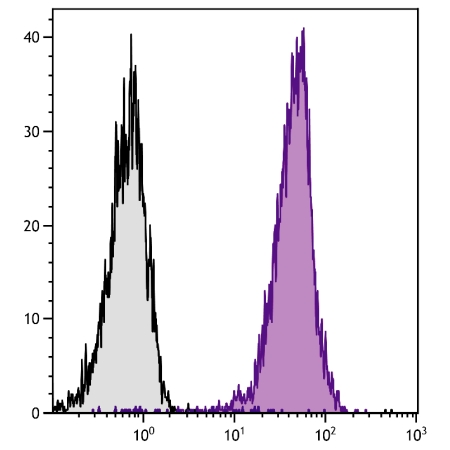
| Other Applications Image 1 Data | Amount Used: ≤1 ug/106 cells SJL spleen cells were stained with mouse antimouse CD45.1-FITC, following which small lymphocytes were gated and analyzed on a FACScan flow cytometer (BDIS, San Jose, CA). |
| Storage | - The purified (UNLB) antibody is supplied as 0.5 mg of purified immunoglobulin in 1.0 mL of 100 mM boratebuffered saline, pH 8.2. No preservatives or amine- containing buffer salts added. Store at 2- 8 C - The fluorescein (FITC) conjugate is supplied as 0.5 mg in 1.0 mL of PBS/NaN3. Store at 2- 8 C - The biotin (BIOT) conjugate is supplied as 0.5 mg in 1.0 mL of PBS/NaN3. Store at 2- 8 C - The R- phycoerythrin (R- PE) conjugate is supplied as 0.1 mg in 1.0 mL or 0.2 mg in 2.0 mL of PBS/NaN3 and astabilizing agent. Store at 2- 8 C. Do not freeze! - The Allophycocyanin (APC) conjugate is supplied as 0.1 mg in 1.0 mL of PBS/NaN3 and a stabilizing agent Store at 2- 8 C. Do not freeze! - The Spectral Red (SPRD), R- phycoerythrin- Cyanine 5.5 (R- PE- CY 5.5), R- phycoerythrin- Cyanine 7 (R- PECY 7), Allophycocyanin- Cyanine 5.5 (APC- CY 5.5) and Allophycocyanin- Cyanine 7 (APC- CY 7) conjugatesare supplied as 0.1 mg in 1.0 mL of PBS/NaN3 and a stabilizing agent. Store at 2- 8 C. Do not freeze! - The Cyanine 5 (CY 5) conjugate is supplied as 0.1 mg in 1.0 mL of PBS/NaN3. Store at 2- 8 C - The Alexa Fluor 647 (AF647) conjugate is supplied as 0.1mg in 0.2mL of PBS/NaN3. Store at 2- 8 C - Protect conjugated forms from light. Each reagent is stable for the period shown on the bottle label if stored asdirected. |
| Reference | 1. Okumura, M. and M. L. Thomas. 1995. Current Opin. Immunol. 7:312- 319 2. Thomas. M. L. 1995. Seminars in Immunol. 7:279- 288 3. Mardiney, M and H. L. Malech. 1996. Blood 87:4049- 4056 4. Vallera, D. A., et al. 1994. Transplantation 57:249- 256 5. Wilson, A., H.R. MacDonald, and F. Radtke. 2001. J. Exp. Med. 194(7):1003 6. Parmar, K., P. Mauch, J. Vergilio, R. Sackstein, and J.D. Down. 2007. Proc. Natl. Acad. Sci. USA 104(13):5431. |
|---|---|
| Gene Symbol | PTPRC |
| Gene Full Name | Receptor-type tyrosine-protein phosphatase C |
| Alias Symbols | Ly-, loc, B220, Cd45, L-CA, Ly-5, Lyt-, T200, CD45R, Lyt-4 |
| NCBI Gene Id | 19264 |
| Protein Name | receptor-type tyrosine-protein phosphatase C |
| Uniprot ID | P06800 |
| Protein Accession # | NP_001104786.2 |
| Nucleotide Accession # | NM_001111316.2 |
Protein interactions
| Name | # of Products |
|---|---|
| ANP32A | 89 |
| C | 150 |
| CD1D | 104 |
| CD2 | 157 |
| CD247 | 234 |
| CD28 | 117 |
| CD4 | 497 |
| CD8A | 170 |
| CSNK2A1 | 551 |
| CSNK2A2 | 274 |
| CXCR4 | 126 |
| DPP4 | 131 |
| EZR | 276 |
| FCGR3A | 132 |
| FYN | 597 |
| GANAB | 68 |
| GRB2 | 1020 |
| IFNAR1 | 93 |
| INSR | 215 |
| IRS1 | 138 |
| ITGAL | 131 |
| JAK1 | 208 |
| JAK2 | 257 |
| JAK3 | 169 |
| LCK | 537 |
| LCP2 | 128 |
| LGALS1 | 190 |
| LSM1 | 97 |
| LYN | 366 |
| MBL2 | 86 |
| PAEP | 72 |
| PPFIA1 | 88 |
| PPFIBP2 | 62 |
| PRKCSH | 77 |
| PTPN6 | 335 |
| PTPRC | 283 |
| PTPRCAP | 60 |
| RASA1 | 218 |
| RNF11 | 156 |
| SEMA4D | 79 |
| SKAP1 | 83 |
| TYK2 | 111 |
| UBC | 7030 |
| UHRF2 | 207 |
| ZAP70 | 252 |
Biological pathways
| Name | # of Products |
|---|---|
| Axon guidance | 739 |
| B cell proliferation | 243 |
| B cell receptor signaling pathway | 217 |
| Defense response to virus | 284 |
| Immunoglobulin biosynthetic process | 61 |
| Negative regulation of cytokine-mediated signaling pathway | 119 |
| Negative regulation of protein kinase activity | 216 |
| Negative regulation of T cell mediated cytotoxicity | 120 |
| Positive regulation of antigen receptor-mediated signaling pathway | 113 |
| Positive regulation of B cell proliferation | 254 |
| Positive regulation of protein kinase activity | 132 |
| Positive regulation of T cell proliferation | 211 |
| Regulation of S phase | 64 |
| Release of sequestered calcium ion into cytosol | 160 |
| T cell differentiation | 128 |
| T cell receptor signaling pathway | 453 |
Biological process
| Name | # of Products |
|---|---|
| Axon guidance | 286 |
| B cell proliferation | 22 |
| B cell receptor signaling pathway | 35 |
| Bone marrow development | 7 |
| Cell surface receptor signaling pathway | 179 |
| Defense response to virus | 72 |
| Dephosphorylation | 39 |
| Hemopoietic progenitor cell differentiation | 18 |
| Immunoglobulin biosynthetic process | 5 |
| Negative regulation of cell adhesion involved in substrate-bound cell migration | 5 |
| Negative regulation of cytokine-mediated signaling pathway | 13 |
| Negative regulation of protein kinase activity | 53 |
| Negative regulation of T cell mediated cytotoxicity | 7 |
| Peptidyl-tyrosine dephosphorylation | 56 |
| Positive regulation of antigen receptor-mediated signaling pathway | 4 |
| Positive regulation of B cell proliferation | 66 |
| Positive regulation of hematopoietic stem cell migration | 3 |
| Positive regulation of protein kinase activity | 36 |
| Positive regulation of stem cell proliferation | 8 |
| Positive regulation of T cell proliferation | 93 |
| Protein dephosphorylation | 88 |
| Regulation of cell cycle | 69 |
| Regulation of S phase | 9 |
| Release of sequestered calcium ion into cytosol | 29 |
| Stem cell development | 12 |
| T cell differentiation | 39 |
| T cell receptor signaling pathway | 90 |
Cellular components
| Name | # of Products |
|---|---|
| External side of plasma membrane | 261 |
| Focal adhesion | 101 |
| Integral to plasma membrane | 817 |
| Membrane raft | 140 |
| Plasma membrane | 2678 |
Protein function
| Name | # of Products |
|---|---|
| Hydrolase activity | 1739 |
| Protein binding | 12191 |
| Protein kinase binding | 1101 |
| Protein tyrosine phosphatase activity | 281 |
| Receptor activity | 3624 |
| Transmembrane receptor protein tyrosine phosphatase activity | 116 |
Diseases
| Name | # of Products |
|---|---|
| Disease mutation | 5332 |
| SCID | 125 |
-
 Human CD45RA Antibody : SPRD (OASB01115)Catalog #: OASB01115Conjugation: Spectral Red®Clone: F8-11-13Species Tested: HumanApplication: FC
-
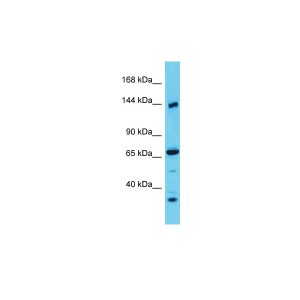 Ptprc Antibody - middle region (ARP59108_P050)Catalog #: ARP59108_P050Species Tested: Human, RatApplication: WBFormat: Liquid. Purified antibody supplied in 1x PBS buffer with 0.09% (w/v) sodium azide and 2% sucrose.
-
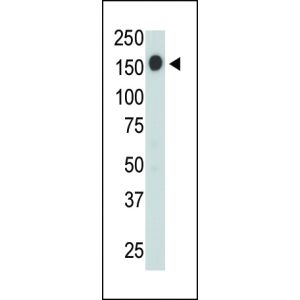 CD45 Antibody - C-terminal region (OAAB11608)Catalog #: OAAB11608Application: FC,IHC-P,WBFormat: Purified polyclonal antibody supplied in PBS with 0.09% (W/V) sodium azide. This antibody is prepared by Saturated Ammonium Sulfate (SAS) precipitation followed by dialysis against PBS.
-
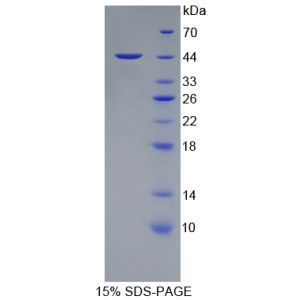 PTPRC Recombinant Protein (OPCD06515)Catalog #: OPCD06515Conjugation: UnconjugatedApplication: Ctrl (+), SDS-PAGE, WBFormat: Freeze-dried Powder. PBS, pH7.4, containing 0.01% SKL, 5% Trehalose.
-