



Quantibody® Mouse Cytokine Array 14 Kit. Suitable for all liquid sample types.
Mouse Cytokine Array Q14
Mouse Cytokine Array Q14
Contact Us for Bulk Request
Product Description
Specifications
| Size | 8 Sample Kit, 22 Sample Kit, 50 Sample Kit |
| Species | Mouse |
| Compatible Sample Types | Cell Culture Supernatants, Plasma, Serum, Tissue Lysates, Cell Lysates |
| Quantitative/Semi-Quantitative | Quantitative |
| Number of Targets Detected | 40 |
| Solid Support | Glass Slide |
| Design Principle | Sandwich-based |
| Method Of Detection | Fluorescence Laser Scanner |
| Shipping Type | Blue ice |
Product Features
- More cost-effective than traditional ELISA
- High specificity and system reproducibility
- Suitable for diverse sample types
- Low sample volume requirement: 50 µL or less
- Get results same day (6-hour processing time)
- Well-suited for high throughput assays
- Q Analyzer software provides one-step computation
Target Names
| Scroll over each target protein for more information | ||||
|---|---|---|---|---|
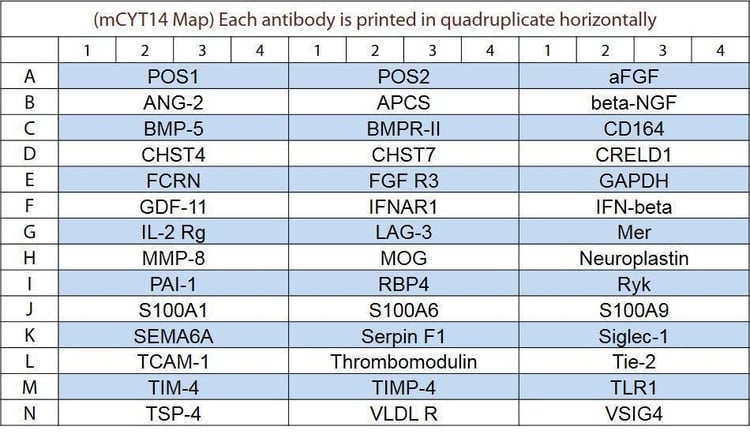
| aFGF (FGF-1)
| Angiopoietin-2
| APCS
| beta-NGF
| BMP-5
|
| BMPR-II
| Carbohydrate Sulfotransferase 7 (CHST7)
| CD164
| CHST4 (GST-3)
| CRELD1
|
| FCRN
| FGF R3
| GAPDH
| GDF-11 (BMP-11)
| IFNAR1
|
| IFN-beta
| IL-2 R gamma (Common gamma Chain)
| LAG-3
| Mer
| |
| MOG
| Neuroplastin
| PAI-1
| RBP4
| Ryk
|
| S100A1
| S100A6
| S100A9
| Semaphorin 6A
| SERPINF1 (PEDF)
|
| Siglec-1 (CD169)
| TCAM-1
| Thrombomodulin
| Tie-2
| TIM-4
|
| TIMP-4
| TLR1
| TSP-4
| VSIG4
| |
Application Notes
Suggested Application
Multiplexed Protein Detection; Biomarker Screening; Identifying Key Factors; Confirming Biological Process; Biomarker Validation; Validation of Antibody Array Results; Quantitative Protein Detection; Establishing Normal Range
Kit Components
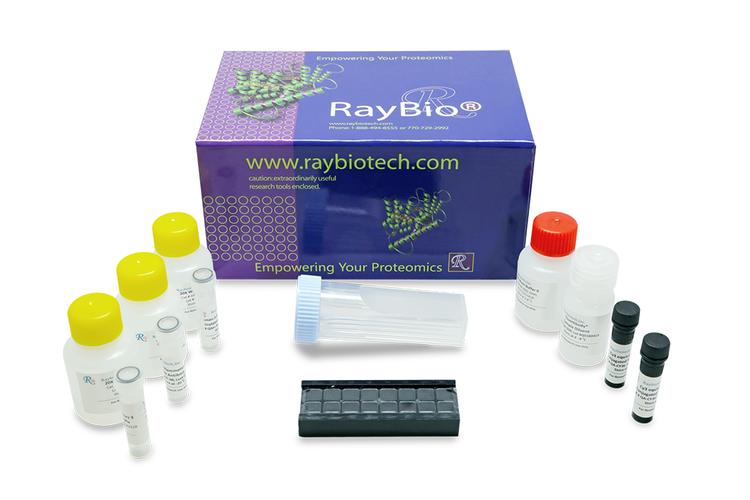
- Mouse Cytokine Array Q14 Slide(s)
- Blocking Buffer
- Wash Buffer 1
- Wash Buffer 2
- Lyophilized Standard Mix
- Biotinylated Detection Antibody Cocktail
- Streptavidin-Conjugated Fluor
- 30 ml Centrifuge Tube
- Adhesive Plastic Strips
- Manual
Other Materials Required
- Distilled or deionized water
- Small plastic boxes or containers
- Pipettors, pipette tips and other common lab consumables
- Orbital shaker or oscillating rocker
- Aluminum foil
- Gene microarray scanner or similar laser fluorescence scanner
View Compatible Laser Scanners
Don't have a compatible scanner? RayBiotech now offers FREE scanning service for all RayBio glass slide antibody arrays! Learn More
Protocol Outline
- Dry the glass slide
- Prepare Standards
- Block array surface
- Incubate with Samples and Standards
- Incubate with Biotinylated Detection Antibody Cocktail
- Incubate with Streptavidin-Conjugated Fluor
- Disassemble the glass slide
- Scan with a gene microarray laser scanner
- Perform densitometry and analysis
Storage/Stability
For best results, store the entire kit frozen at -20°C upon arrival. Stored frozen, the kit will be stable for at least 6 months which is the duration of the product warranty period. Once thawed, store array slide(s), standard mix, detection antibody cocktail, and Cy3-Conjugated Streptavidin at -20°C and all other reagents undiluted at 4°C for no more than 3 months.
documents
citations
Secretome Profiling of Young Multipotent Stem Cells Reveals Angiogenic and Immunomodulatory Mechanisms Supporting Aged Neuromuscular Health
- Species:
- Mouse
- Sample Type:
- Cell Culture Supernatant (culture media from young, old MDSPCs)
- Year:
- 2026
- Journal Name:
- Aging Cell
- PubMed ID:
- 41674450
HPV16-Expressing Tumors Release Multiple IL1 Ligands to Orchestrate Systemic Immunosuppression Whose Disruption Enables Efficacy of a Therapeutic Vaccine
- Species:
- Mouse
- Sample Type:
- Serum (K14HPV16/H2b vs FVBN/H2b mice)
- Year:
- 2025
- Journal Name:
- Cancer Discovery
- PubMed ID:
- 40287949
The Bacterial Outer Membrane Vesicle-Cloaked Immunostimulatory Nanoplatform Reinvigorates T Cell Function and Reprograms Tumor Immunity
- Species:
- Mouse
- Sample Type:
- Serum (4T1 tumor-bearing BALB/c mice)
- Year:
- 2025
- Journal Name:
- ACS Nano
- PubMed ID:
- 40392526
Platelet-derived chemokines promote skeletal muscle regeneration by guiding neutrophil recruitment to injured muscles
- Species:
- Mouse
- Sample Type:
- muscle tissue
- Year:
- 2023
- Journal Name:
- Nature Communications
Phosgene inhalation injury in mice: Modeling human pathophysiology, biomarker discovery, and therapeutic target identification
- Year:
- 2026
- Journal Name:
- Toxicology and Applied Pharmacology
- PubMed ID:
- 42575345