



Use code ELISA25-262 for 25% off all ELISAs through November.
25% off all ELISA kits
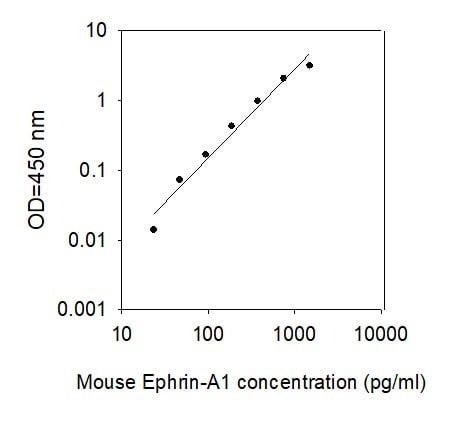

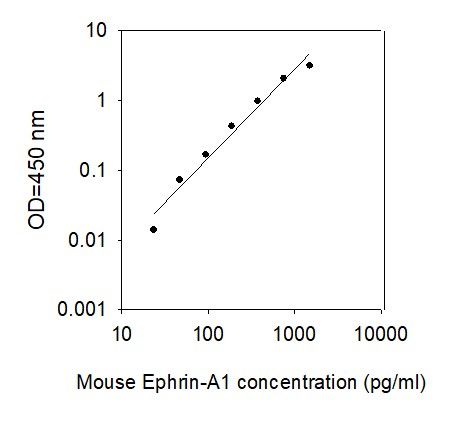
Mouse Ephrin-A1 ELISA Kit Standard Curve
Mouse Ephrin-A1 ELISA Kit
The Mouse Ephrin-A1 ELISA Kit is a pre-coated sandwich-based assay kit designed to quantitatively measure EphA1 (EFNA1) levels in mouse cell culture supernatants, plasma, and serum.
Lead time: Typically ships within 1-2 business days. No Friday shipments.
Contact Us for Bulk Request
Product Description
Specifications
| Size | 1 Plate Kit, 2 Plate Kit, 5 Plate Kit |
| Species | Mouse |
| Sensitivity | 12.8 pg/mL |
| Detection Range | 12.8 pg/mL - 1500 pg/mL |
| Specificity | This ELISA antibody pair detects mouse Ephrin-A1. Other species not determined. |
| Compatible Sample Types | Cell Culture Supernatants, Plasma, Serum |
| Recommended Dilution (Serum/Plasma) | 100 fold |
| Accession Number | P52793 |
| Protein Name / Synonyms | Ephrin-A1 (EPH-related receptor tyrosine kinase ligand 1) (LERK-1) (Immediate early response protein B61) [Cleaved into: Ephrin-A1, secreted form] |
| Quantitative/Semi-Quantitative | Quantitative |
| Solid Support | 96-well Microplate |
| Design Principle | Sandwich-based |
| Method Of Detection | Colorimetric |
| Research Area | Angiogenesis, Cardiovascular Disease |
| Shipping Type | Blue ice |
| Storage | -20°C |
Product Features
- Strip plates and additional reagents allow for use in multiple experiments
- Quantitative protein detection
- Establishes normal range
- The best products for confirmation of antibody array data
Standard Curves
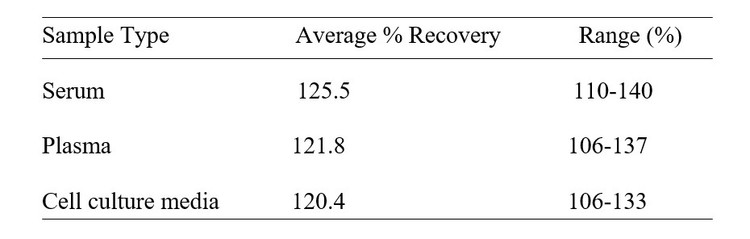
Spiking & Recovery Results
| Sample Type | Average % Recovery | Range (%) |
|---|---|---|
| Serum | 125.5 | 110-140 |
| Plasma | 121.8 | 106-137 |
| Cell culture media | 120.4 | 106-133 |
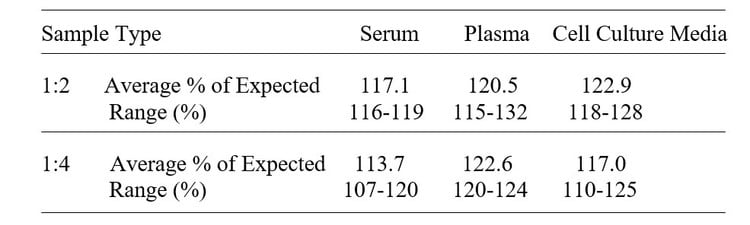
Linearity Results
| Sample Type | Serum | Plasma | Cell Culture Media | |
|---|---|---|---|---|
| 1:2 | Average % of Expected | 117.1 | 120.5 | 122.9 |
| Range (%) | 116-119 | 115-132 | 118-128 | |
| 1:4 | Average % of Expected | 113.7 | 122.6 | 117.0 |
| Range (%) | 107-120 | 120-124 | 110-125 | |
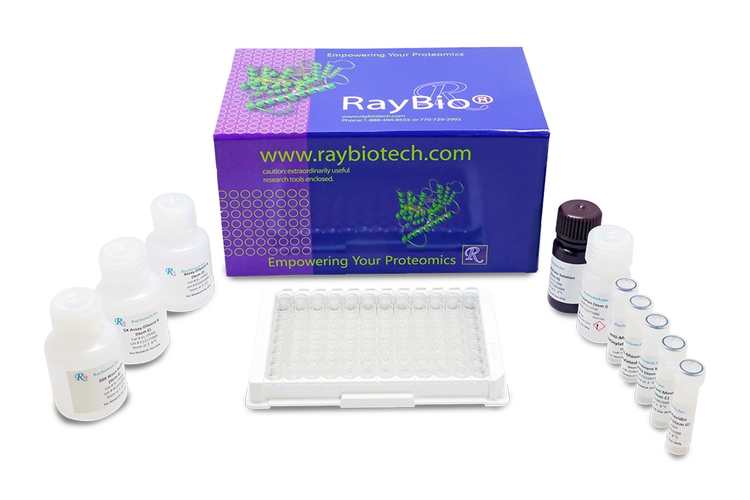
Kit Components
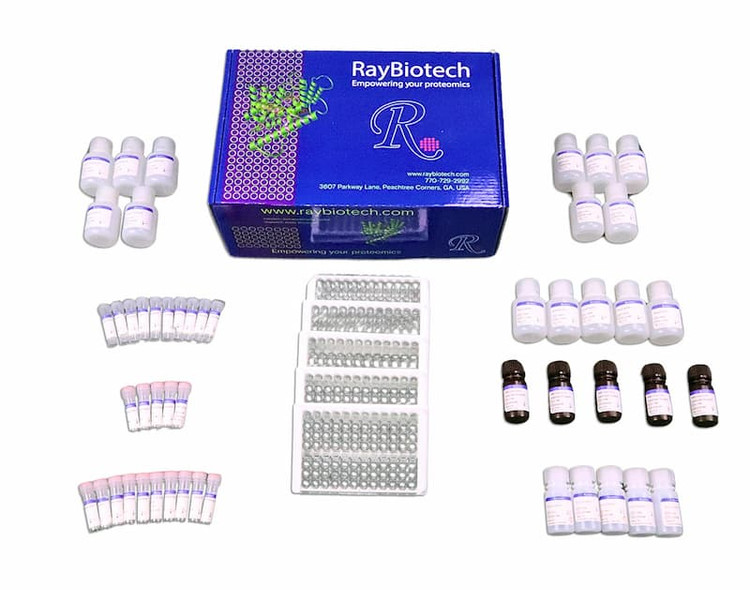
- Pre-Coated 96-well Strip Microplate
- Lyophilized Standard
- Biotinylated Detection Antibody
- Streptavidin-Conjugated HRP
- Wash Buffer
- TMB One-Step Substrate Reagent
- Stop Solution
- Assay Diluent(s)
- Adhesive Sealing Film
Additional Materials Required
- Microplate reader capable of measuring absorbance at 450 nm
- Precision pipettes to deliver 2 µL to 1 µL volumes
- Adjustable 1-25 µL pipettes for reagent preparation
- 100 µL and 1 liter graduated cylinders
- Absorbent paper
- Distilled or deionized water
- Log-log graph paper or computer and software for ELISA data analysis
- Tubes to prepare standard or sample dilutions
- Plastic wrap
Assay Procedure Summary
- Prepare all reagents, samples and standards as instructed in the manual.
- Add 100 µL standard or sample to each well. Incubate 2.5 hours at room temperature.
- Add 100 µL prepared biotin antibody to each well. Incubate 1 hour at room temperature.
- Add 100 µL prepared Streptavidin solution to each well. Incubate 45 minutes at room temperature.
- Add 100 µL TMB One-Step Substrate Reagent to each well. Incubate 30 minutes at room temperature.
- Add 50 µL Stop Solution to each well. Read at 450 nm immediately
Storage/Stability
The entire kit may be stored at -20°C for up to 1 year from the date of shipment. Avoid repeated freeze-thaw cycles. The kit may be stored at 4°C for up to 6 months. For extended storage, it is recommended to store at -80°C.
Customize This Mouse Ephrin-A1 ELISA
We manufacture our ELISAs in-house, so we can build a custom version for your study.
- Post-translational modifications (PTMs): Detect modified EphA1 (EFNA1), including phosphorylation, acetylation, S-nitrosylation, S-acylation, oxidation, lactylation, sumoylation, ubiquitination, nitration, carbamylation, and more
- Sample types: Validation in your matrix using samples you provide, such as CSF, urine, saliva, lysates, or exosomes
- Also available: More sensitive platforms such as Simoa® and NexaTag®, multiplex panels, bulk lots, and other species when suitable reagents exist
Feasibility varies by target and modification, and we’ll tell you upfront what’s achievable.
Learn more about custom ELISA development
