

Paravalbumin Antibody, Clone C12: ATTO 390

Référence MBS8005806-0,1mg
Conditionnement : 0.1mg
Marque : MyBiosource
Contactez votre distributeur local :

Téléphone : +1 850 650 7790
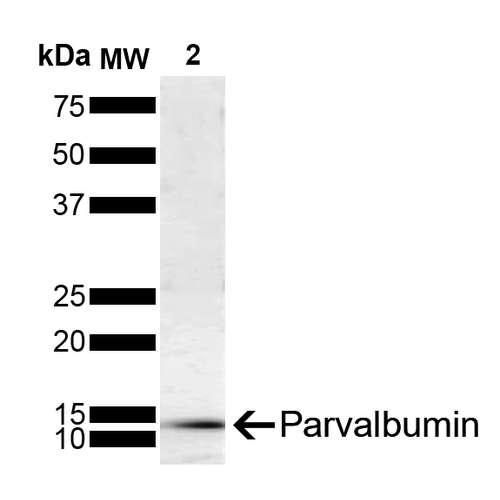
Western Blot analysis of Rat brain showing detection of Parvalbumin protein using Mouse Anti-Parvalbumin Monoclonal Antibody, Clone C12 (SMC-563). Load: 15 ug. Primary Antibody: Mouse Anti-Parvalbumin Monoclonal Antibody (SMC-563) at 1:500 for 2 hours at RT with shaking. Secondary Antibody: Goat anti-mouse IgG:HRP at 1:4000 for 1 hour at RT with shaking. Color Development: Chemiluminescent for HRP (Moss) for 5 min in RT.
Parvalbumin (PVALB) Antibody – Mouse Monoclonal
For Research Use Only. Not for use in diagnostic procedures. Catalog #: MBS8005806Background: Parvalbumin is involved in calcium signaling. Alterations in the function of parvalbumin-expressing neurons hav been implicated in Alzheimer's, autism, schizophrenia, age-related cognitive defects and some forms of cancer (1). More details
Product Overview
Online Datasheet in PDFProduct Name
Parvalbumin (Pvalb), Monoclonal Antibody
Full Product Name
Paravalbumin Antibody, Clone C12: ATTO 390
Product Gene Name
anti-Pvalb antibody
Product Synonym Names
Mouse Anti-Rat Paravalbumin Monoclonal IgG2a; Parvalbumin alpha antibody; PRVA_HUMAN antibody; PVALB antibody
Clonality
Monoclonal
Isotype
IgG2a
Clone Number
C12
Host
Mouse
Species Reactivity
Rat, Mouse
Form/Format
PBS pH 7.4, 50% glycerol, 0.09% Sodium Azide
Purity/Purification
Protein A Purified
Concentration
1mg/ml (lot specific)
Specificity
Detects 12 kDa.
Preparation and Storage
Store at -20 degree C
Shipping Temperature: Blue Ice or 4 degree C
Shipping Temperature: Blue Ice or 4 degree C
Immunogen
Synthetic peptide from the full length Rat Parvalbumin protein
Immunogen Species
Rat
Tissue Specificity
Retina. Expressed throughout the horizontal cells and/or terminals.
Conjugate
ATTO 390
Cellular Localization
Cytoplasmic vesicle membrane
Certificate of Analysis
A 1:500 dilution was sufficient for detection of Parvalbumin in 15 ug of Rat Brain by ECL immunoblot analysis using goat anti-mouse IgG:HRP as the secondary antibody.
Product Categories/Family for anti-Pvalb antibody
Neuroscience; Neurotransmission; Calcium Signaling; Antibodies
Applications Tested/Suitable for anti-Pvalb antibody
Western Blot (WB), ELISA (EIA)
Application Notes for anti-Pvalb antibody
WB: 1:500
Western Blot (WB) of anti-Pvalb antibody
Western Blot analysis of Rat brain showing detection of Parvalbumin protein using Mouse Anti-Parvalbumin Monoclonal Antibody, Clone C12 (SMC-563). Load: 15 ug. Primary Antibody: Mouse Anti-Parvalbumin Monoclonal Antibody (SMC-563) at 1:500 for 2 hours at RT with shaking. Secondary Antibody: Goat anti-mouse IgG:HRP at 1:4000 for 1 hour at RT with shaking. Color Development: Chemiluminescent for HRP (Moss) for 5 min in RT.
Product References and Citations for anti-Pvalb antibody
1. Cates. M.S., Teodoro M.L., Phillips G.N. (2002) Biophys J. 82(3): 1133-1146.
Other Notes
Small volumes of anti-Pvalb antibody vial(s) may occasionally become entrapped in the seal of the product vial during shipment and storage. If necessary, briefly centrifuge the vial on a tabletop centrifuge to dislodge any liquid in the container`s cap. Certain products may require to ship with dry ice and additional dry ice fee may apply.
Searchable Terms for Pvalb purchase
MBS8005806 is an antibody targeting Pvalb. Also known as Paravalbumin Antibody, Clone C12: ATTO 390. Reactive in Rat, Mouse. Host: Mouse.
Additional Details
NCBI/Uniprot data below describe general gene information for Pvalb. It may not necessarily be applicable to this product.
NCBI Official Full Name
parvalbumin alpha
NCBI Official Synonym Full Names
parvalbumin
NCBI Official Symbol
Pvalb
NCBI Official Synonym Symbols
Pva; PALB1
UniProt Protein Name
Parvalbumin alpha
Protein Family
Parvalbumin
UniProt Gene Name
Pvalb
UniProt Synonym Gene Names
Pva
UniProt Entry Name
PRVA_RAT
NCBI Protein Information
parvalbumin alpha
NCBI Summary for Pvalb
binds two calcium ions; may have evolved from an ancestral four domain calcium binding protein [RGD, Feb 2006]
UniProt Comments for Pvalb
PVA: In muscle, parvalbumin is thought to be involved in relaxation after contraction. It binds two calcium ions. Belongs to the parvalbumin family.
Cellular Component: protein complex; cell soma; axon; cytoplasm; terminal button; nucleus
Molecular Function: protein homodimerization activity; protein heterodimerization activity; calcium ion binding
Biological Process: cytosolic calcium ion homeostasis
Show more Cellular Component: protein complex; cell soma; axon; cytoplasm; terminal button; nucleus
Molecular Function: protein homodimerization activity; protein heterodimerization activity; calcium ion binding
Biological Process: cytosolic calcium ion homeostasis
Precautions
All of MyBioSource's Products are for scientific laboratory research purposes and are not for diagnostic, therapeutics, prophylactic or in vivo use. Through your purchase, you expressly represent and warrant to MyBioSource that you will properly test and use any Products purchased from MyBioSource in accordance with industry standards. MyBioSource and its authorized distributors reserve the right to refuse to process any order where we reasonably believe that the intended use will fall outside of our acceptable guidelines.
Disclaimer
While every efforts were made to ensure the accuracy of the information provided in this datasheet, MyBioSource will not be liable for any omissions or errors contained herein. MyBioSource reserves the right to make changes to this datasheet at any time without prior notice.
It is the responsibility of the customer to report product performance issues to MyBioSource within 30 days of receipt of the product. Please visit our Terms & Conditions page for more information.
It is the responsibility of the customer to report product performance issues to MyBioSource within 30 days of receipt of the product. Please visit our Terms & Conditions page for more information.
Product Note
Select online data sheet information is drawn from bioinformatics databases, occasionally resulting in ambiguous or non-relevant product information. It is the responsibility of the customer to review, verify, and evaluate the information to make sure it matches their requirements before purchasing the kit. Our ELISA Kit assays are dynamic research tools and sometimes they may be updated and improved. If the format of this assay is important to you then please request the current manual or contact our technical support team with a presales inquiry before placing an order. We will confirm the current details of the assay. We cannot guarantee the sample manual posted online is the most current manual, it is intended to serve as an example only. Please refer to the instructions For Use provided with the assay kit for precise details.
Product PubMed Publications
Diseases associated with anti-Pvalb antibody
| Disease Name | Pubmed Publications |
|---|---|
| Prenatal Exposure Delayed Effects Antibodies | >4 publications with Pvalb and Prenatal Exposure Delayed Effects |
| Nervous System Diseases Antibodies | >4 publications with Pvalb and Nervous System Diseases |
| Adenoma, Oxyphilic Antibodies | >2 publications with Pvalb and Adenoma, Oxyphilic |
| Carcinoma, Renal Cell Antibodies | >2 publications with Pvalb and Carcinoma, Renal Cell |
| Schizophrenia Antibodies | >2 publications with Pvalb and Schizophrenia |
| Nervous System Malformations Antibodies | >1 publications with Pvalb and Nervous System Malformations |
| Neurobehavioral Manifestations Antibodies | >1 publications with Pvalb and Neurobehavioral Manifestations |
| Nerve Degeneration Antibodies | >1 publications with Pvalb and Nerve Degeneration |
| Necrosis Antibodies | >1 publications with Pvalb and Necrosis |
| Atrophy Antibodies | >1 publications with Pvalb and Atrophy |
Organs/Tissues associated with anti-Pvalb antibody
| Organ/Tissue Name | Pubmed Publications |
|---|---|
| Brain Antibodies | >15 publications with Pvalb and Brain |
| Muscle Antibodies | >8 publications with Pvalb and Muscle |
| Eye Antibodies | >2 publications with Pvalb and Eye |
| Ovary Antibodies | >1 publications with Pvalb and Ovary |