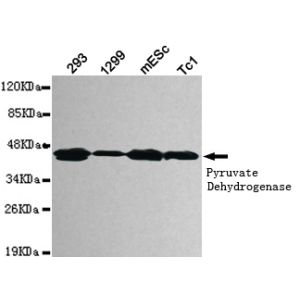

PDHA1 ELISA Kit (Mouse)

Référence OKEH07104
Conditionnement : 96Wells
Marque : Aviva Systems Biology
Contactez votre distributeur local :
 Téléphone : +1 850 650 7790
PDHA1 ELISA Kit (Mouse) (OKEH07104)
| Datasheets/Manuals | Printable datasheet for PDHA1 ELISA Kit (Mouse) (OKEH07104) |
|---|
| Predicted Species Reactivity | Mouse|Mus musculus | ||||||||||||||||||||||
|---|---|---|---|---|---|---|---|---|---|---|---|---|---|---|---|---|---|---|---|---|---|---|---|
| Application | ELISA-Sandwich | ||||||||||||||||||||||
| ELISA Kit Detection Method | Colorimetric, OD 450 nm | ||||||||||||||||||||||
| ELISA Kit Duration | ~3 Hours | ||||||||||||||||||||||
| ELISA Kit Principle | Aviva Systems Biology Pdha1 ELISA Kit (Mouse) (OKEH07104) is based on standard sandwich enzyme-linked immuno-sorbent assay technology. An antibody specific for Pdha1 has been pre-coated onto a 96-well plate (12 x 8 Well Strips) and blocked. Standards or test samples are added to the wells, incubated and removed. A biotinylated detector antibody specific for Pdha1 is added, incubated and followed by washing. Avidin-Peroxidase Conjugate is then added, incubated and unbound conjugate is washed away. An enzymatic reaction is produced through the addition of TMB substrate which is catalyzed by HRP generating a blue color product that changes to yellow after adding acidic stop solution. The density of yellow coloration read by absorbance at 450 nm is quantitatively proportional to the amount of sample Pdha1 captured in the well. | ||||||||||||||||||||||
| ELISA Kit Range | 1.56-100nmol/L | ||||||||||||||||||||||
| ELISA Kit Recovery | Mean recovery when spiking into matrix = 87.5% | ||||||||||||||||||||||
| ELISA Kit Reproducibility | Intra-assay reproducibility was evaluated with 20 replicates of 3 samples representing low, middle and high level LIPC. Inter-assay reproducibility was evaluated with 3 samples representing low, middle and high level LIPC using 8 replicates on each of 3 plates. Intra-Assay CV <6.8% Inter-Assay CV <8.7% | ||||||||||||||||||||||
| ELISA Kit Component |
| ||||||||||||||||||||||
| Reconstitution and Storage | Store as indicated in product manual. | ||||||||||||||||||||||
| Sample Type | Serum, Plasma, Tissue Homogenates | ||||||||||||||||||||||
| Sensitivity | 0.78nmol/L | ||||||||||||||||||||||
| Specificity | Natural and recombinant Mouse Pyruvate dehydrogenase E1 component subunit alpha, somatic form, mitochondrial | ||||||||||||||||||||||
| Assay Info | Assay Methodology: Quantitative Sandwich ELISA |
| Gene Symbol | Pdha1 |
|---|---|
| Gene Full Name | pyruvate dehydrogenase E1 alpha 1 |
| Alias Symbols | Pdha, Pdha-1, PDHE1-A type I, pyruvate dehydrogenase E1 component subunit alpha, somatic form, mitochondrial, pyruvate dehydrogenase E1alpha subunit. |
| NCBI Gene Id | 18597 |
| Protein Name | Pyruvate dehydrogenase E1 component subunit alpha, somatic form, mitochondrial |
| Description of Target | The pyruvate dehydrogenase complex catalyzes the overall conversion of pyruvate to acetyl-CoA and CO(2), and thereby links the glycolytic pathway to the tricarboxylic cycle. |
| Uniprot ID | P35486 |
| Protein Accession # | NP_032836 |
| Nucleotide Accession # | NM_008810 |