

Recombinant Cystic Fibrosis Transmembrane Conductance Regulator (CFTR)

Référence MBS2097537-0,01mg
Conditionnement : 0.01mg
Marque : MyBiosource
Contactez votre distributeur local :
 Téléphone : +1 850 650 7790

Cystic Fibrosis Transmembrane Conductance Regulator (CFTR) Homo Sapiens (Human) Recombinant Protein
For Research Use Only. Not for use in diagnostic procedures. Special Promotion Catalog #: MBS2097537SPECIAL PROMOTION: Get FREE Starbucks gift card (Maximum 5 gift cards/product). Gift card(s) will be included with shipment
MBS2097537 is a recombinant protein targeting CFTR. Also known as Recombinant Cystic Fibrosis Transmembrane Conductance Regulator (CFTR). Reactive in Homo sapiens (Human). Host: E.coli. More details
Product Overview
Product Name
Cystic Fibrosis Transmembrane Conductance Regulator (CFTR), Recombinant Protein
Full Product Name
Recombinant Cystic Fibrosis Transmembrane Conductance Regulator (CFTR)
Product Gene Name
CFTR recombinant protein
Product Synonym Names
ABC35; ABCC7; CF; CFTR/MRP; MRP7; TNR-CFTR; ATP-Binding Cassette Subfamily C,Member 7; Channel conductance-controlling ATPase; cAMP-dependent chloride channel
Host
E.coli
Species Reactivity
Homo sapiens (Human)
Form/Format
PBS, pH7.4, containing 0.01% SKL, 5% Trehalose.
Purity/Purification
> 97%
Concentration
Original Concentration: 300ug/mL (lot specific)
Preparation and Storage
Storage:
Avoid repeated freeze/thaw cycles.
Store at 2-8 degree C for one month.
Aliquot and store at -80 degree C for 12 months.
Stability Test:
The thermal stability is described by the loss rate. The loss rate was determined by accelerated thermal degradation test, that is, incubate the protein at 37 degree C for 48h, and no obvious degradation and precipitation were observed. The loss rate is less than 5% within the expiration date under appropriate storage condition.
Avoid repeated freeze/thaw cycles.
Store at 2-8 degree C for one month.
Aliquot and store at -80 degree C for 12 months.
Stability Test:
The thermal stability is described by the loss rate. The loss rate was determined by accelerated thermal degradation test, that is, incubate the protein at 37 degree C for 48h, and no obvious degradation and precipitation were observed. The loss rate is less than 5% within the expiration date under appropriate storage condition.
Matching Pairs
Unconjugated Antibody: CFTR (MBS2112226)
Immunogen: CFTR (MBS2097537)
Immunogen: CFTR (MBS2097537)
Matching Pairs
Biotin Conjugated Antibody: CFTR (MBS2113486)
Immunogen: CFTR (MBS2097537)
Immunogen: CFTR (MBS2097537)
Molecular Weight
Predicted Molecular Mass: 60.3kDa
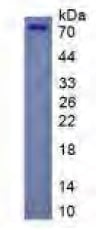
Accurate Molecular Mass: 68kDa as determined by SDS-PAGE reducing conditions.
Accurate Molecular Mass: 68kDa as determined by SDS-PAGE reducing conditions.
OMIM
M28668 mRNA
Supply Chain Verification
Manufactured in a lab with traceable raw materials. Bulk orders can typically be prepared to the customer’s specifications, please inquire.
Source
Prokaryotic expression
Residues
Gln359~Ser858
Tags
N-terminal His Tag
Subcellular Location
Membrane
Traits
Freeze-dried powder
Phenomenon explanation
The possible reasons that the actual band size differs from the predicted are as follows:
1. Splice variants: Alternative splicing may create different sized proteins from the same gene.
2. Relative charge: The composition of amino acids may affects the charge of the protein.
3. Post-translational modification: Phosphorylation, glycosylation, methylation etc.
4. Post-translation cleavage: Many proteins are synthesized as pro-proteins, and then cleaved to give the active form.
5. Polymerization of the target protein: Dimerization, multimerization etc.
1. Splice variants: Alternative splicing may create different sized proteins from the same gene.
2. Relative charge: The composition of amino acids may affects the charge of the protein.
3. Post-translational modification: Phosphorylation, glycosylation, methylation etc.
4. Post-translation cleavage: Many proteins are synthesized as pro-proteins, and then cleaved to give the active form.
5. Polymerization of the target protein: Dimerization, multimerization etc.
Usage
Reconstitute in 10mM PBS (pH7.4) to a concentration of 0.1-1.0 mg/mL. Do not vortex.
Product Categories/Family for CFTR recombinant protein
ISO Certification
Manufactured in an ISO 9001:2015 and ISO 13485:2016 Certified Laboratory.
Applications Tested/Suitable for CFTR recombinant protein
Positive Control; Immunogen; SDS-PAGE; Western Blot (WB).
Application Notes for CFTR recombinant protein
(May be suitable for use in other assays to be determined by the end user.)
Other Notes
Small volumes of CFTR recombinant protein vial(s) may occasionally become entrapped in the seal of the product vial during shipment and storage. If necessary, briefly centrifuge the vial on a tabletop centrifuge to dislodge any liquid in the container`s cap. Certain products may require to ship with dry ice and additional dry ice fee may apply.
Additional Details
NCBI/Uniprot data below describe general gene information for CFTR. It may not necessarily be applicable to this product.
NCBI Official Full Name
cystic fibrosis transmembrane conductance regulator
NCBI Official Synonym Full Names
cystic fibrosis transmembrane conductance regulator
NCBI Official Symbol
CFTR
NCBI Official Synonym Symbols
CF; MRP7; ABC35; ABCC7; CFTR/MRP; TNR-CFTR; dJ760C5.1
UniProt Protein Name
Cystic fibrosis transmembrane conductance regulator
UniProt Synonym Protein Names
ATP-binding cassette sub-family C member 7; Channel conductance-controlling ATPase (EC:3.6.3.49
Protein Family
Cystic fibrosis transmembrane conductance regulator
UniProt Gene Name
CFTR
UniProt Synonym Gene Names
ABCC7; CFTR
NCBI Protein Information
cystic fibrosis transmembrane conductance regulator
NCBI Summary for CFTR
This gene encodes a member of the ATP-binding cassette (ABC) transporter superfamily. The encoded protein functions as a chloride channel, making it unique among members of this protein family, and controls ion and water secretion and absorption in epithelial tissues. Channel activation is mediated by cycles of regulatory domain phosphorylation, ATP-binding by the nucleotide-binding domains, and ATP hydrolysis. Mutations in this gene cause cystic fibrosis, the most common lethal genetic disorder in populations of Northern European descent. The most frequently occurring mutation in cystic fibrosis, DeltaF508, results in impaired folding and trafficking of the encoded protein. Multiple pseudogenes have been identified in the human genome. [provided by RefSeq, Aug 2017]
Show more UniProt Comments for CFTR
CFTR: a member of the MRP subfamily of ATP-binding cassette (ABC) transporters. ABC proteins transport various molecules across extra- and intra-cellular membranes. Functions as a chloride channel and controls the regulation of other transport pathways. Mutations have been observed in patients with the autosomal recessive disorders cystic fibrosis (CF) and congenital bilateral aplasia of the vas deferens (CBAVD). Alternative splice
Protein type: Channel, chloride; EC 3.6.3.49; Hydrolase; Membrane protein, integral; Membrane protein, multi-pass; Transporter; Transporter, ABC family
Chromosomal Location of Human Ortholog: 7q31.2
Cellular Component: apical plasma membrane; cell surface; chloride channel complex; clathrin-coated vesicle membrane; cytoplasm; cytosol; early endosome; early endosome membrane; endoplasmic reticulum membrane; endosome membrane; extracellular exosome; integral component of membrane; integral component of plasma membrane; lysosomal membrane; plasma membrane; protein complex; recycling endosome; recycling endosome membrane
Molecular Function: anion transmembrane-transporting ATPase activity; ATP binding; ATPase activity; ATPase activity, coupled to transmembrane movement of substances; bicarbonate transmembrane transporter activity; channel-conductance-controlling ATPase activity; chloride channel activity; chloride channel inhibitor activity; chloride channel regulator activity; chloride transmembrane transporter activity; enzyme binding; PDZ domain binding; protein binding
Biological Process: bicarbonate transport; cellular response to cAMP; cellular response to forskolin; cholesterol biosynthetic process; cholesterol transport; intracellular pH elevation; membrane hyperpolarization; multicellular organismal water homeostasis; positive regulation of cyclic nucleotide-gated ion channel activity; positive regulation of exocytosis; protein deubiquitination; sperm capacitation; transmembrane transport; vesicle docking involved in exocytosis
Disease: Bronchiectasis With Or Without Elevated Sweat Chloride 1; Cystic Fibrosis; Pancreatitis, Hereditary; Vas Deferens, Congenital Bilateral Aplasia Of
Show more Protein type: Channel, chloride; EC 3.6.3.49; Hydrolase; Membrane protein, integral; Membrane protein, multi-pass; Transporter; Transporter, ABC family
Chromosomal Location of Human Ortholog: 7q31.2
Cellular Component: apical plasma membrane; cell surface; chloride channel complex; clathrin-coated vesicle membrane; cytoplasm; cytosol; early endosome; early endosome membrane; endoplasmic reticulum membrane; endosome membrane; extracellular exosome; integral component of membrane; integral component of plasma membrane; lysosomal membrane; plasma membrane; protein complex; recycling endosome; recycling endosome membrane
Molecular Function: anion transmembrane-transporting ATPase activity; ATP binding; ATPase activity; ATPase activity, coupled to transmembrane movement of substances; bicarbonate transmembrane transporter activity; channel-conductance-controlling ATPase activity; chloride channel activity; chloride channel inhibitor activity; chloride channel regulator activity; chloride transmembrane transporter activity; enzyme binding; PDZ domain binding; protein binding
Biological Process: bicarbonate transport; cellular response to cAMP; cellular response to forskolin; cholesterol biosynthetic process; cholesterol transport; intracellular pH elevation; membrane hyperpolarization; multicellular organismal water homeostasis; positive regulation of cyclic nucleotide-gated ion channel activity; positive regulation of exocytosis; protein deubiquitination; sperm capacitation; transmembrane transport; vesicle docking involved in exocytosis
Disease: Bronchiectasis With Or Without Elevated Sweat Chloride 1; Cystic Fibrosis; Pancreatitis, Hereditary; Vas Deferens, Congenital Bilateral Aplasia Of
Precautions
All of MyBioSource's Products are for scientific laboratory research purposes and are not for diagnostic, therapeutics, prophylactic or in vivo use. Through your purchase, you expressly represent and warrant to MyBioSource that you will properly test and use any Products purchased from MyBioSource in accordance with industry standards. MyBioSource and its authorized distributors reserve the right to refuse to process any order where we reasonably believe that the intended use will fall outside of our acceptable guidelines.
Disclaimer
While every efforts were made to ensure the accuracy of the information provided in this datasheet, MyBioSource will not be liable for any omissions or errors contained herein. MyBioSource reserves the right to make changes to this datasheet at any time without prior notice.
It is the responsibility of the customer to report product performance issues to MyBioSource within 30 days of receipt of the product. Please visit our Terms & Conditions page for more information.
It is the responsibility of the customer to report product performance issues to MyBioSource within 30 days of receipt of the product. Please visit our Terms & Conditions page for more information.
Product Note
Select online data sheet information is drawn from bioinformatics databases, occasionally resulting in ambiguous or non-relevant product information. It is the responsibility of the customer to review, verify, and evaluate the information to make sure it matches their requirements before purchasing the kit. Our ELISA Kit assays are dynamic research tools and sometimes they may be updated and improved. If the format of this assay is important to you then please request the current manual or contact our technical support team with a presales inquiry before placing an order. We will confirm the current details of the assay. We cannot guarantee the sample manual posted online is the most current manual, it is intended to serve as an example only. Please refer to the instructions For Use provided with the assay kit for precise details.
Product PubMed Publications
Products associated with CFTR recombinant protein
| Reference Product | PubMed Publications |
|---|---|
| PDZK1 recombinant protein | >18 publications with CFTR and PDZK1 |
| GOPC recombinant protein | >18 publications with CFTR and GOPC |
| STX1A recombinant protein | >14 publications with CFTR and STX1A |
| DERL1 recombinant protein | >5 publications with CFTR and DERL1 |
| PRKCE recombinant protein | >4 publications with CFTR and PRKCE |
| DNAJA1 recombinant protein | >4 publications with CFTR and DNAJA1 |
| SNAP23 recombinant protein | >4 publications with CFTR and SNAP23 |
| RNF5 recombinant protein | >4 publications with CFTR and RNF5 |
| PRKCA recombinant protein | >2 publications with CFTR and PRKCA |
| PRKAA1 recombinant protein | >2 publications with CFTR and PRKAA1 |
Pathways associated with CFTR recombinant protein
| Products by Pathway | Pathway Diagram |
|---|---|
| ABC Transporters Pathway antibodies | ABC Transporters Pathway Diagram |
| ABC Transporters Pathway antibodies | ABC Transporters Pathway Diagram |
| ABC-family Proteins Mediated Transport Pathway antibodies | ABC-family Proteins Mediated Transport Pathway Diagram |
| Bile Secretion Pathway antibodies | Bile Secretion Pathway Diagram |
| Bile Secretion Pathway antibodies | Bile Secretion Pathway Diagram |
| Gastric Acid Secretion Pathway antibodies | Gastric Acid Secretion Pathway Diagram |
| Gastric Acid Secretion Pathway antibodies | Gastric Acid Secretion Pathway Diagram |
| Pancreatic Secretion Pathway antibodies | Pancreatic Secretion Pathway Diagram |
| Pancreatic Secretion Pathway antibodies | Pancreatic Secretion Pathway Diagram |
| Transmembrane Transport Of Small Molecules Pathway antibodies | Transmembrane Transport Of Small Molecules Pathway Diagram |
Diseases associated with CFTR recombinant protein
| Disease Name | Pubmed Publications |
|---|---|
| Cystic Fibrosis Antibodies | >7225 publications with CFTR and Cystic Fibrosis |
| Inflammation Antibodies | >479 publications with CFTR and Inflammation |
| Pancreatitis Antibodies | >314 publications with CFTR and Pancreatitis |
| Infertility, Male Antibodies | >266 publications with CFTR and Infertility, Male |
| Pancreatitis, Chronic Antibodies | >230 publications with CFTR and Pancreatitis, Chronic |
| Neoplasms Antibodies | >200 publications with CFTR and Neoplasms |
| Bronchiectasis With Or Without Elevated Sweat Chloride 1 Antibodies | >164 publications with CFTR and Bronchiectasis With Or Without Elevated Sweat Chloride 1 |
| Liver Diseases Antibodies | >124 publications with CFTR and Liver Diseases |
| Azoospermia Antibodies | >104 publications with CFTR and Azoospermia |
| Necrosis Antibodies | >104 publications with CFTR and Necrosis |