

Recombinant Mouse Glial fibrillary acidic protein (Gfap)

Référence MBS948245-1mg-E
Conditionnement : 1mg(E-Coli)
Marque : MyBiosource
Contactez votre distributeur local :

Téléphone : +1 850 650 7790
Recombinant Mouse Glial fibrillary acidic protein (Gfap)
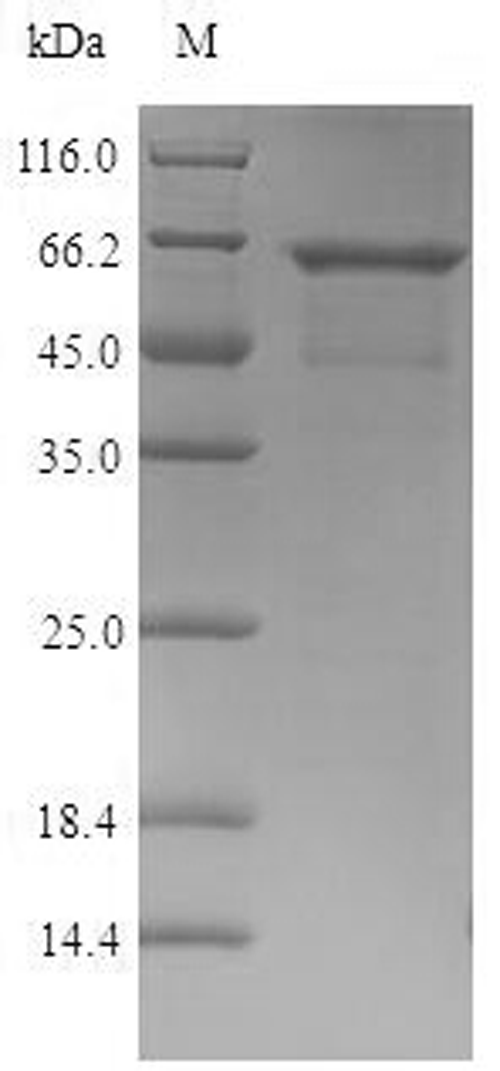
Glial Fibrillary Acidic Protein (GFAP) Mouse Recombinant Protein
For Research Use Only. Not for use in diagnostic procedures. Catalog #: MBS948245GFAP, a class-III intermediate filament, is a cell-specific marker that, during the development of the central nervous system, distinguishes astrocytes from other glial cells. More details
Product Overview
Online Datasheet in PDFProduct Name
Glial fibrillary acidic protein (GFAP), Recombinant Protein
Full Product Name
Recombinant Mouse Glial fibrillary acidic protein (Gfap)
Product Gene Name
GFAP recombinant protein
Sequence
MERRRITSAR RSYASETVVR GLGPSRQLGT MPRFSLSRMT PPLPARVDFS LAGALNAGFK ETRASERAEM MELNDRFASY IEKVRFLEQQ NKALAAELNQ LRAKEPTKLA DVYQAELREL RLRLDQLTAN SARLEVERDN FAQDLGTLRQ KLQDETNLRL EAENNLAAYR QEADEATLAR VDLERKVESL EEEIQFLRKI YEEEVRELRE QLAQQQVHVE MDVAKPDLTA ALREIRTQYE AVATSNMQET EEWYRSKFAD LTDAASRNAE LLRQAKHEAN DYRRQLQALT CDLESLRGTN ESLERQMREQ EERHARESAS YQEALARLEE EGQSLKEEMA RHLQEYQDLL NVKLALDIEI ATYRKLLEGE ENRITIPVQT FSNLQIRETS LDTKSVSEGH LKRNIVVKTV EMRDGEVIKD SKQEHKDVVM
Host
E Coli or Yeast or Baculovirus or Mammalian Cell
Form/Format
Lyophilized or liquid (Format to be determined during the manufacturing process)
Purity/Purification
Greater or equal to 85% purity as determined by SDS-PAGE. (lot specific)
Preparation and Storage
Store at -20 degree C, for extended storage, conserve at -20 degree C or -80 degree C.
Molecular Weight
51.9 kDa
Sequence Positions
1-430aa; Full Length Protein
Tag Information
This protein contains an N-terminal tag and may also contain a C-terminal tag. Tag types are determined by various factors including tag-protein stability, please inquire for tag information.
Sterility
Sterile filter available upon request.
Endotoxin
Low endotoxin available upon request.
Production Note
Special Offer: The E Coli host-expressed protein is manufactured from a stock plasmid containing the protein gene. E Colihost-expressed protein is stocked in different unit sizes ranging from as small as 10 ug to as large as 1 mg. Bulk inventory is also available. The E Coli host-expressed protein has been ordered over and over again by researchers and has stood the test of time as both a robust protein and important target for the research community. It is part of our new program to make our most popular protein targets and corresponding hosts available in expanded unit sizes and with a quick processing time. Select E Coli host-expressed protein for the fastest delivery among all hosts. Please contact our technical support team or email to support@mybiosource.com for more details.
ISO Certification
Manufactured in an ISO 9001:2015 Certified Laboratory.
Product References and Citations for GFAP recombinant protein
Structure of the mouse glial fibrillary acidic protein gene implications for the evolution of the intermediate filament multigene family.Balcarek J.M., Cowan N.J.Nucleic Acids Res. 13:5527-5543(1985) Lineage-specific biology revealed by a finished genome assembly of the mouse.Church D.M., Goodstadt L., Hillier L.W., Zody M.C., Goldstein S., She X., Bult C.J., Agarwala R., Cherry J.L., DiCuccio M., Hlavina W., Kapustin Y., Meric P., Maglott D., Birtle Z., Marques A.C., Graves T., Zhou S., Teague B., Potamousis K., Churas C., Place M., Herschleb J., Runnheim R., Forrest D., Amos-Landgraf J., Schwartz D.C., Cheng Z., Lindblad-Toh K., Eichler E.E., Ponting C.P.PLoS Biol. 7:E1000112-E1000112(2009) Sheng J., Wu X., Lin F., Yang X., Deng J. Identification of two N-terminal non-alpha-helical domain motifs important in the assembly of glial fibrillary acidic protein.Ralton J.E., Lu X., Hutcheson A.M., Quinlan R.A.J. Cell Sci. 107:1935-1948(1994) Sequence of a cDNA clone encoding mouse glial fibrillary acidic protein structural conservation of intermediate filaments.Lewis S.A., Balcarek J.M., Krek V., Shelanski M., Cowan N.J.Proc. Natl. Acad. Sci. U.S.A. 81:2743-2746(1984) Structural implications of a cDNA clone encoding mouse glial fibrillary acidic protein.Cowan N.J., Lewis S.A., Balcarek J.M., Krek V., Shelanski M.L.Ann. N. Y. Acad. Sci. 455:575-582(1985) Characterization of human cDNA and genomic clones for glial fibrillary acidic protein.Brenner M., Lampel K., Nakatani Y., Mill J., Banner C., Mearow K., Dohadwala M., Lipsky R., Freese E.Brain Res. Mol. Brain Res. 7:277-286(1990) High-throughput sequence identification of gene coding variants within alcohol-related QTLs.Ehringer M.A., Thompson J., Conroy O., Xu Y., Yang F., Canniff J., Beeson M., Gordon L., Bennett B., Johnson T.E., Sikela J.M.Mamm. Genome 12:657-663(2001) Novel metastatic mouse tumor cells express multiple properties of macrophages.Huysentruyt L.C., Banerjee D., Seyfried T.N. Lubec G., Klug S., Kang S.U. Lubec G., Sunyer B., Chen W.-Q.Submitted (JAN-2009) to UniProtKB Genetic polymorphism and sequence evolution of an alternatively spliced exon of the glial fibrillary acidic protein gene, GFAP.Singh R., Nielsen A.L., Johansen M.G., Jorgensen A.L.Genomics 82:185-193(2003) A new splice variant of glial fibrillary acidic protein GFAPepsilon, interacts with the presenilin proteins.Nielsen A.L., Holm I.E., Johansen M., Bonven B., Jorgensen P., Jorgensen A.L.J. Biol. Chem. 277:29983-29991(2002) Comprehensive identification of phosphorylation sites in postsynaptic density preparations.Trinidad J.C., Specht C.G., Thalhammer A., Schoepfer R., Burlingame A.L.Mol. Cell. Proteomics 5:914-922(2006) Synemin is expressed in reactive astrocytes in neurotrauma and interacts differentially with vimentin and GFAP intermediate filament networks.Jing R., Wilhelmsson U., Goodwill W., Li L., Pan Y., Pekny M., Skalli O.J. Cell Sci. 120:1267-1277(2007)
Other Notes
Small volumes of GFAP recombinant protein vial(s) may occasionally become entrapped in the seal of the product vial during shipment and storage. If necessary, briefly centrifuge the vial on a tabletop centrifuge to dislodge any liquid in the container`s cap. Certain products may require to ship with dry ice and additional dry ice fee may apply.
Searchable Terms for GFAP purchase
MBS948245 is a recombinant protein targeting GFAP. Also known as Recombinant Mouse Glial fibrillary acidic protein (Gfap). Host: E Coli or Yeast or Baculovirus or Mammalian Cell.
Additional Details
NCBI/Uniprot data below describe general gene information for GFAP. It may not necessarily be applicable to this product.
NCBI Official Full Name
glial fibrillary acidic protein isoform 1
NCBI Official Synonym Full Names
glial fibrillary acidic protein
NCBI Official Symbol
Gfap
NCBI Official Synonym Symbols
AI836096
UniProt Protein Name
Glial fibrillary acidic protein
Protein Family
Glial fibrillary acidic protein
UniProt Gene Name
Gfap
UniProt Synonym Gene Names
GFAP
UniProt Entry Name
GFAP_MOUSE
UniProt Comments for GFAP
GFAP: a class-III intermediate filament protein. A cell-specific marker that, during the development of the central nervous system, distinguishes astrocytes from other glial cells. Mutations in this gene cause Alexander disease, a rare disorder of astrocytes in the central nervous system. An additional transcript variant isoform has been described, but its full length sequence has not been determined.
Protein type: Cytoskeletal
Cellular Component: cell projection; cytoplasm; intermediate filament; intermediate filament cytoskeleton; intracellular; membrane; myelin sheath
Molecular Function: glycoprotein binding; integrin binding; kinase binding; protein binding; structural constituent of cytoskeleton; structural molecule activity
Biological Process: astrocyte development; Bergmann glial cell differentiation; extracellular matrix organization and biogenesis; intermediate filament organization; intermediate filament-based process; neurite regeneration; regulation of neurotransmitter uptake; response to wounding
Show more Protein type: Cytoskeletal
Cellular Component: cell projection; cytoplasm; intermediate filament; intermediate filament cytoskeleton; intracellular; membrane; myelin sheath
Molecular Function: glycoprotein binding; integrin binding; kinase binding; protein binding; structural constituent of cytoskeleton; structural molecule activity
Biological Process: astrocyte development; Bergmann glial cell differentiation; extracellular matrix organization and biogenesis; intermediate filament organization; intermediate filament-based process; neurite regeneration; regulation of neurotransmitter uptake; response to wounding
Precautions
All of MyBioSource's Products are for scientific laboratory research purposes and are not for diagnostic, therapeutics, prophylactic or in vivo use. Through your purchase, you expressly represent and warrant to MyBioSource that you will properly test and use any Products purchased from MyBioSource in accordance with industry standards. MyBioSource and its authorized distributors reserve the right to refuse to process any order where we reasonably believe that the intended use will fall outside of our acceptable guidelines.
Disclaimer
While every efforts were made to ensure the accuracy of the information provided in this datasheet, MyBioSource will not be liable for any omissions or errors contained herein. MyBioSource reserves the right to make changes to this datasheet at any time without prior notice.
It is the responsibility of the customer to report product performance issues to MyBioSource within 30 days of receipt of the product. Please visit our Terms & Conditions page for more information.
It is the responsibility of the customer to report product performance issues to MyBioSource within 30 days of receipt of the product. Please visit our Terms & Conditions page for more information.
Product Note
Select online data sheet information is drawn from bioinformatics databases, occasionally resulting in ambiguous or non-relevant product information. It is the responsibility of the customer to review, verify, and evaluate the information to make sure it matches their requirements before purchasing the kit. Our ELISA Kit assays are dynamic research tools and sometimes they may be updated and improved. If the format of this assay is important to you then please request the current manual or contact our technical support team with a presales inquiry before placing an order. We will confirm the current details of the assay. We cannot guarantee the sample manual posted online is the most current manual, it is intended to serve as an example only. Please refer to the instructions For Use provided with the assay kit for precise details.
Product PubMed Publications
Products associated with GFAP recombinant protein
| Reference Product | PubMed Publications |
|---|---|
| S100b recombinant protein | >185 publications with GFAP and S100b |
| Il6st recombinant protein | >12 publications with GFAP and Il6st |
| Prnp recombinant protein | >11 publications with GFAP and Prnp |
| Ywhaz recombinant protein | >1 publications with GFAP and Ywhaz |
| Ncor1 recombinant protein | >1 publications with GFAP and Ncor1 |
Pathways associated with GFAP recombinant protein
| Products by Pathway | Pathway Diagram |
|---|---|
| Jak-STAT Signaling Pathway antibodies | Jak-STAT Signaling Pathway Diagram |
| Jak-STAT Signaling Pathway antibodies | Jak-STAT Signaling Pathway Diagram |
| Nuclear Signaling By ERBB4 Pathway antibodies | Nuclear Signaling By ERBB4 Pathway Diagram |
| Signal Transduction Pathway antibodies | Signal Transduction Pathway Diagram |
| Signaling By ERBB4 Pathway antibodies | Signaling By ERBB4 Pathway Diagram |
| Spinal Cord Injury Pathway antibodies | Spinal Cord Injury Pathway Diagram |
Diseases associated with GFAP recombinant protein
| Disease Name | Pubmed Publications |
|---|---|
| Nervous System Diseases Antibodies | >5214 publications with GFAP and Nervous System Diseases |
| Brain Diseases Antibodies | >3945 publications with GFAP and Brain Diseases |
| Disease Models, Animal Antibodies | >1590 publications with GFAP and Disease Models, Animal |
| Gliosis Antibodies | >1177 publications with GFAP and Gliosis |
| Neurodegenerative Diseases Antibodies | >1049 publications with GFAP and Neurodegenerative Diseases |
| Cardiovascular Diseases Antibodies | >950 publications with GFAP and Cardiovascular Diseases |
| Brain Injuries Antibodies | >751 publications with GFAP and Brain Injuries |
| Inflammation Antibodies | >748 publications with GFAP and Inflammation |
| Necrosis Antibodies | >637 publications with GFAP and Necrosis |
| Nerve Degeneration Antibodies | >557 publications with GFAP and Nerve Degeneration |
Organs/Tissues associated with GFAP recombinant protein
| Organ/Tissue Name | Pubmed Publications |
|---|---|
| Brain Antibodies | >8377 publications with GFAP and Brain |
| Spinal Cord Antibodies | >1486 publications with GFAP and Spinal Cord |
| Eye Antibodies | >1052 publications with GFAP and Eye |
| Embryonic Tissue Antibodies | >552 publications with GFAP and Embryonic Tissue |
| Liver Antibodies | >217 publications with GFAP and Liver |
| Inner Ear Antibodies | >41 publications with GFAP and Inner Ear |
| Uncharacterized Tissue Antibodies | >1 publications with GFAP and Uncharacterized Tissue |
Vous serez peut-être également intéressé par les produits suivants :
Référence
Description
Cond.
Prix HT