

Recombinant Proprotein Convertase Subtilisin/Kexin Type 5 (PCSK5)

Référence MBS2031660-0,01mg
Conditionnement : 0.01mg
Marque : MyBiosource
Contactez votre distributeur local :

Téléphone : +1 850 650 7790
Proprotein Convertase Subtilisin/Kexin Type 5 (PCSK5) Homo Sapiens (Human) Recombinant Protein
For Research Use Only. Not for use in diagnostic procedures. Special Promotion Catalog #: MBS2031660SPECIAL PROMOTION: Get FREE Starbucks gift card (Maximum 5 gift cards/product). Gift card(s) will be included with shipment
MBS2031660 is a recombinant protein targeting PCSK5. Also known as Recombinant Proprotein Convertase Subtilisin/Kexin Type 5 (PCSK5). Reactive in Homo sapiens (Human). Host: E.coli. More details
Product Overview
Online Datasheet in PDFProduct Name
Proprotein Convertase Subtilisin/Kexin Type 5 (PCSK5), Recombinant Protein
Full Product Name
Recombinant Proprotein Convertase Subtilisin/Kexin Type 5 (PCSK5)
Product Gene Name
PCSK5 recombinant protein
Sequence
DYDFSR AQSTYFNDPK WPSMWYMHCS DNTHPCQSDM NIEGAWKRGY TGKNIVVTIL DDGIERTHPD LMQNYDALAS CDVNGNDLDP MPRYDASNEN KHGTRCAGEV AAAANNSHCT VGIAFNAKIG GVRMLDGDVT DMVEAKSVSF NPQHVHIYSA SWGPDDDGKT VDGPAPLTRQ AFENGVRMGR RGLGSVFVWA SGNGGRSKDH CSCDGYTNSI YTISISSTAE SGKKPWYLEE CSSTLATTYS SGESYDKKII TTDLRQRCTD NHTGTSASAP MAAGIIALAL EANPFLTWRD VQHVIVRTSR AGHLNANDWK TNAAGFKVSH LYGFGLMDAE AMVM
Host
E.coli
Species Reactivity
Homo sapiens (Human)
Form/Format
PBS, pH7.4, containing 0.01% SKL, 5% Trehalose.
Purity/Purification
> 97%
Concentration
Original Concentration: 100ug/mL (lot specific)
Preparation and Storage
Storage:
Avoid repeated freeze/thaw cycles.
Store at 2-8 degree C for one month.
Aliquot and store at -80 degree C for 12 months.
Stability Test:
The thermal stability is described by the loss rate. The loss rate was determined by accelerated thermal degradation test, that is, incubate the protein at 37 degree C for 48h, and no obvious degradation and precipitation were observed. The loss rate is less than 5% within the expiration date under appropriate storage condition.
Matching Pairs
Unconjugated Antibody: PCSK5 (MBS2026024)
Immunogen: PCSK5 (MBS2031660)
Immunogen: PCSK5 (MBS2031660)
Matching Pairs
APC-CY7 Conjugated Antibody: PCSK5 (MBS2074075)
Immunogen: PCSK5 (MBS2031660)
Immunogen: PCSK5 (MBS2031660)
Molecular Weight
Predicted Molecular Mass: 40.8kDa
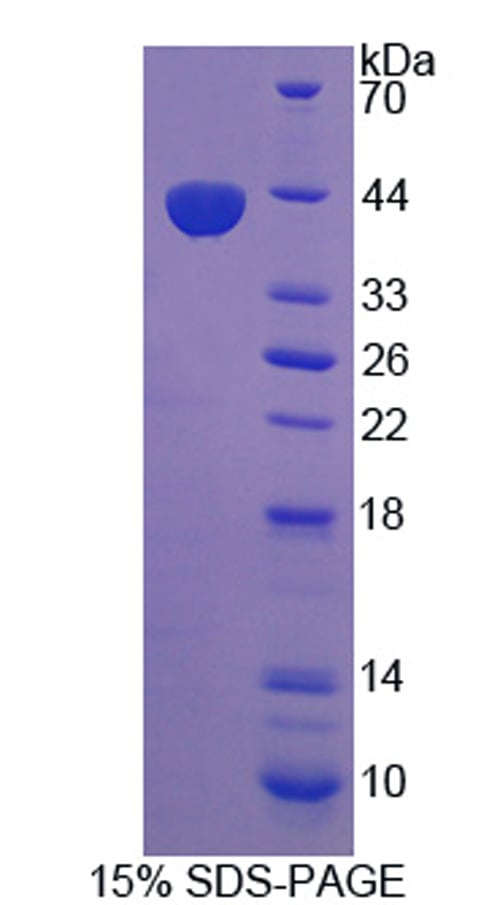
Accurate Molecular Mass: 41kDa as determined by SDS-PAGE reducing conditions.
Accurate Molecular Mass: 41kDa as determined by SDS-PAGE reducing conditions.
Supply Chain Verification
Manufactured in a lab with traceable raw materials. Bulk orders can typically be prepared to the customer’s specifications, please inquire.
Source
Prokaryotic expression
Residues
Asp115~Met454
Tags
N-terminal His Tag
Subcellular Location
Secreted
Traits
Freeze-dried powder
Predicted isoelectric point
5.6
Usage
Reconstitute in 10mM PBS (pH7.4) to a concentration of 0.1-1.0 mg/mL. Do not vortex.
ISO Certification
Manufactured in an ISO 9001:2015 and ISO 13485:2016 Certified Laboratory.
Applications Tested/Suitable for PCSK5 recombinant protein
Positive Control; Immunogen; SDS-PAGE; Western Blot (WB).
Application Notes for PCSK5 recombinant protein
(May be suitable for use in other assays to be determined by the end user.)
Other Notes
Small volumes of PCSK5 recombinant protein vial(s) may occasionally become entrapped in the seal of the product vial during shipment and storage. If necessary, briefly centrifuge the vial on a tabletop centrifuge to dislodge any liquid in the container`s cap. Certain products may require to ship with dry ice and additional dry ice fee may apply.
Additional Details
NCBI/Uniprot data below describe general gene information for PCSK5. It may not necessarily be applicable to this product.
UniProt Related Accession #
GenBank Nucleotide #
NCBI Official Full Name
proprotein convertase subtilisin/kexin type 5 isoform 1 preproprotein
NCBI Official Synonym Full Names
proprotein convertase subtilisin/kexin type 5
NCBI Official Symbol
Pcsk5
NCBI Official Synonym Symbols
PC5; PC6; SPC6; b2b585Clo; b2b1549Clo
UniProt Protein Name
Proprotein convertase subtilisin/kexin type 5
UniProt Synonym Protein Names
Proprotein convertase 5; PC5; Proprotein convertase 6; PC6; Subtilisin-like proprotein convertase 6; SPC6; Subtilisin/kexin-like protease PC5
Protein Family
Proprotein convertase subtilisin/kexin
UniProt Gene Name
Pcsk5
UniProt Synonym Gene Names
PC5; PC6; SPC6
UniProt Entry Name
PCSK5_MOUSE
NCBI Protein Information
proprotein convertase subtilisin/kexin type 5
NCBI Summary for PCSK5
This gene encodes a subtilisin-like proprotein convertase that mediates posttranslational endoproteolytic processing of various proprotein substrates traversing the secretory pathway. The encoded protein is an inactive zymogen that undergoes autoproteolytic processing in the endoplasmic reticulum and the Golgi network to generate an active enzyme. Mice lacking the encoded protein die at an early embryonic stage. Conditional inactivation this gene in the epiblast but not in the extraembryonic tissue bypasses embryonic lethality but results in death at birth. Alternative splicing results in multiple transcript variants encoding different isoforms. [provided by RefSeq, Jul 2015]
Show more UniProt Comments for PCSK5
PCSK5: Likely to represent a widespread endoprotease activity within the constitutive and regulated secretory pathway. Capable of cleavage at the RX(K/R)R consensus motif. Plays an essential role in pregnancy establishment by proteolytic activation of a number of important factors such as BMP2 and CALD1. Belongs to the peptidase S8 family. 2 isoforms of the human protein are produced by alternative splicing.
Protein type: Protease; EC 3.4.21.-; Membrane protein, integral
Cellular Component: Golgi apparatus; extracellular space; membrane; extracellular region; integral to membrane; secretory granule
Molecular Function: peptidase activity; hydrolase activity; serine-type peptidase activity; serine-type endopeptidase activity; endopeptidase activity; peptide binding
Biological Process: signal peptide processing; heart development; respiratory tube development; embryonic skeletal development; cytokine biosynthetic process; peptide hormone processing; female pregnancy; viral infectious cycle; proteolysis; limb morphogenesis; peptide biosynthetic process; anterior/posterior pattern formation; protein processing; kidney development; embryonic gut development; embryo implantation
Show more Protein type: Protease; EC 3.4.21.-; Membrane protein, integral
Cellular Component: Golgi apparatus; extracellular space; membrane; extracellular region; integral to membrane; secretory granule
Molecular Function: peptidase activity; hydrolase activity; serine-type peptidase activity; serine-type endopeptidase activity; endopeptidase activity; peptide binding
Biological Process: signal peptide processing; heart development; respiratory tube development; embryonic skeletal development; cytokine biosynthetic process; peptide hormone processing; female pregnancy; viral infectious cycle; proteolysis; limb morphogenesis; peptide biosynthetic process; anterior/posterior pattern formation; protein processing; kidney development; embryonic gut development; embryo implantation
Precautions
All of MyBioSource's Products are for scientific laboratory research purposes and are not for diagnostic, therapeutics, prophylactic or in vivo use. Through your purchase, you expressly represent and warrant to MyBioSource that you will properly test and use any Products purchased from MyBioSource in accordance with industry standards. MyBioSource and its authorized distributors reserve the right to refuse to process any order where we reasonably believe that the intended use will fall outside of our acceptable guidelines.
Disclaimer
While every efforts were made to ensure the accuracy of the information provided in this datasheet, MyBioSource will not be liable for any omissions or errors contained herein. MyBioSource reserves the right to make changes to this datasheet at any time without prior notice.
It is the responsibility of the customer to report product performance issues to MyBioSource within 30 days of receipt of the product. Please visit our Terms & Conditions page for more information.
It is the responsibility of the customer to report product performance issues to MyBioSource within 30 days of receipt of the product. Please visit our Terms & Conditions page for more information.
Product Note
Select online data sheet information is drawn from bioinformatics databases, occasionally resulting in ambiguous or non-relevant product information. It is the responsibility of the customer to review, verify, and evaluate the information to make sure it matches their requirements before purchasing the kit. Our ELISA Kit assays are dynamic research tools and sometimes they may be updated and improved. If the format of this assay is important to you then please request the current manual or contact our technical support team with a presales inquiry before placing an order. We will confirm the current details of the assay. We cannot guarantee the sample manual posted online is the most current manual, it is intended to serve as an example only. Please refer to the instructions For Use provided with the assay kit for precise details.
Product PubMed Publications
Products associated with PCSK5 recombinant protein
| Reference Product | PubMed Publications |
|---|---|
| Furin recombinant protein | >10 publications with PCSK5 and Furin |
| Pcsk7 recombinant protein | >8 publications with PCSK5 and Pcsk7 |
| Pcsk6 recombinant protein | >6 publications with PCSK5 and Pcsk6 |
| Pcsk1 recombinant protein | >4 publications with PCSK5 and Pcsk1 |
| Mbtps1 recombinant protein | >4 publications with PCSK5 and Mbtps1 |
| Pcsk9 recombinant protein | >4 publications with PCSK5 and Pcsk9 |
| Pcsk4 recombinant protein | >2 publications with PCSK5 and Pcsk4 |
| Pcsk2 recombinant protein | >2 publications with PCSK5 and Pcsk2 |
Pathways associated with PCSK5 recombinant protein
| Products by Pathway | Pathway Diagram |
|---|---|
| NGF Processing Pathway antibodies | NGF Processing Pathway Diagram |
| Signal Transduction Pathway antibodies | Signal Transduction Pathway Diagram |
| Signalling By NGF Pathway antibodies | Signalling By NGF Pathway Diagram |
Diseases associated with PCSK5 recombinant protein
| Disease Name | Pubmed Publications |
|---|---|
| Disease Models, Animal Antibodies | >3 publications with PCSK5 and Disease Models, Animal |
| Heart Defects, Congenital Antibodies | >2 publications with PCSK5 and Heart Defects, Congenital |
| Anus, Imperforate Antibodies | >2 publications with PCSK5 and Anus, Imperforate |
| Cell Transformation, Neoplastic Antibodies | >1 publications with PCSK5 and Cell Transformation, Neoplastic |
| Liver Diseases Antibodies | >1 publications with PCSK5 and Liver Diseases |
| Inflammation Antibodies | >1 publications with PCSK5 and Inflammation |
| Necrosis Antibodies | >1 publications with PCSK5 and Necrosis |
| Tracheoesophageal Fistula Antibodies | >1 publications with PCSK5 and Tracheoesophageal Fistula |
| Lung Diseases Antibodies | >1 publications with PCSK5 and Lung Diseases |
| Neoplasm Metastasis Antibodies | >1 publications with PCSK5 and Neoplasm Metastasis |
Organs/Tissues associated with PCSK5 recombinant protein
| Organ/Tissue Name | Pubmed Publications |
|---|---|
| Intestine Antibodies | >4 publications with PCSK5 and Intestine |
| Ovary Antibodies | >3 publications with PCSK5 and Ovary |
| Kidney Antibodies | >3 publications with PCSK5 and Kidney |
| Liver Antibodies | >2 publications with PCSK5 and Liver |
| Embryonic Tissue Antibodies | >2 publications with PCSK5 and Embryonic Tissue |
| Lung Antibodies | >1 publications with PCSK5 and Lung |
| Extraembryonic Tissue Antibodies | >1 publications with PCSK5 and Extraembryonic Tissue |
| Mammary Gland Antibodies | >1 publications with PCSK5 and Mammary Gland |
| Brain Antibodies | >1 publications with PCSK5 and Brain |