

RNase Inhibitor, Murine

Référence K1046-3000U
Conditionnement : 3000U
Marque : APExBIO Technology
Contactez votre distributeur local :

Téléphone : +1 850 650 7790
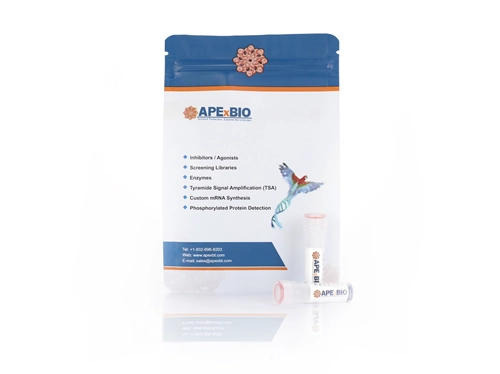
Murine RNase inhibitor is a 50 kDa recombinant protein derived from a mouse RNase inhibitor gene expressed in E.coli. It specifically and non-covalently interacts in a 1:1 ratio with pancreatic-type RNases such as RNase A, B, and C, without affecting RNase 1, RNase T1, RNase H, S1 nuclease, or fungal RNases. This inhibitor demonstrates resistance to oxidative inactivation due to absence of oxidation-sensitive cysteines found in human-derived forms, and maintains activity under low reducing conditions (below 1 mM DTT). Typically applied at concentrations of 0.5–1 U/μL to prevent RNA degradation, it is suitable for real-time RT-PCR, cDNA synthesis, in vitro transcription, RNA enzymatic labeling, and related RNA-based molecular biology assays.
- 1. Yongzhi Cui, Ke Zhao, et al. "A Nanococktail Strategy Regulating Circadian Clock and Re-Establishing Bone-Immune Balance for the Treatment of Senile Osteoporosis." ACS Nano. 2026 Mar 3;20(8):6541-6557. PMID: 41705491
- 2. Jia-Hui Liu, Yujing Lin, et al. "A mutually antagonistic mechanism mediated by RNA m6A modification in plant-virus interactions." Nat Commun. 2025 Nov 24;16(1):10378. PMID: 41285787
- 3. Bingjie Zeng, Anzhi Sheng, et al. "CRISPR/Cas12a Integrated with a Microfluidic System Enhanced Analysis of Programmed Cell Death Ligand 1 Expression in Circulating Tumor Cells from Non-Small Cell Lung Cancer Patients." ACS Sens. 2025 Oct 24;10(10):7388-7402. PMID: 41065718
- 4. Ji Geng, Xiying Wang, Jie Pan. "CRISPR activation of the ribosome-associated quality control factor ASCC3 ameliorates fragile X syndrome phenotypes in mice." Sci Transl Med. 2025 Oct 8;17(819):eadq3551. PMID: 41061044
- 5. Emmanuelle Pitré, Karishma Bisht, et al. "A two-step mechanism for RIG-I activation by influenza virus mvRNAs." Sci Adv. 2025 Aug 8;11(32):eadw8034. PMID: 40779639
- 6. Karishma Bisht, Daniel R. Weilandt, et al. "Temperature-dependent modulation of aberrant influenza A virus RNA synthesis affects innate immune signaling." bioRxiv. 2025 May 22:2025.05.19.654939. PMID: 40475563
| Size | |
| RNase Inhibitor, Murine (40 U/µL) | 3000 U (75 µL) |
| RNase Inhibitor, Murine (40 U/µL) | 15000 U (375 µL) |
| Store the components at -20°C. | |
The product inhibits RNases A, B and C specifically.
Improved resistance to oxidation compared to human/porcine RNase inhibitor
Ideal for reactions when low DTT concentration is necessary (e.g., Real-time PCR)
1. Q: Definition of activity unit?
A: The amount of enzyme required to inhibit 50% of the activity of 5 ng RNase A is defined as 1 unit (U) of activity. The activity of RNase A is quantified by measuring the production of 3’-CMP from the hydrolysis of cyclic 2’,3’-CMP.
2. Q: Compared with human RNase inhibitor, what are the characteristics of RNase Inhibitor, Murine?
A: Compared with the human RNase inhibitor, the murine RNase inhibitor does not contain the two cysteine residues that are highly sensitive to oxidation in the human protein. Therefore, it has higher resistance to oxidation and is more suitable for experiments performed with low concentrations of DTT (such as qPCR).
3. Q: What is the commonly used concentration of RNase Inhibitor, Murine?
A: In common reaction systems such as cDNA synthesis, in vitro transcription, and in vitro translation, RNase Inhibitor, Murine is recommended at a final concentration of 1–2 U/μL to protect RNA in the mixture from RNase degradation.
4. Q: Can RNase Inhibitor, Murine inhibit various RNases?
A: Our product, RNase Inhibitor, Murine, can broadly inhibit RNases A, B, and C, but it does not inhibit RNase 1, RNase T1, nuclease S1, RNase H, or RNases from Aspergillus species.
5. Q: What is the optimal pH for RNase Inhibitor, Murine to inhibit RNase activity?
A: RNase Inhibitor, Murine is effective over a relatively wide pH range and shows maximal activity at pH 7–8.
6. Q: Storage conditions for RNase Inhibitor, Murine?
A: Store the product at -20°C. The shelf life is 2 years.