



RayBio® Human/Mouse/Rat Substance P EIA Kit optimized for serum, plasma, and cell culture supernatants. Competition-based ELISA on a 96-well strip plate.
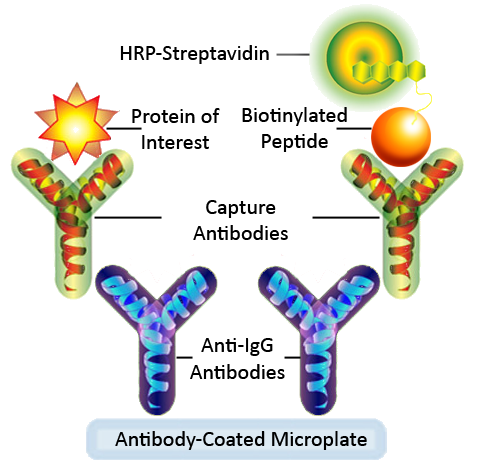

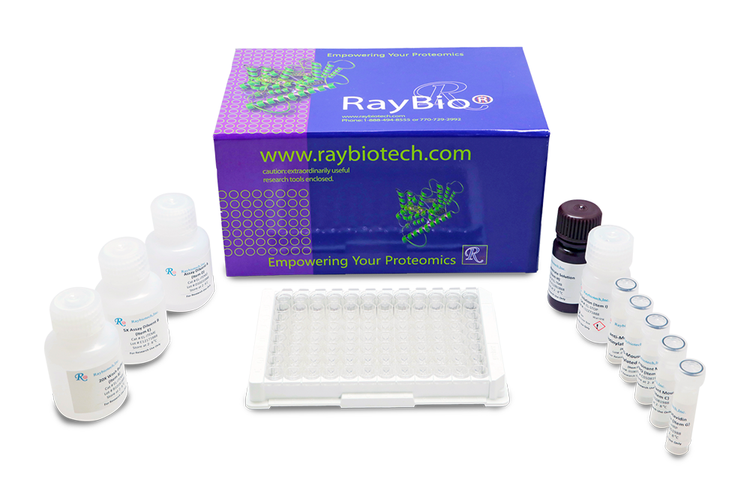
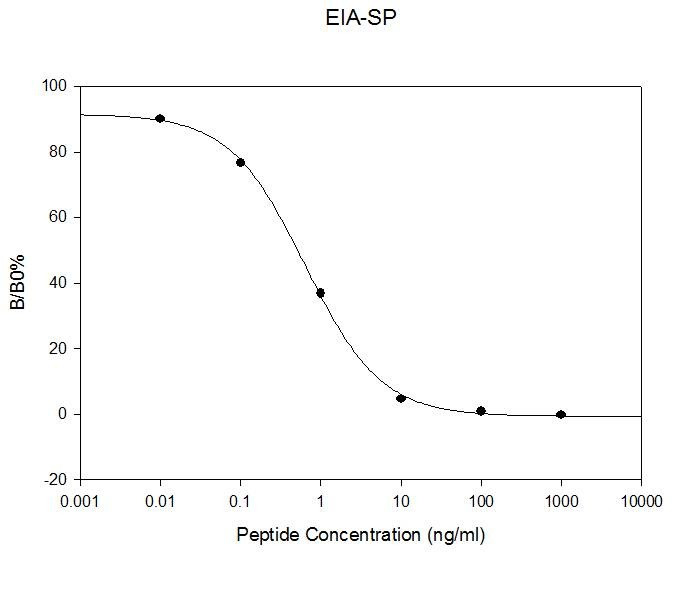
Substance P ELISA Kit
Substance P ELISA Kit
Contact Us for Bulk Request
Product Description
Specifications
| Size | 1 Plate Kit, 2 Plate Kit, 5 Plate Kit |
| Species | Human, Mouse, Rat |
| Sensitivity | 0.1ng/ml |
| Detection Range | 0.1-1,000 ng/ml |
| Specificity | This EIA kit is designed to detect human, mouse, and rat Substance P. |
| Compatible Sample Types | Plasma, Serum |
| Recommended Dilution (Serum/Plasma) | Human: 2x / Mouse: 8x / Rat: 8X |
| Accession Number | P20366 |
| Gene Id | 6863 |
| Gene Symbols | TAC1, NKA, NKNA, TAC2 |
| Protein Name / Synonyms | Protachykinin-1 (PPT) [Cleaved into: Substance P Neurokinin A (NKA) (Neuromedin L) (Substance K) Neuropeptide K (NPK) Neuropeptide gamma C-terminal-flanking peptide] |
| Quantitative/Semi-Quantitative | Quantitative |
| Solid Support | 96-well Microplate |
| Design Principle | Competition-based |
| Method Of Detection | Colorimetric |
| Research Area | Cardiovascular Disease, Inflammation |
| Shipping Type | Blue ice |
| Storage | -20°C |
Introduction
Substance P (SP) is an 11 amino acid peptide produced from a precursor protein, Protachykinin-1. It is a neuropeptide, acting as a neurotransmitter and as a neuromodulator. It is found in the brain and spinal cord and is associated with inflammatory processes and pain. Its receptor, NK1R, is distributed over cytoplasmic and nuclear membranes of many cell types (neurons, glia, endothelia of capillaries and lymphatics, fibroblasts, stem cells, white blood cells) in many tissues and organs. Substance P has been found as a key first responder to most noxious/extreme stimuli (stressors). It has been reported that Substance P is involved in many biological events, such as vasodilation, inflammation, pain, mood, anxiety, Learning, vomiting, cell growth, proliferation, angiogenesis, and migration. Elevation of Substance P and/or its receptor (NK1R) in serum, plasma, or tissue has been associated with many diseases.
Product Features
- Strip plates and additional reagents allow for use in multiple experiments
- Quantitative protein detection
- Establishes normal range
- The best products for confirmation of antibody array data
Application Notes
Kit Components
- Pre-Coated 96-well Strip Microplate
- Wash Buffer
- Standard Peptide
- Assay Diluent(s)
- Biotinylated Peptide
- HRP-Streptavidin
- TMB One-Step Substrate
- Stop Solution
- Assay Diagram
- Positive Control Sample
- Capture Antibody
- User Manual
Other Materials Required
- Distilled or deionized water
- Precision pipettes to deliver 2 µl to 1 ml volumes
- Adjustable 1-25 ml pipettes for reagent preparation
- 100 ml and 1 liter graduated cylinders
- Tubes to prepare standard and sample dilutions
- Orbital shaker
- Aluminum foil
- Saran Wrap
- Absorbent paper
- Microplate reader capable of measuring absorbance at 450nm
- SigmaPlot software (or other software that can perform four-parameter logistic regression models)
Protocol Outline
- Prepare all reagents, samples and standards as instructed.
- Add 100 µl detection antibody to each well.
- Incubate 1.5 h at RT or O/N at 4°C.
- Add 100 µl standard or sample to each well.
- Incubate 2.5 h at RT.
- Add 100 µl prepared streptavidin solution.
- Incubate 45 min at RT.
- Add 100 µl TMB One-Step Substrate Reagent to each well.
- Incubate 30 min at RT.
- Add 50 µl Stop Solution to each well.
- Read plate at 450 nm immediately.
Storage/Stability
Standard, biotinylated peptide, and positive control should be stored at -20°C after arrival. Avoid multiple freeze-thaws. The remaining kit components may be stored at 4°C. Opened microplate wells and antibody (Item N) may be stored for up to 1 month at 2° to 8°C. Return unused wells to the pouch containing desiccant pack and reseal along entire edge.
citations
Functional neuronal circuits promote disease progression in cancer
- Species:
- Mouse
- Sample Type:
- mEERL cell, MOC7 cell, Trp53−/− cell, Pten−/− cell
- Year:
- 2023
- Journal Name:
- Science advances
Novel Apocynin regulates TRPV1 activity in the trigeminal system and controls pain in a temporomandibular joint neurogenic model
- Species:
- Rat
- Sample Type:
- Cell Culture Supernatant (supernatants tissue not stated in passage)
- Year:
- 2024
- Journal Name:
- Research Square
Tumor-infiltrating nociceptor neurons promote immunosuppression
- Species:
- Mouse
- Sample Type:
- Other / Unspecified (condition media from mEERL cells, DRG, or co-culture)
- Year:
- 2025
- Journal Name:
- Science Signaling
- PubMed ID:
- 40763210
Protective role of berberine on ulcerative colitis through modulating enteric glial cells-intestinal epithelial cells-immune cells interactions
- Species:
- Mouse
- Year:
- 2020
- Journal Name:
- Acta Pharmaceutica Sinica B
- PubMed ID:
- 32140391
Inflammatory mediators in nasal secretions of patients with nasal polyposis with and without aspirin sensitivity
- Species:
- Human
- Sample Type:
- nasal secretions
- Year:
- 2023
- Journal Name:
- Immunity Inflammation and Disease
Decreased Level of Neuropeptide Y Is Associated With Gastroparesis in Male Diabetic Rats
- Species:
- Rat
- Sample Type:
- Tissue Lysate (Pylorus smooth muscle tissues homogenized)
- Year:
- 2020
- Journal Name:
- Gastroenterology Research
Nucleus Accumbens Tac1-Expressing Neurons Mediate Stress-Induced Anhedonia-like Behavior in Mice
- Species:
- Mouse
- Sample Type:
- Tissue Lysate (Striatum)
- Year:
- 2020
- Journal Name:
- Cell Reports
1-Deoxynojirimycin (DNJ) Ameliorates Indomethacin-Induced Gastric Ulcer in Mice by Affecting NF-kappaB Signaling Pathway
- Species:
- Mouse
- Sample Type:
- Tissue Lysate (Whole stomach lysates)
- Year:
- 2018
- Journal Name:
- Frontiers in pharmacology
- PubMed ID:
- 29725297
