

TCEP hydrochloride [51805-45-9]

Référence T7087-100mg
Conditionnement : 100mg
Marque : TargetMol
Contactez votre distributeur local :
 Téléphone : +1 850 650 7790
TCEP hydrochloride
(Synonyms: Tris(2-carboxyethyl)phosphine hydrochloride, TCEP HCl) Copy Product Info

TCEP hydrochloride (Tris(2-carboxyethyl)phosphine hydrochloride) is a trialkylphosphine that selectively reduces proteolysis. TCEP hydrochloride is a non-thiol-reducing agent that promotes the binding of NF-κB-DNA.
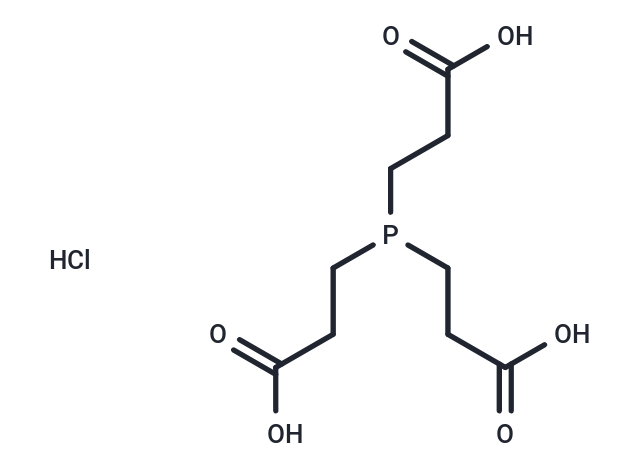
Cas No. 51805-45-9
Custom-made molecule. TargetMol’s expert synthesis team delivers cost-effective solutions. Contact us for inquiries. Committed to serving you.
For research use only—not for human use. No sales to individuals. Use as intended only.
Select Batch
Purity:99.93%
Appearance:Solid
Color:White
COA HNMR LCMS
Product Introduction
TCEP hydrochloride AI Summary
TCEP hydrochloride shows no significant inhibitory activity against HDAC1 and HDAC6 enzymes. Additionally, it does not exhibit significant growth inhibition (GI50 > 50000.0 nM) on human A549, MCF7, and WI38 cells after 96 hours, as determined by the sulphorhodamine B assay..
Note: Summary generated by AI. Data source: ChEMBL 
Bioactivity
Chemical Properties
Storage & Solubility Information
| Description | TCEP hydrochloride (Tris(2-carboxyethyl)phosphine hydrochloride) is a trialkylphosphine that selectively reduces proteolysis. TCEP hydrochloride is a non-thiol-reducing agent that promotes the binding of NF-κB-DNA. |
| Targets & IC50 | MCF-7 cells:> 50 μM (GI50), WI-38 cells:> 50 μM (GI50), NS3/4A:12.8 μM, A549 cells:> 50 μM (GI50) |
| In vitro | The growth inhibitory activity (GI₅₀) of TCEP hydrochloride in A549, MCF-7 tumor cells and WI-38 normal cells was all greater than 50 μM.[1] |
| In vivo | TCEP hydrochloride can dose-dependently promote NF-κB-DNA binding within the concentration range of 0.25–6 mM, and can replace DTT for in vitro NF-κB binding experiments. Compared with DTT, TCEP hydrochloride does not significantly weaken the inhibitory effect of Hg^2+ on NF-κB-DNA binding. When 6 mM TCEP hydrochloride is present, 20 μM Hg^2+ can effectively block NF-κB-DNA binding, while at 0.25 mM DTT conditions, more than 100 μM Hg^2+ is required to achieve a similar effect. [2] TCEP hydrochloride can be used to reduce the disulfide bonds in hLF peptides. At a peptide concentration of 0.1 mM, adding 30-fold molar excess of TCEP hydrochloride and incubating at 37 ℃ for 2 hours can achieve effective reduction. [3] |
| Synonyms | Tris(2-carboxyethyl)phosphine hydrochloride, TCEP HCl |
| Molecular Weight | 286.65 |
| Formula | C9H16ClO6P |
| Cas No. | 51805-45-9 |
| Smiles | Cl.OC(=O)CCP(CCC(O)=O)CCC(O)=O |
| Relative Density. | 1.041 g/cm3 at 25℃ |
| Storage | Store under nitrogen Powder: -20°C for 3 years | In solvent: -80°C for 1 year Shipping with blue ice/Shipping at ambient temperature. | |||||||||||||||||||||||||||||||||||
| Solubility Information | DMSO: 252.5 mg/mL (880.87 mM), Sonication is recommended.  | |||||||||||||||||||||||||||||||||||
| In Vivo Formulation | 10% DMSO+90% Saline: 2.75 mg/mL (9.59 mM), Solution. 5% DMSO+95% Saline: 1.45 mg/mL (5.06 mM), Solution. Please add the solvents sequentially, clarifying the solution as much as possible before adding the next one. Dissolve by heating and/or sonication if necessary. Working solution is recommended to be prepared and used immediately. The formulation provided above is for reference purposes only. In vivo formulations may vary and should be modified based on specific experimental conditions. | |||||||||||||||||||||||||||||||||||
Solution Preparation Table | ||||||||||||||||||||||||||||||||||||
DMSO
Note : The dilution table applies only to solid products. For liquid products, please calculate the stock solution based on the stated concentration and/or density. | ||||||||||||||||||||||||||||||||||||