



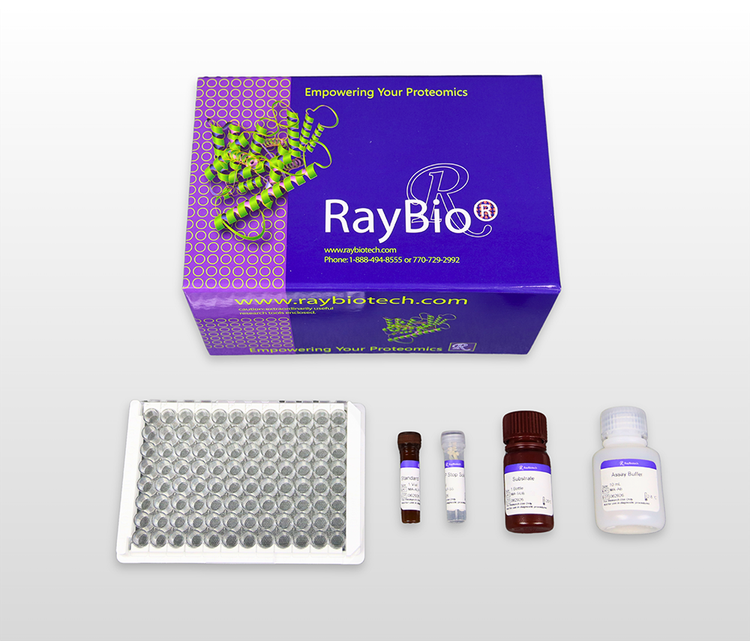
The RayBiotech Triglyceride Colorimetric Assay Kit provides a simple, reproducible, and sensitive tool of measuring triglyceride concentration in plasma, serum, cell lysates and other biological liquid samples.
Triglyceride Assay Kit (Colorimetric)
Triglyceride Assay Kit (Colorimetric)
Contact Us for Bulk Request
Product Description
Specifications
| Size | 1 Plate Kit, 2 Plate Kit, 5 Plate Kit |
| Compatible Sample Types | Cell Culture Supernatants, Plasma, Serum, Tissue Lysates, Cell Lysates |
| Quantitative/Semi-Quantitative | Quantitative |
| Solid Support | 96-well Microplate |
| Method Of Detection | Colorimetric |
| Research Area | Cardiovascular Disease, Energy Metabolism, Obesity & Metabolic Disease, Glycolysis & Lipid Metabolism |
| Shipping Type | Blue ice |
| Storage | 2-8°C |
| Storage / Stability | The entire kit should be stored at 2-8°C for up to 6 months from the date of shipment. Do not use the kit beyond its expiration date. For prepared reagent storage, see the manual. |
Related Products
Non-Esterified Fatty Acids (NEFA/FFA) Detection Assay Kit
As low as $649.00
Total Cholesterol Assay Kit (Colorimetric)
As low as $299.00
Free Glycerol Assay Kit (Colorimetric)
As low as $339.00
Introduction
Triglycerides are a family of lipids absorbed from the diet and produced endogenously from carbohydrates. Triglycerides constitute 95% of fat stocked in tissues and their main role is to provide energy to cells. The synthesis of triglycerides occurs in two main locations: the intestine, where dietary fats are processed, and the liver, where carbohydrates are converted into triglycerides. Subsequently, these triglycerides are transported in the bloodstream by chylomicrons and very low-density lipoproteins (VLDL). Elevated levels of triglycerides have been associated with high risk of severe atherosclerosis. High triglyceride levels and hyperlipidemia, in general, can be attributed to genetic factors or can arise as a consequence of various disorders, such as diabetes mellitus, nephrosis, biliary obstruction, and metabolic disorders associated with endocrine imbalances.
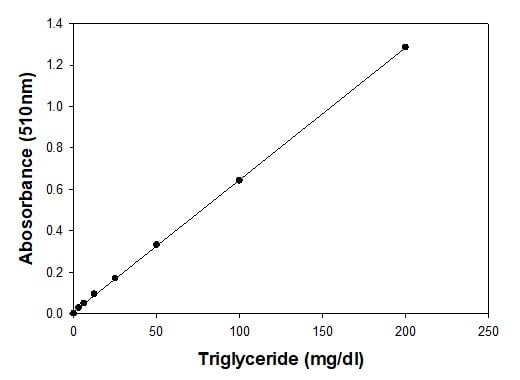
RayBio® Triglyceride Colorimetric Assay Kit provides a simple, reproducible, and sensitive tool of measuring triglyceride concentration in plasma, serum, cell lysates and other biological liquid samples. This assay employs a coupled enzymatic reaction system that combines multiple steps. Initially, lipase catalyzes the hydrolysis of triglycerides into free fatty acids and glycerol. The released glycerol is then phosphorylated by adenosine triphosphate (ATP) with glycerol kinase (GK) to produce glycerol-3-phosphate and adenosine diphosphate. Glycerol-3-phosphate is subsequently oxidized by dihydroxyacetone phosphate (DAP) via glycerolphosphate oxidase producing hydrogen peroxide (H2O2) which then reacts with the Colorimetric Probe to form a pink colored product. The optical density measured at 510nm is directly proportional to the concentration of triglyceride present in the sample
Kit Components
| Component | Size / Description |
|---|---|
| Microplate | A 96-well (12 strips x 8 wells) plate |
| Sample Buffer | 10 ml |
| Triglyceride Standard | 1 vial (100 µl of 200 mg/dL) |
| Enzyme Mix Solution | 20 ml |
Additional Materials Required
- Microplate reader capable of measuring absorbance at 510 nm
- Precision pipettes to deliver 2 µl to 1 ml volumes
- Distilled or deionized water
- Tubes to prepare sample dilutions
- Incubator at 37°C.
Assay Procedure Summary
Each triglyceride standard and sample should be assayed in duplicate or triplicate. Additionally, each sample should be tested without lipase to determine free glycerol background. A freshly prepared standard curve should be used each time the assay is performed.
- Add 10 µL of the diluted Triglyceride Standards or Samples to the 96-well microtiter plate.
- Initiate the reaction by adding 200 µL of diluted enzyme mix solution to each well.
- Cover with the plate cover. Carefully shake the plate for a few seconds to mix.
- Incubate the plate for 10 minutes at 37°C.
- Measure the absorbance at 510nm using a plate reader.