

Active Luteinizing Hormone (LH)

Référence MBS2153304-0,05mg
Conditionnement : 0.05mg
Marque : MyBiosource
Contactez votre distributeur local :

Téléphone : +1 850 650 7790
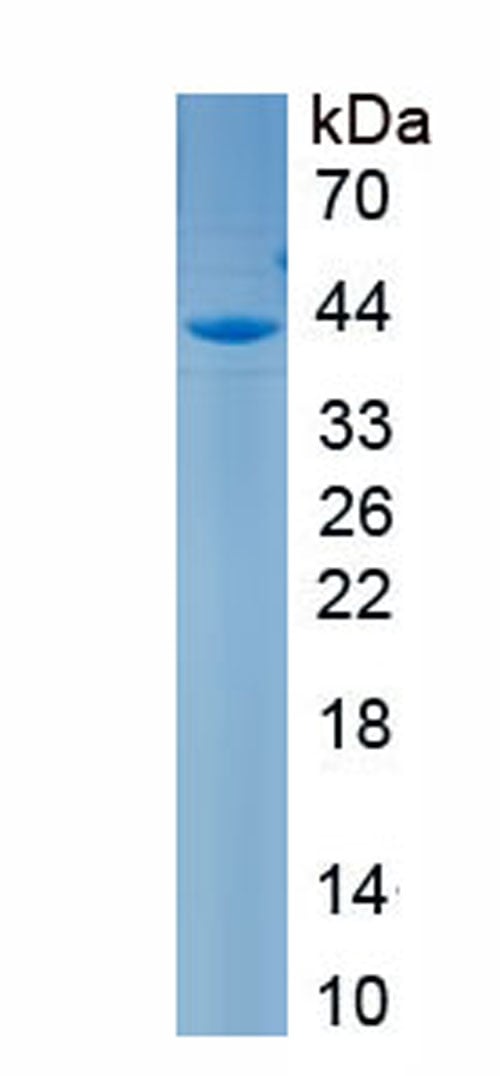
Figure. SDS-PAGE
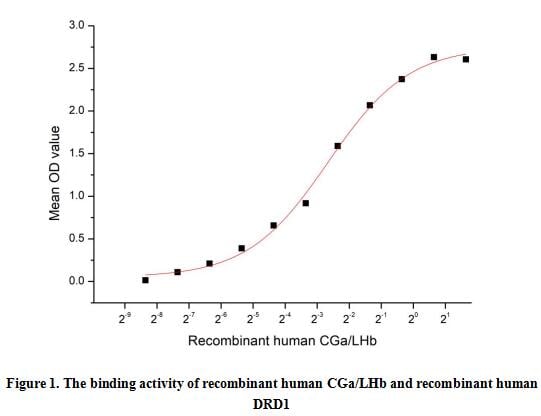
Luteinizing Hormone (LH) is a 42 kDa heterodimer belonging to the glycoprotein hormone family. It is composed of noncovalently linked glycosylated alpha and beta chains. The alpha subunit (CG alpha ) is also a component of Follicle-Stimulating Hormone (FS
Luteinizing Hormone (LH) Active Protein
For Research Use Only. Not for use in diagnostic procedures. Catalog #: MBS2153304MBS2153304 is an active protein targeting LH. Also known as Active Luteinizing Hormone (LH). Host: E coli. More details
Product Overview
Online Datasheet in PDFProduct Name
Luteinizing Hormone (LH), Active Protein
Full Product Name
Active Luteinizing Hormone (LH)
Product Gene Name
LH active protein
Product Synonym Names
Luteinizing Hormone; LH active protein (prokaryotic), Human; ICSH; Lutropin; Interstitial Cell Stimulating Hormone
Host
E coli
Form/Format
PBS, pH7.4, containing 0.01% SKL, 5% Trehalose.
Freeze-dried powder
Freeze-dried powder
Purity/Purification
Greater than 90% by SDS-PAGE
Preparation and Storage
Store at 2-8 degree C for one month, -80 degree C for 12 months
Stable for 12 months if correctly stored.
Stable for 12 months if correctly stored.
Molecular Weight
Predicted: 34 kDa
Observed: 36 kDa
Observed: 36 kDa
Sequence Positions
Ala25~Ser116+GGGGS*3+Ser21~Leu141
OMIM
113730
Supply Chain Verification
Manufactured in a lab with traceable raw materials. Bulk orders can typically be prepared to the customer’s specifications, please inquire.
Active Protein Note
Protein activity can be an ambiguous term. Please refer to the data sheet or inquire with Technical Support to determine the definition of activity for this product.
Expression System
Prokaryotic expression
Species
Human
Tag
N-terminal His
Endotoxin Level
<1.0EU per 1ug (determined by the LAL method)
Isoelectric Point
8
Research Area
Endocrinology
Product Categories/Family for LH active protein
Active proteins
ISO Certification
Manufactured in an ISO 9001:2015 and ISO 13485:2016 Certified Laboratory.
Applications Tested/Suitable for LH active protein
Cell culture, Activity Assay
Other Notes
Small volumes of LH active protein vial(s) may occasionally become entrapped in the seal of the product vial during shipment and storage. If necessary, briefly centrifuge the vial on a tabletop centrifuge to dislodge any liquid in the container`s cap. Certain products may require to ship with dry ice and additional dry ice fee may apply.
Additional Details
NCBI/Uniprot data below describe general gene information for LH. It may not necessarily be applicable to this product.
NCBI Official Full Name
mitochondrial brown fat uncoupling protein 1
NCBI Official Synonym Full Names
uncoupling protein 1 (mitochondrial, proton carrier)
NCBI Official Symbol
UCP1
NCBI Official Synonym Symbols
UCP; SLC25A7
UniProt Protein Name
Mitochondrial brown fat uncoupling protein 1
UniProt Synonym Protein Names
Solute carrier family 25 member 7; Thermogenin
UniProt Gene Name
UCP1
UniProt Synonym Gene Names
SLC25A7; UCP; UCP 1
UniProt Entry Name
UCP1_HUMAN
NCBI Protein Information
mitochondrial brown fat uncoupling protein 1; thermogenin; solute carrier family 25 member 7
NCBI Summary for LH
Mitochondrial uncoupling proteins (UCP) are members of the family of mitochondrial anion carrier proteins (MACP). UCPs separate oxidative phosphorylation from ATP synthesis with energy dissipated as heat, also referred to as the mitochondrial proton leak. UCPs facilitate the transfer of anions from the inner to the outer mitochondrial membrane and the return transfer of protons from the outer to the inner mitochondrial membrane. They also reduce the mitochondrial membrane potential in mammalian cells. Tissue specificity occurs for the different UCPs and the exact methods of how UCPs transfer H+/OH- are not known. UCPs contain the three homologous protein domains of MACPs. This gene is expressed only in brown adipose tissue, a specialized tissue which functions to produce heat. [provided by RefSeq, Jul 2008]
Show more UniProt Comments for LH
UCP1: UCP are mitochondrial transporter proteins that create proton leaks across the inner mitochondrial membrane, thus uncoupling oxidative phosphorylation from ATP synthesis. As a result, energy is dissipated in the form of heat. Belongs to the mitochondrial carrier family.
Protein type: Membrane protein, integral; Membrane protein, multi-pass; Mitochondrial
Chromosomal Location of Human Ortholog: 4q28-q31
Cellular Component: mitochondrion; mitochondrial inner membrane; integral to membrane
Molecular Function: oxidative phosphorylation uncoupler activity
Biological Process: regulation of transcription from RNA polymerase II promoter; cellular metabolic process; proton transport; brown fat cell differentiation; mitochondrial transport
Disease: Obesity
Show more Protein type: Membrane protein, integral; Membrane protein, multi-pass; Mitochondrial
Chromosomal Location of Human Ortholog: 4q28-q31
Cellular Component: mitochondrion; mitochondrial inner membrane; integral to membrane
Molecular Function: oxidative phosphorylation uncoupler activity
Biological Process: regulation of transcription from RNA polymerase II promoter; cellular metabolic process; proton transport; brown fat cell differentiation; mitochondrial transport
Disease: Obesity
Precautions
All of MyBioSource's Products are for scientific laboratory research purposes and are not for diagnostic, therapeutics, prophylactic or in vivo use. Through your purchase, you expressly represent and warrant to MyBioSource that you will properly test and use any Products purchased from MyBioSource in accordance with industry standards. MyBioSource and its authorized distributors reserve the right to refuse to process any order where we reasonably believe that the intended use will fall outside of our acceptable guidelines.
Disclaimer
While every efforts were made to ensure the accuracy of the information provided in this datasheet, MyBioSource will not be liable for any omissions or errors contained herein. MyBioSource reserves the right to make changes to this datasheet at any time without prior notice.
It is the responsibility of the customer to report product performance issues to MyBioSource within 30 days of receipt of the product. Please visit our Terms & Conditions page for more information.
It is the responsibility of the customer to report product performance issues to MyBioSource within 30 days of receipt of the product. Please visit our Terms & Conditions page for more information.
Product Note
Select online data sheet information is drawn from bioinformatics databases, occasionally resulting in ambiguous or non-relevant product information. It is the responsibility of the customer to review, verify, and evaluate the information to make sure it matches their requirements before purchasing the kit. Our ELISA Kit assays are dynamic research tools and sometimes they may be updated and improved. If the format of this assay is important to you then please request the current manual or contact our technical support team with a presales inquiry before placing an order. We will confirm the current details of the assay. We cannot guarantee the sample manual posted online is the most current manual, it is intended to serve as an example only. Please refer to the instructions For Use provided with the assay kit for precise details.
Product PubMed Publications
Products associated with LH active protein
| Reference Product | PubMed Publications |
|---|---|
| UCP2 active protein | >311 publications with LH and UCP2 |
| PPARG active protein | >68 publications with LH and PPARG |
| CIDEA active protein | >21 publications with LH and CIDEA |
| NPY active protein | >17 publications with LH and NPY |
| ADRB3 active protein | >11 publications with LH and ADRB3 |
| INS active protein | >8 publications with LH and INS |
| LEP active protein | >7 publications with LH and LEP |
| GHRL active protein | >1 publications with LH and GHRL |
| IRS1 active protein | >1 publications with LH and IRS1 |
Pathways associated with LH active protein
| Products by Pathway | Pathway Diagram |
|---|---|
| Adipogenesis Pathway antibodies | Adipogenesis Pathway Diagram |
| Electron Transport Chain Pathway antibodies | Electron Transport Chain Pathway Diagram |
| Huntington's Disease Pathway antibodies | Huntington's Disease Pathway Diagram |
| Huntington's Disease Pathway antibodies | Huntington's Disease Pathway Diagram |
| Metabolism Pathway antibodies | Metabolism Pathway Diagram |
| Mitochondrial Uncoupling Proteins Pathway antibodies | Mitochondrial Uncoupling Proteins Pathway Diagram |
| PPAR Signaling Pathway antibodies | PPAR Signaling Pathway Diagram |
| PPAR Signaling Pathway antibodies | PPAR Signaling Pathway Diagram |
| Respiratory Electron Transport, ATP Synthesis By Chemiosmotic Coupling, And Heat Production By Uncoupling Proteins. Pathway antibodies | Respiratory Electron Transport, ATP Synthesis By Chemiosmotic Coupling, And Heat Production By Uncoupling Proteins. Pathway Diagram |
| The Citric Acid (TCA) Cycle And Respiratory Electron Transport Pathway antibodies | The Citric Acid (TCA) Cycle And Respiratory Electron Transport Pathway Diagram |
Diseases associated with LH active protein
| Disease Name | Pubmed Publications |
|---|---|
| Obesity Antibodies | >472 publications with LH and Obesity |
| Weight Gain Antibodies | >104 publications with LH and Weight Gain |
| Insulin Resistance Antibodies | >95 publications with LH and Insulin Resistance |
| Fatty Liver Antibodies | >64 publications with LH and Fatty Liver |
| Weight Loss Antibodies | >60 publications with LH and Weight Loss |
| Inflammation Antibodies | >41 publications with LH and Inflammation |
| Disease Models, Animal Antibodies | >27 publications with LH and Disease Models, Animal |
| Liver Diseases Antibodies | >24 publications with LH and Liver Diseases |
| Hyperglycemia Antibodies | >21 publications with LH and Hyperglycemia |
| Necrosis Antibodies | >20 publications with LH and Necrosis |
Organs/Tissues associated with LH active protein
| Organ/Tissue Name | Pubmed Publications |
|---|---|
| Adipose Tissue Antibodies | >938 publications with LH and Adipose Tissue |
| Connective Tissue Antibodies | >668 publications with LH and Connective Tissue |