



Mouse anti-Human/Rhesus Monkey. CD5 Antibody
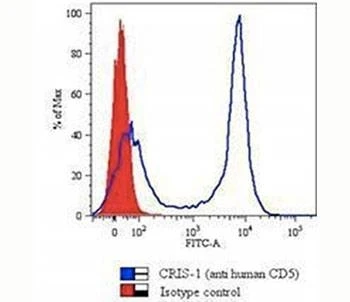
Anti-Monkey. CD5 Antibody
Anti-Monkey. CD5 Antibody
Contact Us for Bulk Request
Product Description
Specifications
| Size | 20 µg, 100 µg |
| Species | Human |
| Host Species | Mouse |
| Accession Number | P06127 |
| Gene Id | 921 |
| Gene Symbols | CD5, LEU1 |
| Protein Name / Synonyms | T-cell surface glycoprotein CD5 (Lymphocyte antigen T1/Leu-1) (CD antigen CD5) |
| Immunogen | Stimulated human leukocytes were used as the immunogen for this CD5 antibody. |
| Isotype | Kappa, IgG2a |
| Purity | Protein G affinity chromatography |
| Concentration (lot specific) | 0.2 mg/ml in 1X PBS (pH 7.4) with 0.1 mg/ml BSA (US sourced) and 0.05% sodium azide |
| Recommended Applications | Functional Testing: order BSA/azide-free format FACS: 0.5-1ug/million cells IF: 0.5-1ug/ml |
| Domain / Region / Terminus | Cell surface |
| Shipping Type | Blue ice |
| Storage | ≤-20°C |
Description
This antibody recognizes a 67kDa transmembrane protein, which is identified as CD5. It is found on 95% of thymocytes and 72% of peripheral blood lymphocytes. In lymph nodes, the main reactivity is observed in Tcell areas. CD5 antibody is a pan Tcell marker that also reacts with a range of neoplastic Bcells, e.g. chronic lymphocytic leukemia/small lymphocytic lymphoma (CLL/SLL), mantle cell lymphoma, and a subset (~10%) of diffuse large Bcell lymphoma. Aberrant expression is useful in making a diagnosis of mature Tcell neoplasms. CD5 antibody detection is diagnostic in CLL/SLL within a panel of other Bcell markers, especially one that includes anti-CD23. CD5 antibody is also very useful in differentiating among mature small lymphoid cell malignancies. In addition, it can be used in distinguishing thymic carcinoma (+) from thymoma (-). It does not react with granulocytes or monocytes.
Storage
Store the CD5 antibody at 2-8°C (with azide) or aliquot and store at -20°C or colder (without azide).
Expiration:
12 months from the date of shipment when stored properly.