



Use code ELISA25-262 for 25% off all ELISAs through November.
25% off all ELISA kits

Apelin ELISA Kit
Apelin ELISA Kit
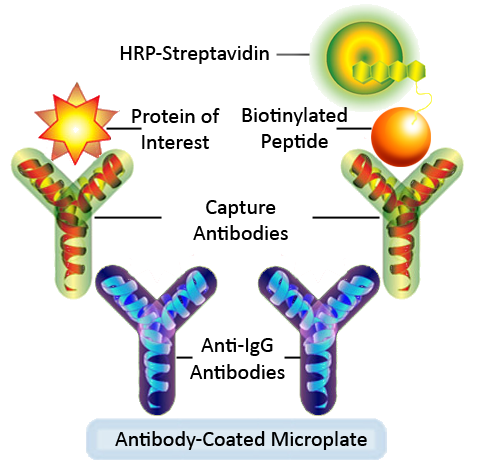
RayBio® Human/Mouse/Rat Apelin EIA Kit optimized for serum and cell culture medium. Competition-based ELISA on a 96-well strip plate.
Contact Us for Bulk Request
Product Description
Specifications
| Size | 1 Plate Kit, 2 Plate Kit, 5 Plate Kit |
| Species | Human, Mouse, Rat |
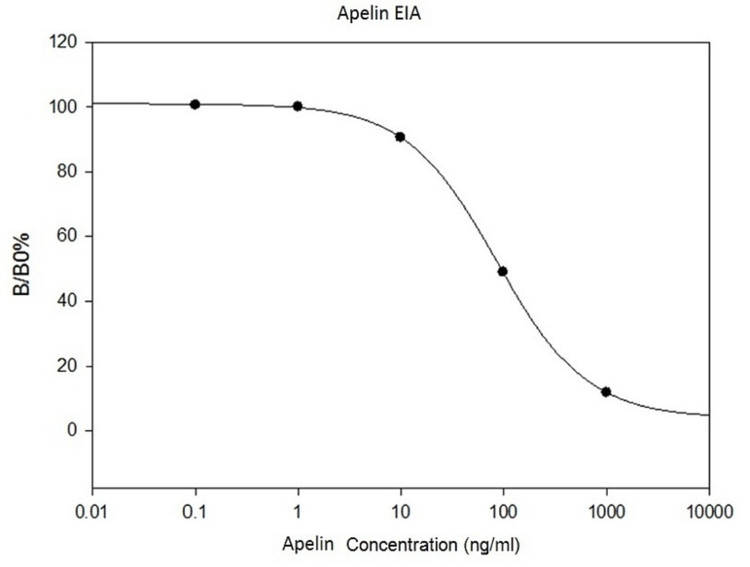
| Sensitivity | 15.8 ng/ml |
| Detection Range | 0.1-1,000 ng/ml |
| Specificity | This kit is designed to target the C-terminus of the 77-aa apelin peptide and therefore is expected to detect all active forms of Apelin including Apelin-36, Apelin-31, Apelin-28 and Apelin 13 can be detected. Cross Reactivity: This kit shows no cross-reactivity with any of the cytokines tested: Ghrelin, Nesfatin, and NPY. |
| Compatible Sample Types | Plasma, Serum |
| Recommended Dilution (Serum/Plasma) | Human: 2X / Mouse: 2X / Rat: 2X |
| Accession Number | Q9ULZ1 |
| Gene Id | 8862 |
| Gene Symbols | APLN, APEL |
| Protein Name / Synonyms | Apelin (APJ endogenous ligand) [Cleaved into: Apelin-36 Apelin-31 Apelin-28 Apelin-13] |
| Quantitative/Semi-Quantitative | Quantitative |
| Solid Support | 96-well Microplate |
| Design Principle | Competition-based |
| Method Of Detection | Colorimetric |
| Research Area | Angiogenesis, Cardiovascular Disease, Obesity & Metabolic Disease |
| Shipping Type | Blue ice |
| Storage | -20°C |
Related Products
Anti-APL Antibody
As low as $41.60
Introduction
Apelin, an endogenous ligand for the G-protein-coupled APJ receptor, has been recently extensively studied in obesity research. It is not only expressed in adipocyte tissue, but also widely expressed in various other organs such as the heart, lung, kidney, gastrointestinal tract, brain, adrenal glands, endothelium, and human plasma.
Apelin is derived from a 77-amino-acid prepropeptide that is cleaved into a 55-amino-acid fragment and then into shorter forms. The physiologically active form is thought to be apelin 36, although the pyroglutamylated form of apelin 13, which is also produced endogenously, is more potent.
Studies have shown the association between apelin and obesity. Apelin has higher circulating levels in obesity. Insulin exerts a positive action on adipocyte apelin production. Apelin also regulates fluid homeostasis, playing an important role in the hypothalamic regulation of food and water intake, and pituitary hormone release.
In addition to its role in obesity, apelin acts as a mediator of cardiovascular control, including for blood pressure and blood flow. It is one of the most potent stimulators of cardiac contractility yet identified, and plays a role in cardiac tissue remodeling. Apelin levels are increased in left ventricles of patients with chronic heart failure and also in patients with chronic liver disease.
Product Features
- Strip plates and additional reagents allow for use in multiple experiments
- Quantitative protein detection
- Establishes normal range
- The best products for confirmation of antibody array data
Application Notes
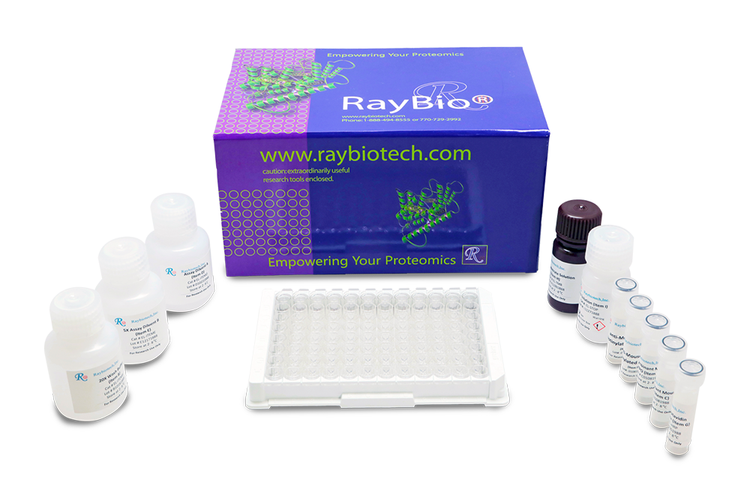
Kit Components
- Pre-Coated 96-well Strip Microplate
- Wash Buffer
- Standard Peptide
- Assay Diluent(s)
- Biotinylated Peptide
- HRP-Streptavidin
- TMB One-Step Substrate
- Stop Solution
- Assay Diagram
- Positive Control Sample
- Capture Antibody
- User Manual
Other Materials Required
- Distilled or deionized water
- Precision pipettes to deliver 2 µl to 1 ml volumes
- Adjustable 1-25 ml pipettes for reagent preparation
- 100 ml and 1 liter graduated cylinders
- Tubes to prepare standard and sample dilutions
- Orbital shaker
- Aluminum foil
- Saran Wrap
- Absorbent paper
- Microplate reader capable of measuring absorbance at 450nm
- SigmaPlot software (or other software that can perform four-parameter logistic regression models)
Protocol Outline
- Prepare all reagents, samples and standards as instructed.
- Add 100 µl detection antibody to each well.
- Incubate 1.5 h at RT or O/N at 4°C.
- Add 100 µl standard or sample to each well.
- Incubate 2.5 h at RT.
- Add 100 µl prepared streptavidin solution.
- Incubate 45 min at RT.
- Add 100 µl TMB One-Step Substrate Reagent to each well.
- Incubate 30 min at RT.
- Add 50 µl Stop Solution to each well.
- Read plate at 450 nm immediately.
Storage/Stability
Standard, Biotinylated Apelin C-Terminus peptide, and Positive Control should be stored at -20°C after arrival. Avoid multiple freeze-thaws. The remaining kit components may be stored at 4°C. Opened Microplate Wells and antibody (Item N) may be stored for up to 1 month at 2° to 8°C. Return unused wells to the pouch containing desiccant pack and reseal along entire edge.
citations
Role of apelin as a biomarker in functional recovery and post-stroke-associated sarcopenia: insights from rehabilitation therapy
- Species:
- Human
- Sample Type:
- Plasma (stroke patients, pre/post rehabilitation)
- Year:
- 2026
- Journal Name:
- PeerJ
- PubMed ID:
- 41809696
The role of serum apelin in retinopathy of prematurity
- Species:
- Human
- Sample Type:
- Serum
- Year:
- 2022
- Journal Name:
- Clinical Ophthalmology
Adipokine levels and carbohydrate metabolism in patients diagnosed de novo with polycystic ovary syndrome
- Species:
- Human
- Sample Type:
- Serum (plasma or serum not specified); Plasma
- Year:
- 2021
- Journal Name:
- Qatar medical journal
- PubMed ID:
- 34604014
Relationships between plasma apelin and adiponectin with normal weight obesity, body composition, and cardiorespiratory fitness in working adults
- Species:
- Human
- Sample Type:
- Plasma (fasting plasma)
- Year:
- 2021
- Journal Name:
- Journal of clinical & translational endocrinology
- PubMed ID:
- 34178605
Angiotensin AT1 receptor antagonism by losartan stimulates adipocyte browning via induction of apelin
- Species:
- Mouse
- Sample Type:
- Conditioned media (3T3-L1 preadipocytes)
- Year:
- 2020
- Journal Name:
- The Journal of biological chemistry
- PubMed ID:
- 32839272
Serum elabela and apelin levels during different stages of chronic kidney disease
- Species:
- Human
- Sample Type:
- Serum (CKD patients, stages 1-5)
- Year:
- 2020
- Journal Name:
- Renal Failure
- PubMed ID:
- 32713238
Investigation of changes in apelin receptor mRNA and protein expression in the myocardium and aorta of rats with two-kidney, one-clip (2K1C) Goldblatt hypertension
- Species:
- Rat
- Sample Type:
- Serum (Two kidney one clip hypertension model)
- Year:
- 2015
- Journal Name:
- Journal of Physiology and Biochemsitry
- PubMed ID:
- 25708823
Diagnostic Significance of Plasma Levels of Novel Adipokines in Patients With Symptomatic Intra- and Extracranial Atherosclerotic Stenosis
- Species:
- Human
- Sample Type:
- Plasma (symptomatic atherosclerotic stenosis patients)
- Year:
- 2019
- Journal Name:
- Frontiers in Neurology
- PubMed ID:
- 31803136
Inflammatory markers and obstructive sleep apnea in obese children: The NANOS Study
- Species:
- Human
- Sample Type:
- Plasma
- Year:
- 2014
- Journal Name:
- Mediators of Inflammation
Induction of Apelin by Losartan in Renal Ischemia/Reperfusion Injury in Rats - Implication of Endothelial Nitric Oxide Synthase (eNOS) Phosphorylation
- Species:
- Rat
- Sample Type:
- Tissue Lysate (Renal / Liver tissue lysates)
- Year:
- 2014
- Journal Name:
- Journal of Physiology and Pharmacology Advances
