Réactifs et instruments pour l'immunologie, la biologie cellulaire et la biologie moléculaire.
Biovalley > CAMK2A (Calcium/Calmodulin-dependent Protein Kinase Type II Subunit alpha, CaM-kinase II Subunit alpha, CaM Kinase II Subunit alpha, CAMKA, KIAA0968) (AP)
CAMK2A (Calcium/Calmodulin-dependent Protein Kinase Type II Subunit alpha, CaM-kinase II Subunit alpha, CaM Kinase II Subunit alpha, CAMKA, KIAA0968) (AP)
CAMK2A (Calcium/Calmodulin-dependent Protein Kinase Type II Subunit alpha, CaM-kinase II Subunit alpha, CaM Kinase II Subunit alpha, CAMKA, KIAA0968) (AP)
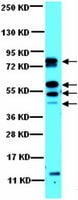
Western Blot Analysis: HEK293 lysate was resolved by electrophoresis, transferred to PVDF membrane and probed with anti-CaM Kinase II (1:500). Proteins were visualized using a donkey anti-rabbit secondary antibody conjugated to HRP and a chemiluminescence detection system. Arrow indicates protein CAMKII (~60kD).
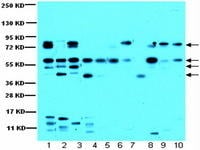
Western Blot Analysis: Representative image from a previous lot. Jurkat lysate (Lane1), RAW 264 lysate (Lane2), HEK293 lysate (Lane 3), NIH/3T3 lysate (Lane 4), C2C12 lysate (Lane 5), Huvec lysate (Lane 6), A431 lysate (Lane 7), L6 lysate (Lane 8), HepG2 lysate (Lane 9), HeLa lysate (Lane 10) and PC3 lysate (Lane 11) were resolved by electrophoresis, transferred to PVDF membrane and probed with anti-CaM Kinase II (1:500 dilution of a previous lot). Proteins were visualized using a donkey anti-rabbit secondary antibody conjugated to HRP and a chemiluminescence detection system. Arrow indicates protein CaM Kinase II (pan-isoforms) (~50-72kD).
CAMK2A Antibody – Rabbit Polyclonal
For Research Use Only. Not for use in diagnostic procedures.Catalog #: MBS6444589
MBS6444589 is an antibody targeting CAMK2A. Also known as CAMK2A (Calcium/Calmodulin-dependent Protein Kinase Type II Subunit alpha, CaM-kinase II Subunit alpha, CaM Kinase II Subunit alpha, CAMKA, KIAA0968) (AP). Reactive in Rat, Bovine, Chicken, Guinea Pig,… More details
Product Overview
Online Datasheet in PDF
Product Name
CAMK2A, Polyclonal Antibody
Full Product Name
CAMK2A (Calcium/Calmodulin-dependent Protein Kinase Type II Subunit alpha, CaM-kinase II Subunit alpha, CaM Kinase II Subunit alpha, CAMKA, KIAA0968) (AP)
Product Gene Name
anti-CAMK2A antibody
Clonality
Polyclonal
Isotype
IgG
Host
Rabbit
Species Reactivity
Rat, Bovine, Chicken, Guinea Pig, Hamster, Human, Mouse, Rabbit
Form/Format
Supplied as a liquid in PBS, pH 7.2. No preservative added. Labeled with Alkaline Phosphatase.
Purity/Purification
Purified by Immunoaffinity chromatography.
Specificity
Recognizes rat CaMK II. Species Crossreactivity: human, mouse, bovine, hamster, guinea pig, chicken and rabbit.
Preparation and Storage
Store product at 4 degree C. DO NOT FREEZE! Stable at 4 degree C for 12 months after receipt as an undiluted liquid. Dilute required amount only prior to immediate use. Further dilutions can be made in assay buffer. For maximum recovery of product, centrifuge the original vial prior to removing the cap.
Synthetic peptide corresponding to the N-terminal of rat CaMK II.
Conjugate
AP
Control
HEK293 cell lysate
Note
Preservative Free
Product Categories/Family for anti-CAMK2A antibody
Antibodies; Calmodulin
Applications Tested/Suitable for anti-CAMK2A antibody
Western Blot (WB)
Application Notes for anti-CAMK2A antibody
WB: 1:500-1:1000 Applications are based on unconjugated antibody.
Western Blot (WB) of anti-CAMK2A antibody
Western Blot Analysis: HEK293 lysate was resolved by electrophoresis, transferred to PVDF membrane and probed with anti-CaM Kinase II (1:500). Proteins were visualized using a donkey anti-rabbit secondary antibody conjugated to HRP and a chemiluminescence detection system. Arrow indicates protein CAMKII (~60kD).
Western Blot (WB) of anti-CAMK2A antibody
Western Blot Analysis: Representative image from a previous lot. Jurkat lysate (Lane1), RAW 264 lysate (Lane2), HEK293 lysate (Lane 3), NIH/3T3 lysate (Lane 4), C2C12 lysate (Lane 5), Huvec lysate (Lane 6), A431 lysate (Lane 7), L6 lysate (Lane 8), HepG2 lysate (Lane 9), HeLa lysate (Lane 10) and PC3 lysate (Lane 11) were resolved by electrophoresis, transferred to PVDF membrane and probed with anti-CaM Kinase II (1:500 dilution of a previous lot). Proteins were visualized using a donkey anti-rabbit secondary antibody conjugated to HRP and a chemiluminescence detection system. Arrow indicates protein CaM Kinase II (pan-isoforms) (~50-72kD).
Related Product Information for anti-CAMK2A antibody
MBS6444589 is an antibody targeting CAMK2A. Also known as CAMK2A (Calcium/Calmodulin-dependent Protein Kinase Type II Subunit alpha, CaM-kinase II Subunit alpha, CaM Kinase II Subunit alpha, CAMKA, KIAA0968) (AP). Reactive in Rat, Bovine, Chicken, Guinea Pig, Hamster, Human, Mouse, Rabbit. Host: Rabbit.
Product References and Citations for anti-CAMK2A antibody
1. Downregulation of delta CaM kinase II in human tumor cells.Tombes, R M, et al. (1999). Biochim. Biophys. Acta, 1452: 1-11 (1999). 2. Regulation of DLG localization at synapses by CaMKII-dependent phosphorylation. Koh, Y H, et al. (1999). Cell, 98: 353-63 (1999). 3. Inhibition of calcium/calmodulin-dependent protein kinase II in rat hippocampus attenuates morphine tolerance and dependence. Fan, G H, et al. (1999). Mol. Pharmacol., 56: 39-45 (1999). 4. Identification and expression of delta-isoforms of the multifunctional Ca2+/calmodulin-dependent protein kinase in failing and nonfailing human myocardium. Hoch, B, et al. (1999). Circ. Res., 84: 713-21 (1999). 5. Regional distribution of type II Ca2+/calmodulin-dependent protein kinase in rat brain. Erondu, N E and Kennedy, M B (1985) J. Neurosci., 5: 3270-7 (1985). 6. AlphaCaMKII binding to the C-terminal tail of NMDA receptor subunit NR2A and its modulation by autophosphorylation. Gardoni, F, et al. (1999). FEBS Lett., 456: 394-8 (1999). 7. CaMKII regulates the density of central glutamatergic synapses in vivo. Rongo, C and Kaplan, J M (1999). Nature, 402: 195-9 (1999).
Other Notes
Small volumes of anti-CAMK2A antibody vial(s) may occasionally become entrapped in the seal of the product vial during shipment and storage. If necessary, briefly centrifuge the vial on a tabletop centrifuge to dislodge any liquid in the container`s cap. Certain products may require to ship with dry ice and additional dry ice fee may apply.
Additional Details
NCBI/Uniprot data below describe general gene information for CAMK2A. It may not necessarily be applicable to this product.
calcium/calmodulin-dependent protein kinase type II subunit alpha isoform 2
NCBI Official Synonym Full Names
calcium/calmodulin-dependent protein kinase II alpha
NCBI Official Symbol
CAMK2A
NCBI Official Synonym Symbols
CAMKA
UniProt Protein Name
Calcium/calmodulin-dependent protein kinase type II subunit alpha
Protein Family
Calcium/calmodulin-dependent protein kinase
UniProt Gene Name
CAMK2A
UniProt Synonym Gene Names
CAMKA; KIAA0968; CaM kinase II subunit alpha
UniProt Entry Name
KCC2A_HUMAN
NCBI Protein Information
calcium/calmodulin-dependent protein kinase type II subunit alpha; CaMKIINalpha; CaMK-II alpha subunit; caMK-II subunit alpha; CaM-kinase II alpha chain; CaM kinase II alpha subunit; caM kinase II subunit alpha; calcium/calmodulin-dependent protein kinase
NCBI Summary for CAMK2A
The product of this gene belongs to the serine/threonine protein kinases family, and to the Ca(2+)/calmodulin-dependent protein kinases subfamily. Calcium signaling is crucial for several aspects of plasticity at glutamatergic synapses. This calcium calmodulin-dependent protein kinase is composed of four different chains: alpha, beta, gamma, and delta. The alpha chain encoded by this gene is required for hippocampal long-term potentiation (LTP) and spatial learning. In addition to its calcium-calmodulin (CaM)-dependent activity, this protein can undergo autophosphorylation, resulting in CaM-independent activity. Two transcript variants encoding distinct isoforms have been identified for this gene. [provided by RefSeq, Nov 2008]
CAMK2A: a protein kinase of the CAMK2 family. A prominent kinase in the central nervous system that may function in long-term potentiation and neurotransmitter release. Member of the NMDAR signaling complex in excitatory synapses that may regulate NMDAR-dependent potentiation of the AMPAR and synaptic plasticity. The holoenzyme is composed of four different chains: alpha, beta, gamma, and delta. The different chains assemble into homo- or heteromultimeric holoenzymes composed of 8 to 12 subunits. May interact with BAALC, MPDZ, SYN1 and synGAP. 2 isoforms of the human protein are produced by alternative splicing.
Protein type: Kinase, protein; Protein kinase, CAMK; EC 2.7.11.17; Protein kinase, Ser/Thr (non-receptor); CAMK group; CAMK2 family
Molecular Function: calmodulin binding; protein serine/threonine kinase activity; glutamate receptor binding; protein binding; protein homodimerization activity; calmodulin-dependent protein kinase activity; kinase activity; ATP binding
Biological Process: synaptic transmission; peptidyl-serine phosphorylation; protein amino acid autophosphorylation; calcium ion transport; cytokine and chemokine mediated signaling pathway; regulation of neurotransmitter secretion; positive regulation of calcium ion transport; protein amino acid phosphorylation; regulation of neuronal synaptic plasticity; G1/S transition of mitotic cell cycle; activation of NF-kappaB transcription factor
All of MyBioSource's Products are for scientific laboratory research purposes and are not for diagnostic, therapeutics, prophylactic or in vivo use. Through your purchase, you expressly represent and warrant to MyBioSource that you will properly test and use any Products purchased from MyBioSource in accordance with industry standards. MyBioSource and its authorized distributors reserve the right to refuse to process any order where we reasonably believe that the intended use will fall outside of our acceptable guidelines.
Disclaimer
While every efforts were made to ensure the accuracy of the information provided in this datasheet, MyBioSource will not be liable for any omissions or errors contained herein. MyBioSource reserves the right to make changes to this datasheet at any time without prior notice.
It is the responsibility of the customer to report product performance issues to MyBioSource within 30 days of receipt of the product. Please visit our Terms & Conditions page for more information.
Product Note
Select online data sheet information is drawn from bioinformatics databases, occasionally resulting in ambiguous or non-relevant product information. It is the responsibility of the customer to review, verify, and evaluate the information to make sure it matches their requirements before purchasing the kit. Our ELISA Kit assays are dynamic research tools and sometimes they may be updated and improved. If the format of this assay is important to you then please request the current manual or contact our technical support team with a presales inquiry before placing an order. We will confirm the current details of the assay. We cannot guarantee the sample manual posted online is the most current manual, it is intended to serve as an example only. Please refer to the instructions For Use provided with the assay kit for precise details.